Get Full Government Meeting Transcripts, Videos, & Alerts Forever!
Get email alerts on the Public Safety Funding topic
No spam. Unsubscribe anytime.
Grayson County court votes to call election on 1.5% county assistance district sales tax
Summary
The Grayson County Commissioners Court approved an amended order to place a proposed 1.5% County Assistance District sales tax on the November ballot for unincorporated areas, prioritizing fire and EMS funding; the vote followed hours of public comment and legal questions about rate and ETJ coverage.
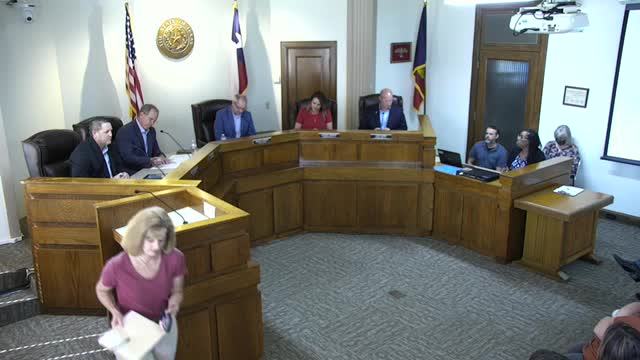
The Grayson County Commissioners Court on Tuesday voted to call a November election on an order creating “Grayson County Assistance District No. 1” and imposing a proposed 1.5% sales-and-use tax in unincorporated areas to finance district operations.
Commissioner Timothy Marr, who presented the order, said the district’s primary purpose would be to fund “the provision of services that benefit public health and welfare, including the provision of firefighting and fire prevention services,” then to fund road work and, if necessary, law enforcement and detention services. “The primary purpose of this court is to use this sales tax to fund fire and EMS in the unincorporated areas of the county,” Marr said during the discussion.
The nut graf: Commissioners said the tax would be collected only on purchases made in unincorporated Grayson County and held in a separate account for the district; they estimated the tax could generate roughly $4 million annually for the unincorporated area, which the court says faces rising costs for contracted fire and emergency medical services (EMS).
Court and public comments traced the issue to several facts and concerns. County officials told the court the county currently spends about $2.9 million annually for fire and EMS in unincorporated areas and expects that obligation to rise to about $3.2 million next year. Commissioner Marr said the proposed district would relieve pressure on the general fund, which pays for many county functions such as courts, jail, indigent defense and health administration.
Public commenters who identified themselves as residents of unincorporated precincts generally supported a local funding mechanism but sought clearer limits on how the money could be spent. Angela Wilson of 176 Snap Road asked that funds be “specified and dedicated to fire and EMS.” Jeff Whitmire, a former commissioner, urged the court to consider a dedicated district narrowly targeted to fire and EMS rather than a broader assistance district that a future court might redirect. “I just think it would be easier to get public acceptance of something when it's really specifically targeted at the fire and EMS,” Whitmire said.
Other speakers raised legal and technical questions. One commenter told the court he had provided documents suggesting state law may limit the county to a 1.0% maximum or a 0.5% maximum where municipal jurisdictions are included; the speaker recommended considering a 0.5% or 1.0% rate or a separate district for roads. The court’s discussion referenced Local Government Code chapter 387 (County Assistance Districts), an attorney general opinion cited in the meeting (identified in the record as KPDash0365), and recent legislative changes that affect ballot wording requirements.
The court amended the posted order before approving it. The three amendments approved by the court were: (1) add language in the preamble making public health and welfare (including firefighting and fire prevention) the first priority before roads and law enforcement; (2) revise the ballot proposition wording to comply with the Legislature’s new formatting requirement (the meeting referenced recent Senate legislation affecting ballot presentation) and to state the proposition in mixed case rather than all caps; and (3) add Exhibit A (a map) to the order showing the district boundary (the court said the green area on the map denotes the unincorporated territory to be included). The court also removed a catch-all phrase that would have allowed “any other lawfully permitted purpose” so the document more clearly specified priorities.
Commissioner Wright moved to approve the amended order; Commissioner Arthur seconded. The court recorded the motion as passing after a voice vote with one member saying “I oppose.” The court did not assign a name to the opposing vote in the record.
County officials and speakers acknowledged that adopting the order calls only for the election; any sales tax would take effect only if a majority of voters in the unincorporated area approve the proposition. “We are not imposing a sales tax. This is to only call for an election in November,” the presiding judge said after the vote.
The court also discussed how sales tax revenue estimates were calculated. Staff told the court the $4 million estimate was derived from Texas Comptroller sales-tax collection data for Grayson County, subtracting city-collected totals from the countywide figure to arrive at an amount attributable to unincorporated-area retail activity. Commissioners cautioned that collections depend on retail activity and on how remote sales and ZIP-code assignments are credited under state rules.
Next steps: the court said a revised order will be posted on the public agenda (the county noted the revised order was not available within the 72-hour posting window before the meeting), and the item will return on the next agenda for finalization of language ahead of the November ballot.
Ending: Court members encouraged residents to monitor the posted agenda and promised further discussion. “You get to vote on whether or not you approve this or don’t approve it,” the presiding judge said. The election, if ordered into effect by voters, would affect only purchases in the unincorporated parts of Grayson County.