Get Full Government Meeting Transcripts, Videos, & Alerts Forever!
Get email alerts on the College Athletics topic
No spam. Unsubscribe anytime.
Ohio State allocates $20.5 million in initial revenue-share payments, adds scholarships as NIL settlement takes effect
Summary
Athletics director Ross Bjork outlined Ohio State’s plan to implement institutional NIL revenue sharing under the recent House case settlement: $20.5 million in year one (about $18 million for institutional payments after scholarship additions), new scholarships across sports, and a phased expansion amid unresolved federal and state rules.
Ross Bjork, athletics director at The Ohio State University, said the university has budgeted $20.5 million for revenue-share payments under the court-approved “House” antitrust settlement, with institutional NIL distributions for year one totaling about $18 million after accounting for added scholarships.
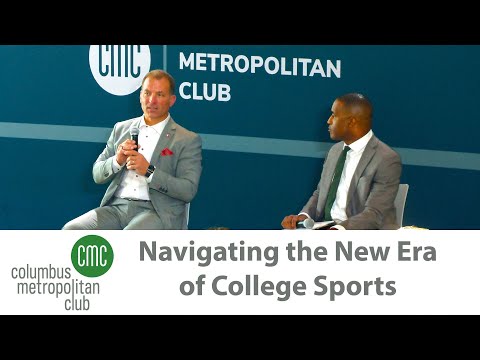
At a Columbus Metropolitan Club forum on the city’s Near East Side, Bjork described how the settlement, approved in June, sets a 22 percent allocation of certain averaged revenue streams for autonomy conferences and directs an initial distribution that begins July 1. "We came out ... and announced that we will share that revenue with 4 sports, football, men's and women's basketball, and women's volleyball," Bjork said. He added the institutional institutional-NIL allocation will grow over time and estimated the figure could approach roughly $30 million in four to five years.
The settlement and Ohio State’s implementing decisions matter because they change the flow of institutional revenue toward student-athletes and require athletic departments to adjust budgets, scholarships and compliance processes. Bjork said Ohio State also added more than 90 scholarships across 23 sports as part of the implementation, and that the scholarship increases were taken into account when calculating the amount available for institutional NIL this year.
Under the settlement’s formula, the 22 percent allocation is calculated from averaged revenues that include ticket sales, conference distributions such as College Football Playoff money, sponsorships and television income across the autonomy conferences (Big Ten, SEC, ACC, Big 12). Bjork said that after accounting for the scholarship increases, Ohio State set aside approximately $18,000,000 this year for institutional NIL payments and that the amount will rise by about 4 percent annually. He described the initial budgeting work that preceded his arrival and said university staff had been planning “whiteboard exercises” to determine how to pay for maintaining 36 sports while delivering the new revenue share.
The settlement also includes a back-payment component for past seasons. Bjork said a claims process opened for athletes to sign up for payments from a roughly $2.8 billion pool before attorney fees; the number of athletes who had registered was described as over 300,000 and Bjork said the net pool after fees was about $2.0 billion. "That part of it goes back a 10 year period," he said, characterizing it as the settlement’s antitrust window.
Bjork described operational steps Ohio State has taken to implement institutional NIL, including launching Buckeye Sports Group (operated by Ohio State Sports Properties) to source marketing agreements and to serve as a coordinating entity in the market. He said institutions must route NIL contracts through a clearinghouse for review; some submitted contracts have been approved quickly and others remain under review. "We've submitted deals through the clearing house that have got approved in, like, hours. We've submitted deals that we're still waiting on," he said.
Legal and governance uncertainty remains. Bjork noted that state NIL laws (including Ohio’s) vary and can conflict with the national settlement, and he said federal action will be necessary to provide consistent authority and avoid repeated litigation. He pointed to a recently issued presidential executive order described in the forum as aiming to "save college sports" and to federal legislation known as the SCORE Act (which has passed the House Energy and Commerce Committee) as pieces of broader federal attention. Bjork said the new College Sports Commission created under the settlement has only a handful of staff and will require far more resources to perform the regulatory and clearance functions the settlement envisions.
The role of third-party "collectives" also remains in flux. Bjork explained the settlement’s language requires third-party NIL arrangements to have a "valid business purpose," provide goods or services to the public, and meet a compensation range comparable to similar arrangements. "Just because somebody calls themselves a collective doesn't mean they're not a business," he said, noting the settlement’s tests will determine which groups can operate and under what terms.
Bjork addressed related operational and cultural concerns that follow the financial changes. He said the department is conscious of competitive and locker-room equity as some athletes and sports may see larger institutional payments than others, and said coaches now must manage transparency and culture within teams. He emphasized academic and development programs remain central to Ohio State’s approach: "We will go to class, and we will play the games. And we will also develop young people," Bjork said, citing the university’s student-athlete support services and the Jean Smith Leadership Institute for career development and internships.
Bjork framed the current moment as a rapid transition with many moving parts. "We are building the plane as we're flying it," he said, describing the hurried timeline between the settlement's approval in early June and the July 1 start date for revenue-sharing. He and others at the forum said they expect additional rules and clarifications to be published in the coming days and weeks but warned enforcement and governance structures are still under development.
Until federal or clearer regulatory guardrails are in place, Bjork said, institutions face operational risk if market participants pursue third-party deals that later prove inconsistent with settlement rules. He urged patience as the College Sports Commission, conferences and the federal process attempt to align the many moving pieces.
Looking forward, Bjork said Ohio State hopes to expand institutional revenue-sharing beyond the initial four sports over time and that the department is planning to invest in centralized strategy, compliance and athlete development to manage the new financial environment.