Get Full Government Meeting Transcripts, Videos, & Alerts Forever!
Get email alerts on the Community Violence Prevention topic
No spam. Unsubscribe anytime.
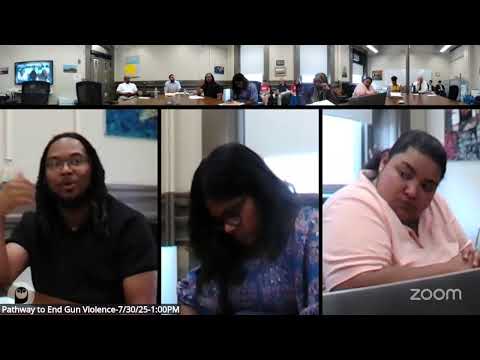
Providence advisory committee discusses reviving gun-ammo tax proposal, youth program database and a dedicated office for violence prevention
Summary
A Providence City community advisory committee met without a quorum and discussed reviving a 2019 proposal to impose a tax on guns, ammunition and shooting ranges to create a steady funding stream for community violence intervention programs, along with plans for an AI-driven youth-programs directory and a push to establish a municipal office of violence prevention.
A Providence City community advisory committee met without a quorum and discussed reviving a 2019 proposal to impose a tax on guns, ammunition and shooting ranges to create a steady funding stream for community violence intervention programs, along with plans for an AI-driven youth-programs directory and a push to establish a municipal office of violence prevention.
Committee members said state or national partners have expressed willingness to carry legislation if the city builds a supporting coalition and a program design that aligns with on-the-ground work. Participants cited recent action in other states as examples to study, discussed revenue estimates mentioned during the meeting, and pressed for next steps involving city and mayoral leadership.
The conversation opened with a proposal to “revitalize” a 2019 budget submission that would tax firearms, ammunition and shooting ranges to fund violence-prevention work. Committee members said representatives told the group they would be willing to sponsor the bill, but only if the city organized a clear advocacy alliance and designed the tax to fit program needs. Speakers noted that other jurisdictions have used mixed policy packages to win votes and funding—for example, participants referenced Connecticut and California as recent examples—but emphasized Rhode Island’s smaller tax base would require a tailored approach.
Participants discussed several revenue figures that were presented during the meeting. One attendee said a previous memo projected roughly $1.4 million in annual revenue from a proposed tax rate in the range of 8–12 percent; others mentioned larger sums (one comment referenced a $30 million figure, and another cited a 6 percent plan associated with Governor Gina Raimondo). Committee members characterized the numbers as illustrative rather than final and said the exact formula and yield would need technical analysis before drafting legislation.
Beyond the tax discussion, the committee reviewed a proposed resource guide and an AI-supported dashboard that would compile youth programming and related services in near-real time. The database concept described in the meeting would automatically ingest data as participating organizations publish it, scrape nonprofit annual reports to populate program details, and provide a public-facing directory plus internal dashboards for analysis of service gaps and crime trends. Committee members suggested the completed tool could be handed to a nonprofit or other steward for maintenance and recommended producing both a consumer-facing directory and staff-facing resource guides for police, rec-center staff and other intermediaries.
Committee members noted existing local programs and partners to include in the directory: Providence recreation centers, Boys & Girls Clubs, community libraries, the American Jobs Center (AJC), public housing authorities, workforce programs and several after-school and arts groups. The Department of Labor and Training and the Governor’s Workforce Board were cited as having current solicitations (Real Jobs and Real Skills for Youth) that committee members encouraged organizations to pursue; one speaker said they would recuse themselves from discussions related to those solicitations because of their agency role.
A recurring thread was how to convert discussion into sustained, coordinated investment. Multiple participants argued for establishing a dedicated office of violence prevention (city or statewide), staffed to coordinate data access, hospital-based and hospital-respondent programs, reentry services and community partners. One committee speaker said an intervention team of roughly a dozen people could be deployed statewide with approximately $1.5 million in annual funding; others proposed smaller initial staffing and suggested a range of cost estimates depending on scope and whether the office would be housed in the mayor’s office, the city council or a state agency.
National partners and models were discussed as potential sources of technical assistance and funding: the Milken Institute, Everytown (and its gun-tracker tools), Johns Hopkins (research capacity), and national offices of violence prevention were mentioned as organizations the committee could approach for help with messaging, fundraising and program design. Members also recommended pursuing hospital partnerships for hospital-based violence-intervention programs and reiterated that packaging the work as a public-health and economic argument could broaden support.
Committee members identified next steps that include drafting a clear scope for a violence-prevention office, estimating realistic staffing and operating costs, mapping existing discretionary funding streams within state and city agencies, and convening city council and mayoral leadership for a decision on where an office should sit and how it would be funded. Several participants volunteered to pursue external fellowship or foundation support to help the group build a formal plan and to reach out to potential national partners.
The meeting ended without formal votes or motions because six of 13 members were present; committee leaders said they would bring recommendations to council leadership and the mayor’s office and continue the work at future meetings.