Get Full Government Meeting Transcripts, Videos, & Alerts Forever!
Get email alerts on the Water Wells topic
No spam. Unsubscribe anytime.
Larimer County denies Schubert appeal to drill well inside Northern Colorado Water service area
Summary
Larimer County commissioners denied an appeal from property owner Craig Schubert seeking permission to use a well as the primary domestic water source for a 2.5-acre lot in the Robidoux Conservation Development after staff found the request did not meet multiple review criteria.
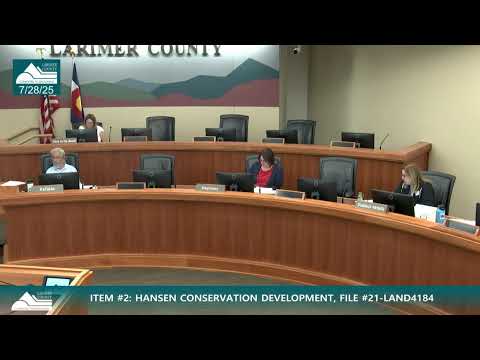
Larimer County commissioners on July 28 denied an appeal by Craig Schubert to allow a well as the primary domestic water source for Lot 1 of the Robidoux Conservation Development, a 2.5-acre parcel at 9698 Hat Trick Lane in Wellington.
County planner Samantha (Sam) Lascher told the Board the application appealed sections of the county land use code governing wells within the Northern Colorado Water Association service area and that staff recommended denial. "The Roberdeau Conservation development was approved with the assurance that Northern Colorado Water could serve the properties," Lascher said, adding that the development was not conceived to rely on wells. She also noted Northern Colorado Water had enacted a tap moratorium and that the county’s recent code amendment (May 2025) that eased appeals for properties larger than 35 acres does not apply to this lot because it is only 2.5 acres.
Lascher said staff found the appeal failed three of five required review criteria, including that approval would not subvert the purpose of the land use code and comprehensive plan and that sufficient evidence on water quantity and quality for a new well was not provided. She recommended denial, saying granting the appeal could "lead to unsustainable development patterns, long term consequences, and potentially set a precedent for other property owners in a similar situation."
Applicant Craig Schubert, appearing remotely, said he previously applied for a well permit in 2021 and that the Colorado Division of Water Resources had, at that time, treated the subdivision as qualifying for a cluster development. Schubert said the county previously told him it had no process to amend the conservation development to allow a well and that a test well cost estimate of $8,000–$12,000 posed a financial barrier. He asked the commissioners to approve a well permit now with a condition requiring a water-quality and -quantity report at the building permit stage. "There is no other way to provide water to develop my land or to even sell so it can be developed," Schubert said.
County staff and the health department said the presence and production of nearby wells does not guarantee similar results on Schubert’s lot because subsurface geology can change over short distances; staff maintained a test well on the lot is the reliable evidence. The discussion also addressed Colorado law that generally limits domestic wells on lots smaller than 35 acres, and the county’s distinction between conservation developments and the statutory "cluster development" eligible for an exempt well.
After deliberation, Commissioner John Kefalas moved to deny the appeal (file no. 25GNRL0570). The motion passed 3–0. Commissioners Kristen Stevens (chair) and Jody Shattuck McNally joined Kefalas in voting to deny the appeal.
The county record shows the Robidoux Conservation Development was approved in 2017 and recorded in 2018; Schuberts purchased Lot 1 in August 2018 and learned of Northern Colorado Water Association’s 07/01/2020 tap moratorium in 2021. The application was referred to nearby property owners and five agencies; staff received four written comments or voicemails opposing the proposal. Northern Colorado Water provided a March 2024 letter confirming it could not serve the property; Wellington Fire Protection District did not provide formal comment. Staff noted the application was submitted before the county’s May 2025 code amendment that changed some procedures for properties larger than 35 acres, but the amendment does not affect this 2.5-acre lot.
Commissioners made clear the denial was based on the land-use review criteria and the development’s original approval assumptions rather than the applicant’s personal circumstances. The board’s formal action denies the appeal and leaves the property subject to the land use code standards for water supply and state water-rights limits.