Get Full Government Meeting Transcripts, Videos, & Alerts Forever!
Get email alerts on the Land Use Zoning topic
No spam. Unsubscribe anytime.
Iron County approves land-use and zoning changes to limit septic density, backs solar tax settlement
Summary
The Iron County Commission adopted an ordinance and approved general-plan tier and zone changes aimed at limiting septic density around Summit and Newcastle after a Utah Geological Survey-backed study. The commission also approved settlement and mitigation agreements with Appaloosa Solar and awarded an invasive-species grant.
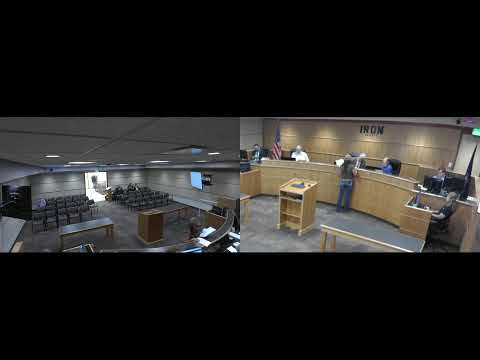
Iron County commissioners on the morning of a July 2025 meeting approved a set of land-use code amendments and accompanying general-plan tier and zoning changes intended to limit septic-system density near Summit and Newcastle and protect the county’s groundwater. The board also approved a settlement and tax-adjustment package to correct a missed incentive payment to Appaloosa Solar 1 LLC, and authorized a Utah Department of Agriculture and Food grant for invasive-species work in Coal Creek.
The actions follow technical studies by the Utah Geological Survey and a groundwater analysis used to set a nitrate-based threshold for the areas under review. County planning staff told the commission that the studies model how many septic systems each study area can sustain before local well nitrate levels increase by a measurable amount; the planning presentation tied proposed lot-size and zoning changes to those findings.
“This is the result of a lot of study,” Reid, county planning staff, told the commission during the public hearing and presentation. He directed residents seeking the underlying reports to the Utah Geological Survey website: “If you just type in Utah Geological Survey, then they’ll have a link there for recent studies, and they’ll list all the studies that they’ve done. You can go and click on that and get the whole report,” Reid said.
Why it matters: Planning staff and commissioners said the changes aim to reduce the risk of long-term groundwater contamination from a growing concentration of septic systems. The county relied on a 2005 Central Iron County Water Conservancy District study and more recent, site-specific sampling that established baseline nitrate levels and modeled how much additional septic loading would take those levels to a point of concern. Where the modeling showed high existing baseline nitrate levels, staff recommended larger minimum lot sizes and zoning that would limit further septic-system density until centralized sewer or pretreatment options are feasible.
Key details from the planning presentation and discussion
- The county presented maps and an analysis showing the number of existing septic systems and how many additional systems could be added before modeled nitrate concentrations would rise by the committee’s chosen threshold. Staff described the approach as a “mass balance” method tied to baseline well sampling. - For some of the study areas staff used a working threshold that would limit nitrate increases to roughly 1 milligram per liter above baseline in many places; in parts with already elevated baseline nitrate the practical target was a 3.5 mg/L cap in the modeling exercise. - As a consequence of the modeling, the commission approved changes that reduce the previously zoned tier-3/urbanizing footprints near Summit and Newcastle and applied R‑5 and RA‑20 zoning in buffer areas. Planning staff said RA‑20 was adopted previously as a rural-agricultural buffer that removes higher-intensity agricultural uses from parcels near residential concentrations.
Public comment and record access
At the hearing, resident Jesse Bennett said he had professional experience in the field and asked for the technical report. Reid responded by pointing to the Utah Geological Survey’s online reports and encouraged commentors to review the published studies.
Commission reaction and next steps
Commissioners thanked staff for the multi-year effort. “This has been a big lift,” Commissioner Blake told Reid, and other commissioners noted the changes are intended to protect aquifers until broader sewer solutions are feasible. Planning staff said the county will continue work on other tier areas, including a forthcoming review around Brian Head and follow-up work for Cedar City and Enoch.
Votes at a glance
- County code amendment — Ordinance 2025‑6 (amending sections 17.16.0.04, 16.2.0.07, 16.22.0.06 and adding 16.04.0.065): Motion to adopt carried after public hearing. (Motion moved and seconded; verbal roll call yielded “Aye”; outcome recorded as approved.)
- General plan amendment — tier changes for Summit and Newcastle urbanizing areas (tier 3↔tier 4 adjustments): Motion to approve carried after public hearing. (Motion moved and seconded; verbal roll call yielded “Aye”; outcome recorded as approved.)
- Zone changes — rezoning parcels around Summit and Newcastle to conform to the new tiers (examples: R‑1½, R‑1, A‑20 to R‑5; A‑20 to RA‑20; and related swaps described in the agenda): Motion to approve carried. (Motion moved and seconded; verbal roll call yielded “Aye”; outcome recorded as approved.)
Other formal actions at the meeting (summary)
- Appaloosa Solar 1 LLC: The commission and the county’s redevelopment agency approved a resolution and settlement to correct an administrative distribution error so the developers receive the incentive plan originally agreed when the project was built. The board approved a settlement agreement, a letter agreement with the water conservancy district for mitigation payments, and related inter‑entity letters to align cash flow and incentive timing.
- Invasive‑species grant: The commission approved acceptance of a Utah Department of Agriculture and Food invasive‑species mitigation grant ($53,789) for targeted Russian‑olive and tamarisk treatment in Coal Creek; the program will use chainsaw removal and stump chemical treatment to avoid heavy mechanized disturbance of streambanks.
- Rollback (Greenbelt) appeals: The commission, acting as the board of equalization, upheld the hearing officer’s recommendation to deny continued Greenbelt classification for several parcels in the BZI Innovation Park and NKM Family Trust matters; the hearing officer had found the properties lacked continuous agricultural use and contained surface improvements and other uses inconsistent with the county’s Greenbelt criteria.
What the commission did not change
Staff and commissioners emphasized that the tiering system itself is the county’s growth‑management tool and not a one‑time land‑use freeze. Commissioners said the goal of the adopted changes is to preserve water quality while allowing municipalities and the county to pursue sewer or pretreatment options that would later permit higher densities if infrastructure is installed.
What to watch next
Planning staff said the county will proceed with tier and zoning reviews for other areas, including the Brian Head tier‑2 area and remaining municipalities (Cedar City and Enoch). Staff also signaled ongoing work on sewer‑district planning as the long‑term solution for higher‑density growth while protecting groundwater.
Ending note
County planners and commissioners framed the changes as measures intended to protect wells and public health while preserving options for future infrastructure-funded development. Residents seeking the technical reports or the Utah Geological Survey analyses were directed to the survey’s website for published study documents.