Get Full Government Meeting Transcripts, Videos, & Alerts Forever!
Get email alerts on the Local Budget topic
No spam. Unsubscribe anytime.
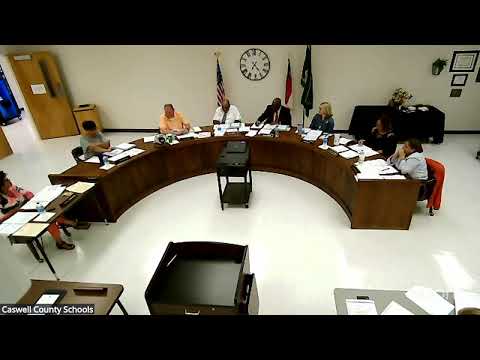
Caswell school board conducts line-by-line review of proposed budget; members debate reassigning capital funds
Summary
At a July 28 meeting the Caswell County Board of Education reviewed a proposed FY2025–26 budget line by line, with prolonged discussion about capital outlay priorities, furniture and contingency lines, and a motion to reallocate savings toward an activity (athletic) bus.
The Caswell County Board of Education on July 28 conducted a detailed, line-by-line review of the school system's proposed local budget and heard extended debate over whether to reassign certain capital outlay and contingency items toward an activity bus and other immediate needs.
Superintendent Stokes opened the budget discussion by noting the district had received information from county commissioners about funding and that staff would meet with the county to decide how to allocate county-held capital funds. Brooke, the district finance lead, presented line items and reported a capital outlay total presented to the board (stated in the meeting as roughly $4,067,500). Board members pressed for detail on specific expenditures such as furniture purchases, floor coverings, playground equipment, HVAC and roofing work and Civic Center repairs.
Board members repeatedly questioned recurring line items that were not spent in the prior year and asked staff to justify keeping them in the proposed budget. Concerns focused on two furniture line items (board members asked which purchases had triggered prior expenditures and requested superintendent approval be documented), a contingency line the board described as an “open checkbook,” and several maintenance and contracted-repair lines. Several board members proposed cutting or reducing lines and requiring budget amendments for non‑urgent purchases.
Board member Lillard moved a package of changes to the capital outlay portion of the proposed budget, including removing both furniture lines and certain van/vehicle lines, reducing maintenance equipment to a $10,000 line, moving some landscaping and contracted-repair lines to match current contract amounts, and reducing playground equipment from $20,000 to $5,000. The motion listed specific line numbers and dollar adjustments as discussed on the floor.
Board discussion included repeated procedural clarifications about how to amend a multi-item motion (members asked whether individual items could be pulled and voted on separately). Several attempts to amend or split portions of the main motion failed for lack of a second; board members were instructed that to isolate items they must amend the motion one item at a time.
The record shows multiple individual questions and clarifications from board members about the rationale for each contested line item. Staff said some prior-year expenditures (for example, Civic Center bleacher repairs and landscape work to address washouts) had required out-of-contract charges; staff also said some lines were held in the budget because state or federal restrictions limit the funding sources that can be used for certain purchases.
The board asked staff to provide lists and backup documentation for several items (which schools received new furniture or flooring, which playgrounds had been replaced, breakdowns of contracted landscaping charges and the use of contingency and emergency repair funds). CFO Brooke agreed to provide requested detail and to return with final numbers.
At the end of the discussion the board proceeded with votes on discrete items in subsequent business (see separate items for transfers, consultant contracts and other approvals). The meeting transcript records the budget review as thorough and contested; staff will return with clarified line-by-line documentation and any recommended amendments before final budget adoption.
Ending: Board members emphasized the need to balance immediate operational needs (plumbing, HVAC, safety) with long-term capital planning and requested additional documentation from staff on prior expenditures and contract scopes so the board can act on any final amendments at a later meeting.