
Alachua County schools outline McKinney‑Vento supports, cite state law changes and rising post‑secondary enrollment
Get AI-powered insights, summaries, and transcripts
Subscribe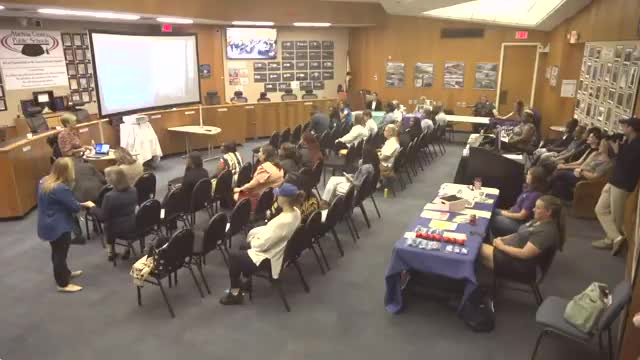
Summary
Alachua County Public Schools and partner agencies described McKinney‑Vento rights, recent Florida policy changes for unaccompanied youth and district data showing increased post‑secondary enrollment for students identified as experiencing homelessness.
Alachua County Public Schools officials and partner agencies summarized the district's McKinney‑Vento services and cited recent Florida policy changes at a homeless student awareness event, saying those measures remove barriers to enrollment and to health and higher‑education access for students without stable housing.
The McKinney‑Vento Homeless Assistance Act, a federal law, requires schools to remove barriers that children and youth experiencing homelessness may face when enrolling, attending and succeeding in school, Gina Dickey, regional navigator for the McKinney‑Vento program, said. "The purpose of the McKinney Vento act is to remove barriers that children and youth experiencing homelessness may face when enrolling, attending, and succeeding in school," Dickey said.
The law's protections include immediate enrollment even without typical records and the right to stay at a school of origin with transportation supports. "They have the right to immediate enrollment," Dickey said.
Why it matters: district leaders said these protections and recent state actions expand practical access to health care and post‑secondary education for homeless and unaccompanied students, improving the district's ability to keep students in class and on track to graduate.
Key district data and outcomes Pam Worsham, McKinney‑Vento coordinator for Alachua County Public Schools, told attendees the district identifies about 1,000 students per year as McKinney‑Vento eligible, roughly 3.5 percent of K‑12 enrollment and 16.8 percent of children living in poverty. "Generally speaking, we are identifying about 1,000 students a year that are identified as McKinney Vento eligible," Worsham said.
Worsham said those identifications rely on a housing questionnaire entered into the student information system and acknowledged that local identification likely undercounts need; she said district staff estimate the county's true number is substantially higher. She also cited outcome improvements for high school seniors: "Forty of the 47 high school seniors graduated; 31 enrolled in college," she said.
State law and rule changes discussed Dickey and Worsham described a set of Florida changes that affect service delivery: House Bill 1577 (April 2022) allows certification of students age 16 or older who meet McKinney‑Vento criteria as unaccompanied youth, enabling those certified students to consent to their own medical treatment and receive identity documents needed to access services. Dickey described the change as "huge" for students who otherwise could not obtain medical care.
Dickey also referenced a 2024 Florida administrative requirement (Rule 68‑10.0088) that districts distribute a student housing questionnaire and provide training for staff across the district, including bus drivers and food service employees, so staff can better identify and help students in unstable housing.
District services and common barriers Worsham outlined local supports used to address barriers to attendance and stability: bus passes and coordinated transportation when families are displaced across county lines, school supplies, hygiene items, clothing and referrals to community partners. She noted transportation remains a primary obstacle to consistent attendance. "Bus passes. That is something that is essential to getting them to school as they move around," Worsham said.
Worsham and Dickey emphasized that McKinney‑Vento rights are intended to ensure students have access to comparable services: free meals, credit accrual protections for students who move frequently and fee waivers for Florida public higher education for eligible seniors.
What the district asked of partners and attendees Speakers encouraged attendees to help identify students who may qualify by watching for indicators such as frequent moves, inconsistent clothing or hygiene, chronic tardiness and declining school performance. Worsham invited community members to contact her office and the district website for referrals and volunteer opportunities.
Ending Speakers closed by urging continued cross‑sector collaboration, citing the combination of federal protections, recent Florida policy changes and on‑the‑ground community support as central to improving outcomes for students experiencing homelessness.