Council adopts new towing rule, restores enforceable ban on sleeping in vehicles; public calls for shelter options
Loading...
Summary
Council approved changes to the city's vehicle-removal and vehicle-sleeping rules, shortening the minimum movement to 150 feet in 72 hours (from staff's 300-foot proposal) and deleting a code exception tied to shelter bed availability following the U.S. Supreme Court ruling. Public commenters urged the city to expand safe-parking and sheltering.
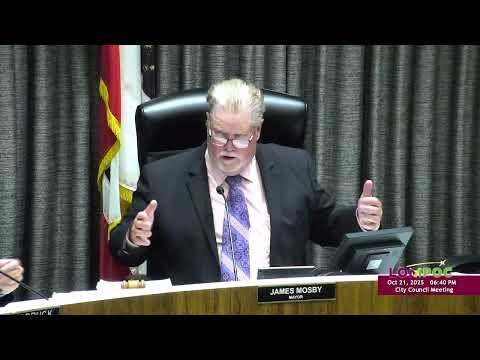
The city attorney presented two related municipal code changes at the Oct. 21 meeting: (1) a clarification to the 72-hour street-parking rule to prevent vehicles from avoiding removal by moving only a few inches every three days, and (2) deletion of a now-invalid exception to the city's prohibition on using a vehicle for residential purposes.
Staff explained the first ordinance would add a minimum-displacement requirement so a vehicle would need to move a defined distance every 72 hours to avoid tow removal; an odometer-based alternative (change of 0.1 mile) would also be available for enforcement. Staff had recommended 300 feet; the council voted to set the distance at 150 feet and adopted the ordinance language that clarifies the vehicle must be 150 feet from its earlier position at the end of the 72-hour period. The second ordinance deletes the code language that had required evidence of an available shelter bed before enforcement, citing the U.S. Supreme Court decision in City of Grants Pass v. Johnson that removed that restriction. The council approved the pair of ordinance changes by a 5-0 vote.
Public comment: several residents urged the council to pair enforcement with support services. Alexis Otero said the houseless are "human beings deserving of decency" and asked the council to expand safe-parking and shelter options before strict enforcement; Nick Gonzales and others said they support targeted enforcement for "the worst of the worst" while emphasizing outreach and assistance for people who want services. City public-safety staff said officers will continue to seek services for people in distress but that enforcement is a tool for addressing hazardous or criminal behavior and persistent encampments.
Why it matters: The two code changes remove an enforcement obstacle and standardize local towing tools. Council members and commenters said enforcement should be paired with services and safe-parking capacity. The council also asked staff to return with a recreational-vehicle parking permit process for future consideration.
What the council decided: The council adopted the towing/vehicle rules as amended (150-foot displacement or 0.1-mile odometer threshold) and removed the shelter-availability exception from the residential-vehicle prohibition. Council asked staff to return with a report on RV permit processes and to continue coordinating with county behavioral-health services on outreach and alternatives.