
Buellton council introduces ordinance to revert Avenue of Flags motel units to short-term rentals; first reading approved 3-1
Get AI-powered insights, summaries, and transcripts
Sign Up Free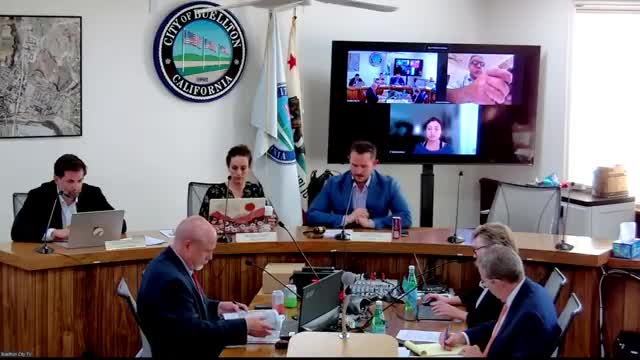
Summary
Buellton City Council on Aug. 14 took initial action to change how long-term occupants of certain motels on the Avenue of Flags are regulated, approving the introduction and first reading of Ordinance No. 25-06 with amended deadlines.
Buellton City Council on Aug. 14 took initial action to change how long-term occupants of certain motels on the Avenue of Flags are regulated, approving the introduction and first reading of Ordinance No. 25-06 with amended deadlines.
The ordinance would amend Buellton Municipal Code provisions to require that units originally developed as motels be rented only on a short-term basis (less than 30 days) and that transient occupancy tax (TOT) be collected on those units. The council voted to introduce the ordinance as amended on the record; the motion passed 3-1 with Vice Mayor Lewis, Councilmember Hornick and Mayor Silva voting yes and Councilmember Sanchez voting no (one councilmember was absent for the vote). The council directed staff to return the ordinance for a second reading at the council's first meeting in September.
City Manager Scott Wolf told the council the proposal is intended to remove an obstacle to reinvestment and redevelopment along the Avenue of Flags. Wolf said motel units that had been used as long-term residences were treated by state law as housing units (single-room-occupancy or SRO) and, without replacement housing, were effectively protected from removal. To address that, the city has participated in affordable housing projects and used approximately $340,000 from the city’s affordable-housing in-lieu fund to support the Polo Village Apartments; Wolf said 14 family units moved from motel units on the Avenue of Flags into Polo Village.
The draft ordinance has two main components: a zoning change and a taxing/regulatory change to require TOT collection. Wolf said the planning commission reviewed the item and recommended expanding the pool of qualifying replacement projects beyond Buellton so that extensions could be granted for motel residents who are prequalified for affordable-housing projects in surrounding jurisdictions. The planning commission previously reviewed a version that would have required conversion to short-term use by Dec. 31, 2025 and limited extensions to in-city projects through June 30, 2026. During the Aug. 14 session the council amended the dates in the ordinance text to require reversion to hotel/motel (short-term) uses no later than April 1, 2026, and to allow documented tenants who are prequalified for qualifying affordable-housing projects to remain in place until Oct. 1, 2026, as reflected in the introduced ordinance language.
At the hearing the Farmhouse Motel owner, Kerry Moriarty, and several motel tenants opposed the change. Moriarty said the Farmhouse has functioned as long-term housing for decades, said he holds a mortgage and insurance under an apartment-use underwriting, and argued the motel currently serves as transitional and affordable housing for residents who have credit or other barriers to moving into newer affordable projects. A Farmhouse tenant described being disabled and living at the property for 14 years and asked the council not to displace residents who rely on the site as home.
An attorney identified as Chris Guillen representing the law firm Brownstein Hyatt Farber Schreck submitted a written letter and spoke at the meeting raising legal and policy objections. Guillen said the city's housing element and past settlement agreements require the city to consider amnesty and replacement for SRO tenants, that only 14 of an estimated 41 affected households have been relocated, and that the city has not demonstrated that proposed replacement units meet required size or affordability levels under state law. Guillen argued the draft ordinance could amount to a downzoning that singles out certain motels (he cited Farmhouse Motel) and urged the council not to adopt the ordinance without further legal review.
City Attorney/legal staff and the city manager told the council they have begun reviewing the law firm’s letter and that adoption requires two readings, giving staff time to investigate the legal points before a final decision. Council members asked staff for clarifications. Councilmember Hornick pressed staff on outreach and asked about an “amnesty” program referenced in the city's housing documents; Wolf said the city began owner outreach verbally in 2022, first sent written drafts in October (year not specified in the record), and provided revised drafts to owners in mid‑August. Wolf said county housing authority staff and related partners began outreach in February to help motel residents apply for the new affordable projects that are coming online.
Council discussion focused on timing. Several council members said they supported moving forward with a first reading while directing staff to continue legal review and to reconsider the calendar deadlines so residents would not be moved during winter holidays. After discussion the council amended the ordinance text on the record to the April 1, 2026 reversion date and Oct. 1, 2026 occupancy/deadline provisions, then introduced the ordinance for first reading and set the second reading for the council’s first September meeting.
The ordinance as introduced includes a process for property owners to request extensions for individual units if they provide documentation that a tenant has been prequalified for a qualifying affordable-housing project; staff said the property owner would report which units are converted and that staff could issue extensions (the final reporting and verification mechanics will be handled in the ordinance’s implementation and through follow-up staff work). The planning commission’s earlier recommendation broadened qualifying replacement projects beyond Buellton to include projects in surrounding jurisdictions; that change appears in the introduced text.
The council did not adopt the ordinance tonight; the action was introduction and first reading with the amended dates. Staff said it will continue legal review of the law firm’s letter and will return the ordinance for final consideration at the second reading in September. Several residents and the Farmhouse owner urged the council to ensure replacement housing is secured before conversion occurs and to provide additional outreach to tenants with barriers to qualifying for new affordable units.
What’s next • Staff will review the legal submissions from Brownstein Hyatt Farber Schreck and report back to council before the second reading. • The council scheduled a second reading at its first meeting in September. • The introduced ordinance sets conversion deadlines of April 1, 2026 (reversion to short-term use) and Oct. 1, 2026 (occupancy/extension cutoff for prequalified tenants) and retains planning-commission language allowing extensions for tenants prequalified for qualifying affordable projects.