Get Full Government Meeting Transcripts, Videos, & Alerts Forever!
Get email alerts on the School Health Nursing Policy topic
No spam. Unsubscribe anytime.
Virginia committee reviews bill on diabetes care, considers adding pre-K and using at‑risk funds to hire school nurses
Summary
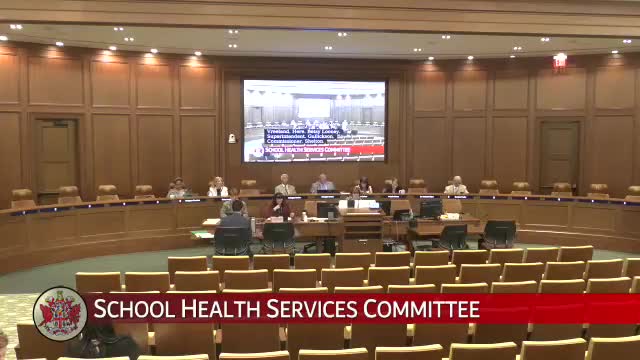
Richmond — The Virginia School Health Services Full Committee reviewed Senate Bill 1303, a measure on care for students with type 1 diabetes, and considered two related legislative proposals that would expand which students are covered by school health rules and give school divisions more flexibility to use at‑risk funds to hire registered nurses.
Richmond — The Virginia School Health Services Full Committee reviewed Senate Bill 1303, a measure on care for students with type 1 diabetes, and considered two related legislative proposals that would expand which students are covered by school health rules and give school divisions more flexibility to use at‑risk funds to hire registered nurses.
Senate Bill 1303, authored by Senator McPike and reviewed in a subcommittee earlier the same day, addresses responsibilities of school nurses and division staff for treating students with type 1 diabetes, including how treatment will be provided during the school day. "That is the bill by Senator McPike that deals with type 1 diabetes students and the role of the nurse and the school division," Ryan Brimmer of the Division of Legislative Services told the committee.
The committee also examined two staff-drafted proposals. The first, submitted to staff by Angela Moore, would explicitly add prekindergarten students to existing Virginia Code provisions about student medication and health management. "It clarifies that certain provisions of law relating to the administration of epinephrine, undesignated stock albuterol inhalers, involved holding chambers, insulin, nasal or injectable glucagon, and opioid antagonists to public school students ... also apply to any student enrolled in a pre kindergarten program in a public school," Brimmer summarized.
The second proposal, requested by Chairwoman Senator Favola, would permit school divisions to use the existing at‑risk program (the SOQ add‑on for students educationally at risk) to support initiatives that "support both the physical and mental health of students in public schools, including the hiring of registered nurses." Brimmer told the panel this change would not increase or decrease the at‑risk funding pool but would broaden allowable uses: "This is simply not increasing or decreasing that pot of money, but saying that you can use that money, as a school division if you see fit, to provide for the health of students and possibly hire registered nurses with those funds."
Committee members asked how the proposals would affect rural divisions and whether the state has data to target resources. Delegate Doug Cohen and Delegate Walker pressed staff and other members on rural staffing challenges and local funding limits. Brimmer and members said the Virginia Department of Education and the Virginia Department of Health recently provided a public dashboard that identifies staffing gaps; Brimmer said it shows some schools are completely unstaffed while others rely on unlicensed unassigned assistive personnel (UAPs) to meet health needs.
Public commenters urged stronger action and use of existing revenue streams. Catherine Haines, health equity manager with the Virginia Interfaith Center for Public Policy, told the committee she has tracked organizing by parents of children with diabetes since 2018 and urged using Medicaid and a budget amendment to increase school nursing capacity. "An RN in every school would address access to care inequities," Haines said, citing research and the role school nurses play in both medical emergencies and early intervention for mental‑health concerns. Haines also told the committee she had obtained Freedom of Information Act data showing 43 schools (out of 131 reviewed in her FOIA) billed Medicaid beyond individualized education program (IEP) claims and urged the state to survey districts not billing Medicaid to identify supports they need.
Betsy Looney, a new committee member who introduced herself as a school nurse supervisor, cautioned the panel about adding pre‑K to K–12 rules without consulting the state early‑childhood stakeholders because pre‑K programs operate under different licensing and regulatory regimes. She also raised a question about how Medicaid reimbursements are routed locally: "My understanding is that when we bill for Medicaid that it goes into one lump sum. I'm not sure all that money goes back to school nurses or school health services," Looney said.
Members noted an existing $300,000 scholarship appropriation to help LPNs become RNs, and Looney described plans to stand up the scholarship application and cohort process beginning January, with larger cohorts expected in the fall semester. Committee members said they will track opportunities to pair funding changes with targeted scholarship and pipeline strategies.
No formal votes were taken during the meeting. Committee leadership asked staff to track the proposals and related budget items ahead of the next session; Ryan Brimmer agreed to confirm whether recent budget language directed the Virginia Department of Medical Assistance Services (DMAS) or other agencies to provide technical assistance to districts seeking to bill Medicaid for school health services.
The committee also introduced two new members: Betsy Looney, a school nurse supervisor, and Lee Vreeland, president and CEO of An Achievable Dream, who joined the meeting virtually.
The subcommittee review of Senate Bill 1303 was reported to have lasted just over two hours earlier that morning and was available for online review when the Senate posts it. Committee leaders said they will continue to refine language and consult early‑childhood stakeholders before advancing statutory changes affecting prekindergarten programs.
Looking ahead, staff were asked to produce a short list of priority items and budget amendment ideas for the committee to consider before the next legislative session. The committee adjourned with no further business.