Get Full Government Meeting Transcripts, Videos, & Alerts Forever!
Get email alerts on the Stormwater Management topic
No spam. Unsubscribe anytime.
Whiteville council approves consistency finding for stormwater text amendment after public concern over runoff
Summary
Council approved a consistency statement for a proposed text amendment to the city stormwater ordinance requested by Whiteville City Schools; public commenters raised concerns about flooding, existing infrastructure and whether the change would apply to existing businesses.
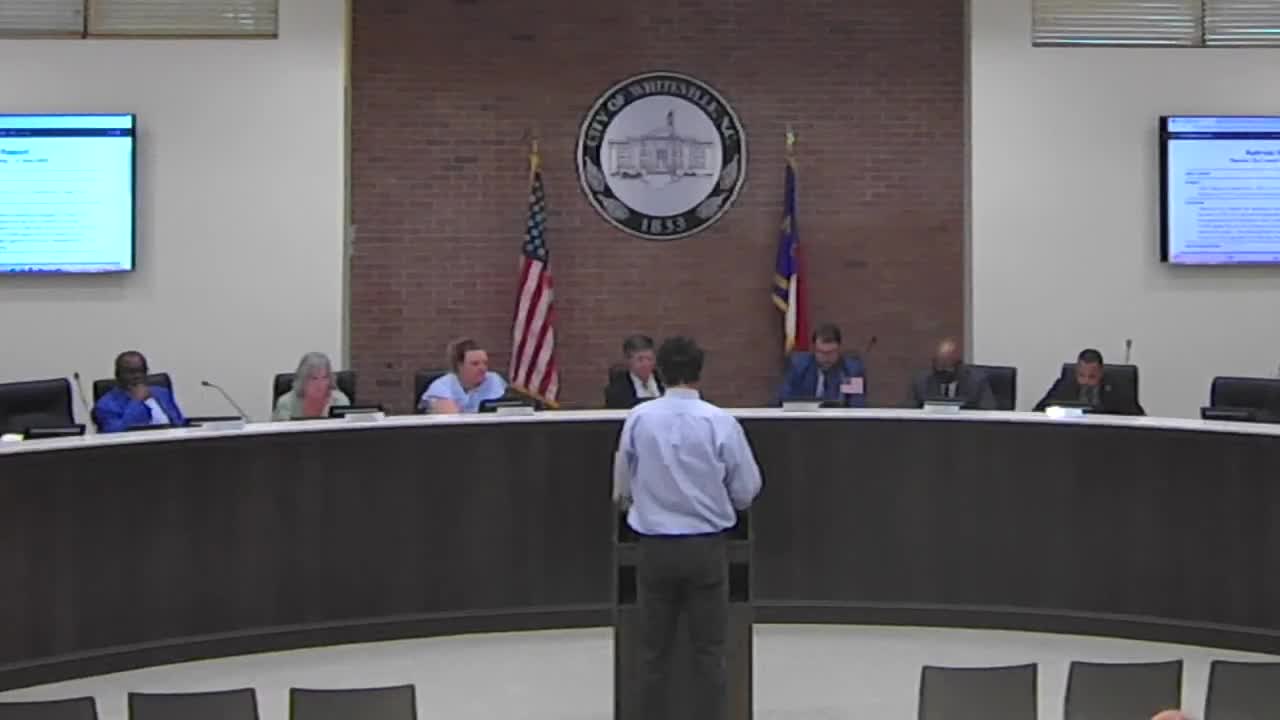
A public hearing and subsequent council action at the Whiteville City Council meeting addressed a text amendment request from Whiteville City Schools to change the city stormwater ordinance’s threshold for nonresidential expansions.
City planning staff said the amendment would alter the city’s stormwater rules so that nonresidential properties that expand impervious surface to 20,000 square feet would be required to obtain a stormwater permit and install retention or detention facilities. Under current local rules, staff said, the threshold in some contexts had been 10,000 square feet; state rules requiring a plan when a project disturbs one acre also apply. The planner said, “This will pertain to all to existing commercial development. . . if anything is nonresidential, and they wish to expand that impervious surface to 20,000 square feet, that would be required to get a storm permit and install retention or detention facilities at that location.”
The change was introduced during an advertised public hearing and a consistency statement was presented to the council for action. Councilman Clarence moved to approve the consistency statement and Councilman Harris seconded; the motion carried. In making the finding, staff referenced the city’s comprehensive land use plan and its Chapter 8 language on reviewing development ordinances.
Several residents spoke during the hearing expressing concern that the amendment could place new burdens on local businesses and would not fix existing flooding problems. Mike Shuck, who identified himself as “president of the High Street, [Wayneville],” said, “We already have flooding problems . . . If you approve something like this, you don't know how big Whiteville is gonna grow. This is gonna be a snowball.” Other commenters asked whether the amendment would require retroactive work on existing buildings; staff replied that the amendment targets new or expanded nonresidential development and that the state’s one-acre disturbance threshold remains a separate requirement from local permitting.
Council discussion included requests to clarify the ordinance language about which combinations of thresholds apply (for example, whether multiple listed triggers operate as “and” or “or”). Staff summarized that plans would be required for “all new commercial, industrial, nonresidential development or major subdivisions as defined in chapter 11,” and for the listed project thresholds; staff and council agreed to clarify the draft language before final ordinance adoption.
The council approved the consistency statement that staff presented, clearing the proposal to move forward to the next step in the local ordinance process. The amendment, if adopted as drafted, would raise the local impervious-surface trigger noted by staff to 20,000 square feet for the specified nonresidential expansions; the state requirement to submit plans when an acre or more is disturbed remains separately enforceable.
Staff noted that the amendment would be returned for final ordinance action at a later meeting and that additional technical edits were expected to the draft language to address council questions.
Ending: The council’s vote on the consistency statement does not itself change the ordinance; it is a required finding that allows the proposed text amendment to advance in the local review process. Specific compliance obligations, permit forms and any grandfathering or retrofit requirements will be determined when a final ordinance is presented to council.