Get Full Government Meeting Transcripts, Videos, & Alerts Forever!
Get email alerts on the Transportation topic
No spam. Unsubscribe anytime.
Council rejects Infrastructure committee esign for State Highway 52 (East Wausau Avenue) after hours of debate
Summary
The Wausau Common Council voted 5-6 to reject the Infrastructure & Facilities Committee esign recommendation for State Highway 52 (East Wausau Avenue), after extensive public comment and split council discussion about safety, property impacts and pedestrian/cycling facilities.
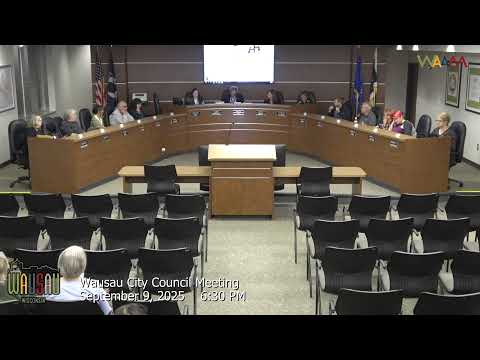
The Wausau Common Council on Sept. 9 rejected a design recommendation for State Highway 52 (East Wausau Avenue) between North Sixth and North Eighteenth streets, voting 5-6 after more than two hours of public and council debate.
The Infrastructure & Facilities committee had forwarded a blended design that would add a two-way left-turn lane (a "twiddle") from Sixth to Thirteenth Street, include bike lanes on the roadway, and a multiuse path on the south side from Thirteenth to Eighteenth. Supporters said the twiddle would address a high rate of rear-end crashes in the corridor. Opponents said the committee process did not sufficiently explore alternatives, that the design would require property takings in places, and that the city had not done a recent speed study.
Jonathan Smith, a resident and chair of the Bicycle and Pedestrian Advisory Committee, asked the council not to endorse the committee recommendation. "Iam asking that you do not endorse the A2 or the A2 and C1 design proposals and ask for better for our citizens," Smith said during public comment.
Several alderpersons said they were sympathetic to safety goals but wanted more time to examine alternatives on a block-by-block basis. "This project is a generational project for that neighborhood and it really, I think, provides an opportunity for us to look at this kind of thing with fresh eyes," Alder Neal said during debate. "I will not support this tonight, for a variety of reasons."
City engineering staff and the DOT consultant defended the committee—ompromise and described technical limits. Stephanie Christiansen, the project manager for consultant EMCES, said the corridor is a state highway and certain lane and shoulder widths are required. "A speed study can only come at the request of the municipality," she noted, and added that minimum design standards limit how narrow travel lanes can be. She also said engineers developed the alternate (C1) to respond to public input.
Councilmembers debated multiple technical points: whether bike facilities should be on the roadway or in a separated path, whether a continuous twiddle should extend the full corridor for consistency, and whether single-lane roundabouts at key intersections had been studied. Alan Waslowski, the city engineer, said the project team evaluated trade-offs and that a multiuse path could require right-of-way purchases that would stop a project if a single property owner refused an easement.
Alder Rasmussen offered an amendment to adopt option A2 (the twiddle) from Sixth through Eighteenth with sidewalks on both sides and no multiuse path; that amendment failed 4-6. The main motion to adopt the committee esign also failed on a 5-6 vote.
Because the main motion failed, staff will return the project to the Infrastructure & Facilities committee for further work, according to the council chair. Council members urged additional public engagement and a clear presentation of alternatives before another council vote. The DOT consultant noted that federal and state funding timing can constrain schedule if the city delays a final decision.
Votes at a glance - File 250910: Resolution approving design recommendation for State Highway 52 (East Wausau Avenue) from North Sixth Street to North Eighteenth Street. Motion to adopt committee recommendation: Failed, 5-6. (Mover on main motion: Alder Veil; second: Alder Henke.)
Context and next steps Councilmembers who opposed the committee recommendation said they wanted more outreach, block-by-block drawings, and technical follow-up on right-of-way impacts, lighting decisions and speed management options. Several members specifically asked staff and the consultant to return with more detailed renderings and to document any additional property takings or construction cost changes.
The DOT consultant and city engineer said some alternatives (for example, narrowed travel lanes below state minimums) are not feasible under state rules, but that the city could re-evaluate the corridor and return to the committee with refined options. Staff also warned that delaying the decision could jeopardize available state or federal funding if the project is not ready when those programs expect construction-ready plans.
Ending Council members and residents asked for more public meetings and a clearer presentation of trade-offs between pedestrian continuity, bicycle facilities and traffic safety. The Infrastructure & Facilities committee will receive the project back for further work; no final schedule was announced during the meeting.