Get Full Government Meeting Transcripts, Videos, & Alerts Forever!
Get email alerts on the Public Transit topic
No spam. Unsubscribe anytime.
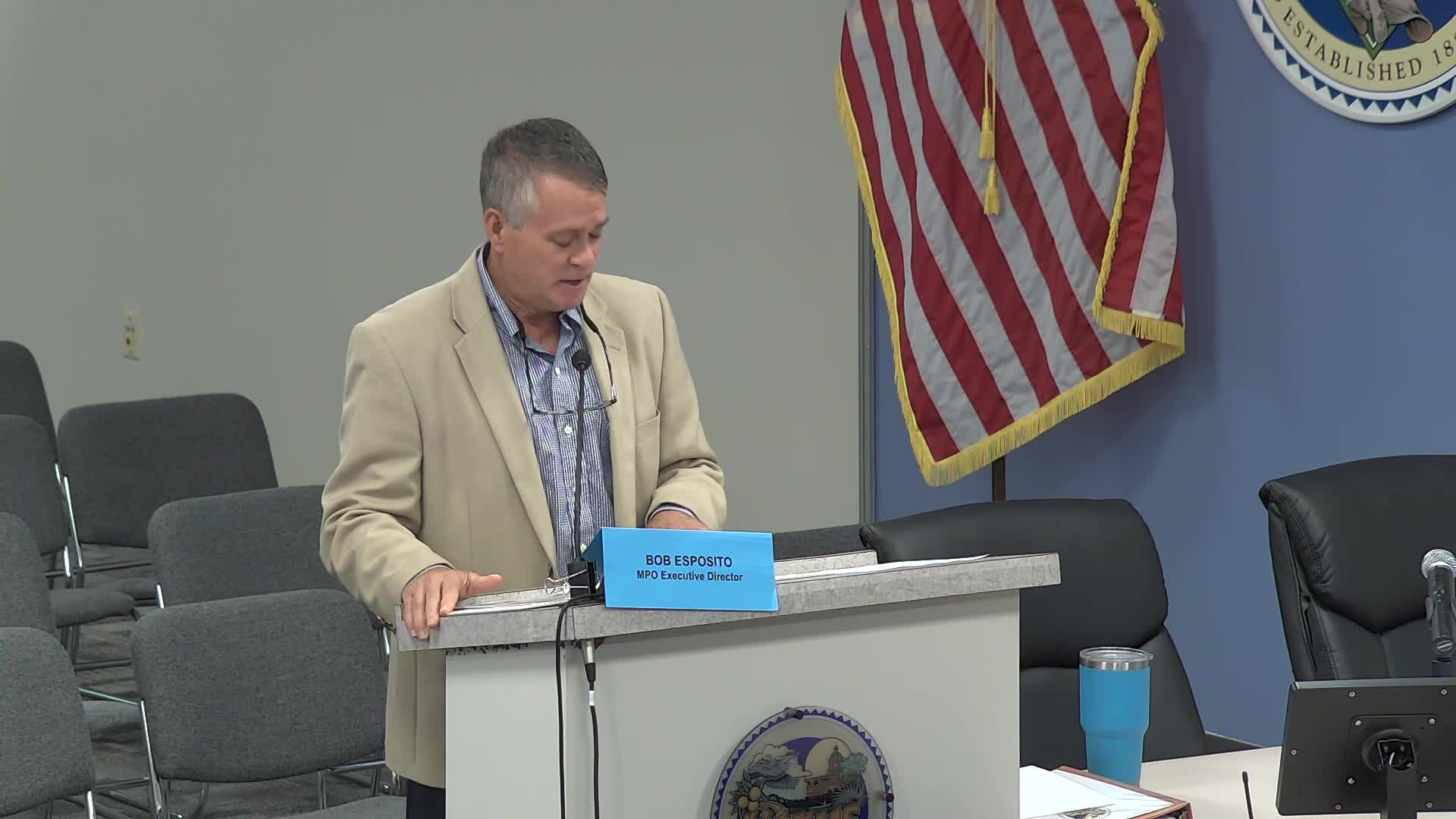
Hernando Citrus MPO members and transit officials debate costs, service models and funding for local transit
Summary
Officials from Citrus and Hernando counties briefed the Hernando Citrus MPO on ridership, per-trip costs, funding sources and service differences; board members asked staff for clearer cost-benefit data and possible alternatives such as vouchers and microtransit pilots.
At a meeting of the Hernando Citrus Metropolitan Planning Organization (MPO) Board, county transit officials and board members discussed the cost, funding and service models for public transportation across Hernando and Citrus counties, focusing on differences between fixed-route and door-to-door (paratransit) services and options for improving efficiency.
The discussion mattered because transit operating costs, local match requirements and service design affect county budgets and state and federal grant eligibility. Board members pressed staff for clearer, unduplicated ridership counts and for cost comparisons between continuing current service and alternative delivery models such as vouchers, rideshare partnerships and microtransit.
Joanne Granger, Transit Services Director for Citrus County, described Citrus’s funding mix and recent ridership figures. Granger said Citrus County’s door-to-door (demand-response) trips had an average operating cost of about $70 per trip and fixed-route trips averaged about $35 per trip; the local portion of those costs averaged roughly $8.37 per trip. She told the board Citrus reported 56,086 total trips in fiscal year 2024 and explained that commission-for-transportation-disadvantaged (CTD) subsidies and bus pass programs reduced fares for many riders. Granger also said Citrus could apply for an Innovative Service Demonstration (ISD) grant to pilot voucher programs for rideshare services, noting eligibility and match requirements for such grants.
Darlene Lolly, Transit Administrator for Hernando County, explained Hernando’s service model and data reporting. Lolly said Hernando provides fixed-route service that follows the same stops every run and that Hernando’s 2024 annual operating expense was about $3,000,197; Hernando reported 56,000 trips in FY 2024 and an estimated 64,000 trips for the current year to date. Lolly noted Hernando is 100% grant funded for operations in recent years and that capital purchases are typically funded at 100% by federal capital grants with state matching credits. Lolly also cited the National Transit Database (NTD) as a source of comparative cost-per-trip figures across peer agencies and offered to share NTD reports with board members.
Board members raised several recurring concerns: (1) whether unduplicated-user counts and per-user annual costs are being tracked so officials can evaluate individualized service alternatives; (2) whether rideshare or voucher pilots (including Uber Health and Lyft) can meet ADA and wheelchair-access requirements; (3) how one-time pandemic-era funds (CARES Act) altered recent local-match and operating figures; and (4) whether fare increases would meaningfully reduce local match obligations without reducing grant eligibility. Commissioner questions repeatedly emphasized the need for accurate, comparable data before policy changes.
Officials clarified a number of technical points. Granger described differences in Citrus’s operations as both the public operator and the Community Transportation Coordinator (CTC), which means Citrus directly administers CTD funds and bus-pass programs; Hernando’s CTD functions are administered by a separate CTC entity. Lolly described Hernando’s fleet and peak-service vehicle counts and cautioned that differences in service design (deviated fixed route versus fixed-route without deviations, separate CTC arrangements) make direct agency-to-agency comparisons imperfect.
Board direction, as recorded in the meeting, included requests for more detailed, unduplicated ridership and cost-per-user analyses and for staff to explore feasible pilot programs (likely through ISD grants) that could supplement or replace parts of current paratransit service. MPO staff acknowledged those requests and said they would provide relevant NTD reports and local data to the board and to their respective county commissions for policy decisions.
Board members and staff also discussed local funding sources. Speakers noted use of federal FTA programs (including urban 5307 and rural 5311 formula grants as referenced during the meeting), CTD subsidies, the 9¢ local gas-tax allocation, CARES Act and ARPA funds used after the pandemic, and how each source affects local match obligations and long-term sustainability.
No formal policy changes or votes were taken on transit service at this meeting. The Transit Development Plan (TDP) for each county remains a planning document; staff reiterated that the TDP is a strategic plan and not a binding capital-improvement program. Board members were advised that implementation or expansion of service requires subsequent action by county commissions and appropriate budget allocations.
The discussion closed with staff offering to share the NTD summary and to return with clearer cost-per-user and unduplicated-client figures and with options for pilot programs that would preserve ADA access while testing lower-cost alternatives.