Get Full Government Meeting Transcripts, Videos, & Alerts Forever!
Get email alerts on the Clean Energy Vppa topic
No spam. Unsubscribe anytime.
Sedona council backs further study of NAU-led virtual power purchase agreement consortium
Summary
Council directed staff to continue exploring an intergovernmental agreement with Northern Arizona University to join a multi-entity consortium seeking renewable energy via virtual power purchase agreements (VPPAs). No contract or final vote was taken; staff will return with a finalized IGA and emissions inventory updates.
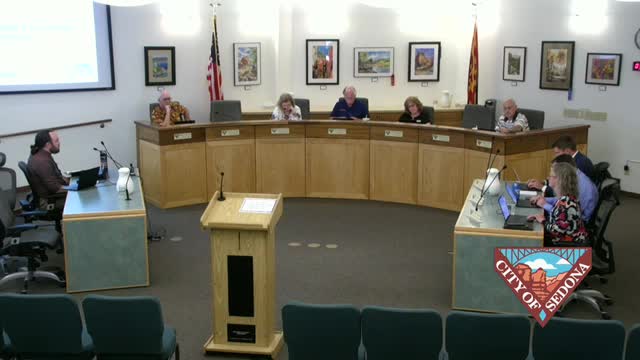
Sedona city officials told staff on Oct. 25 they support further study of an intergovernmental agreement (IGA) with Northern Arizona University to pursue renewable energy through virtual power purchase agreements (VPPAs), but no contract or formal vote was taken at the meeting.
Bryce, a city staff member presenting the proposal, said the IGA with NAU would bring Sedona into a statewide consortium that includes Northern Arizona University, Arizona State University, the City of Flagstaff, the cities of Tempe and Phoenix and others. “There is no direct project up for review,” Bryce said, describing the session as an information and direction request rather than a final proposal.
The presentation explained the difference between on-site power purchase agreements and VPPAs, in which energy from a remotely sited renewable facility is sold into a wholesale market and participants settle the financial difference against a negotiated “strike price.” Bryce said VPPAs typically run 10 to 25 years and that NAU has retained consultants (USource) and outside counsel to support procurement and modeling.
Why it matters: Sedona’s municipal electricity use is comparatively small — about 4,000–5,000 megawatt hours a year — which makes standalone projects less attractive to developers. Joining a consortium can increase scale, improve pricing, and help the city secure long-term renewable energy credits (RECs) tied to new generation. The presenter said the consortium’s combined load is roughly two thirds of a million megawatt hours (about 666,000 MWh); Sedona’s share would be a small portion of that total.
Background and local context: The city’s prior renewable efforts include a 2012 wastewater solar power purchase agreement that produces roughly 1 million kilowatt-hours per year (bought at a little over 7.5¢/kWh), a 2019 APS Solar Communities arrangement that provides a monthly bill credit, and a 2022 enrollment in APS’s Green Power Partners program (a green tariff costing about $8,400 per year for the city). For comparison, the city’s municipal purchases were cited at about 4,000–5,000 MWh annually and the broader community at about 167,000 MWh.
Costs, benefits and risks: City staff gave preliminary cost context: the wastewater PPA’s contracted price is a little over 7.5¢/kWh compared with APS retail rates of about 12¢/kWh in June 2025, producing estimated annual savings for that project in the tens of thousands of dollars. Bryce warned that federal incentives have changed, project costs and timelines have increased in recent months, and wholesale market prices can swing month to month. He said modeling by NAU’s consultants would be used to estimate how likely a VPPA would be to outperform its strike price and whether it could act as a hedge against future utility costs.
Timing and structure: The presenter said the IGA is expected to come back to the council for consideration in late September or early October (staff noted that selection and negotiation processes could extend into 2026) and that energy from a newly built site would not be expected until about 2027–28. If a project is selected through the consortium solicitation, each participating entity would sign its own VPPA negotiated as part of the larger process.
Engagement with utilities: The IGA scope as described would include outreach to Arizona utilities (specifically APS and SRP) to understand what on-state options they could provide and to avoid bypassing local utility engagement. The presenter said that part of the consortium’s work is to signal market demand and to compare off-site VPPA options with utility-offered programs.
Council reaction and next steps: Several council members spoke in favor of continuing work with NAU and its consultants. Mayor Jablow said, “I would support you moving forward.” Councilor Kathy Kinsella said she supported the effort and noted there is no direct city cost at this exploratory stage. Staff said they would return with a finalized IGA for council consideration and planned a deeper dive on the municipal and community emissions inventory before the end of the year.
What was not decided: Council did not authorize spending on a VPPA, did not approve any specific project, and did not enter a contract at the meeting. Staff said legal and negotiation costs would be incurred only if a project were selected and the city chose to proceed with a negotiated VPPA.
Looking ahead: Staff will bring a finalized IGA and more detailed modeling and cost estimates from NAU’s consultants to a future meeting. The city will also review its emissions inventory and return to council with those findings before year’s end.