Get Full Government Meeting Transcripts, Videos, & Alerts Forever!
Get email alerts on the Development Review topic
No spam. Unsubscribe anytime.
Consultant recommends about 70 changes to Oshkosh development review; council discusses leadership council and digitization
Summary
A consultant told the Oshkosh City Council on Oct. 25 that the city’s development review system is delivering strong service levels but could be made more consistent and efficient through roughly 70 targeted changes, including clearer standard operating procedures, broader use of permitting software and a new internal leadership council.
A consultant told the Oshkosh City Council on Oct. 25 that the city’s development review system is delivering strong service levels but could be made more consistent and efficient through roughly 70 targeted changes, including clearer standard operating procedures, broader use of the city’s permitting software and a new internal leadership council to shepherd implementation.
Aaron Bagherly, a consultant with Matrix Consulting Group, presented the firm’s development-review final report and said the report — roughly 220 pages with appendices — will be followed by a fee study this fall. “You do have very strong service levels,” Bagherly said, adding that the city’s turnaround times are a strength even while some processes rely on institutional knowledge and uneven use of the city’s Evolv permitting system.
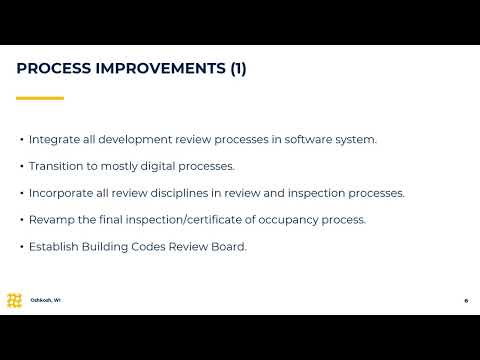
Bagherly told council members the recommendations fall into management and administration, process improvement, customer engagement and regulatory changes. Key process recommendations include creating formal standard operating procedures for review disciplines, performing application completeness checks at intake and rejecting incomplete submissions, standardizing internal review timelines, digitizing paper workflows where feasible and better including secondary reviewers in inspection and permit closeout steps. He also recommended establishing a building code review board to provide an appeal body for applicants and staff.
The consultant recommended modifying Oshkosh’s extensive pre-application process to focus more on staff review and to tighten thresholds for when pre-application meetings are required. Bagherly said staff currently provide a very expansive pre-application service that sometimes consumes time the city could better direct to formal applications.
Bagherly recommended greater, citywide use of the Evolv permitting platform and the development of performance dashboards to document when applications were returned to applicants and how long they remained dormant. He said dashboards and automated alerts would make it easier to show, for example, whether a multi-month delay was caused by applicants not resubmitting materials rather than by city review time.
On customer-facing changes, the report urges a centralized development landing page on the city website, online application checklists and an online meeting schedule so applicants can book virtual time with building staff. On regulatory items, Bagherly suggested the city review zoning and building permit requirements, noting some permit triggers are broader than peer communities; he added that Wisconsin law limits some options — such as issuing instant permits — and that those statutory limits constrain certain approaches.
Council members pressed on sequencing and early wins. One council member asked whether the next step should be the development leadership council; Bagherly said that council would be a high priority because it would unify staff leadership around a mission and assign responsibilities for code updates, software changes and website improvements. City staff told council members they plan to return with an action plan and noted the city already is budgeting for a new permitting software license, which staff said will address many recommendations but will not implement all of them immediately.
Several council members urged transparent progress reporting. Bagherly and council members discussed a public tracking approach — a red/yellow/green “dashboard” on the city website showing completed recommendations, items under implementation and future tasks — so residents and developers can see what to expect and when. Bagherly and staff said prioritization will be done in collaboration with staff to reflect capacity and other ongoing projects; he said the firm will help the city develop an implementation timeline once staff input is added.
No formal council votes or ordinance changes occurred during the presentation. Council members and staff emphasized the city’s existing strengths, including counter hours and relatively fast turnaround from staff review, even while acknowledging change will require time, resources and sustained management attention.
Bagherly closed by inviting questions; staff and council members said they will work to prioritize recommendations, return with a phased action plan and provide public updates as items are implemented.