Get Full Government Meeting Transcripts, Videos, & Alerts Forever!
Get email alerts on the County Budget topic
No spam. Unsubscribe anytime.
Washington County presents $438 million recommended 2026 budget, proposes 6.95% levy increase
Summary
County administrators presented a $438,000,000 recommended 2026 budget and a proposed 6.95% levy increase to the Washington County Board of Commissioners, citing capital projects, staffing to address human-services wait lists, technology upgrades and anticipated state and federal funding reductions as key drivers.
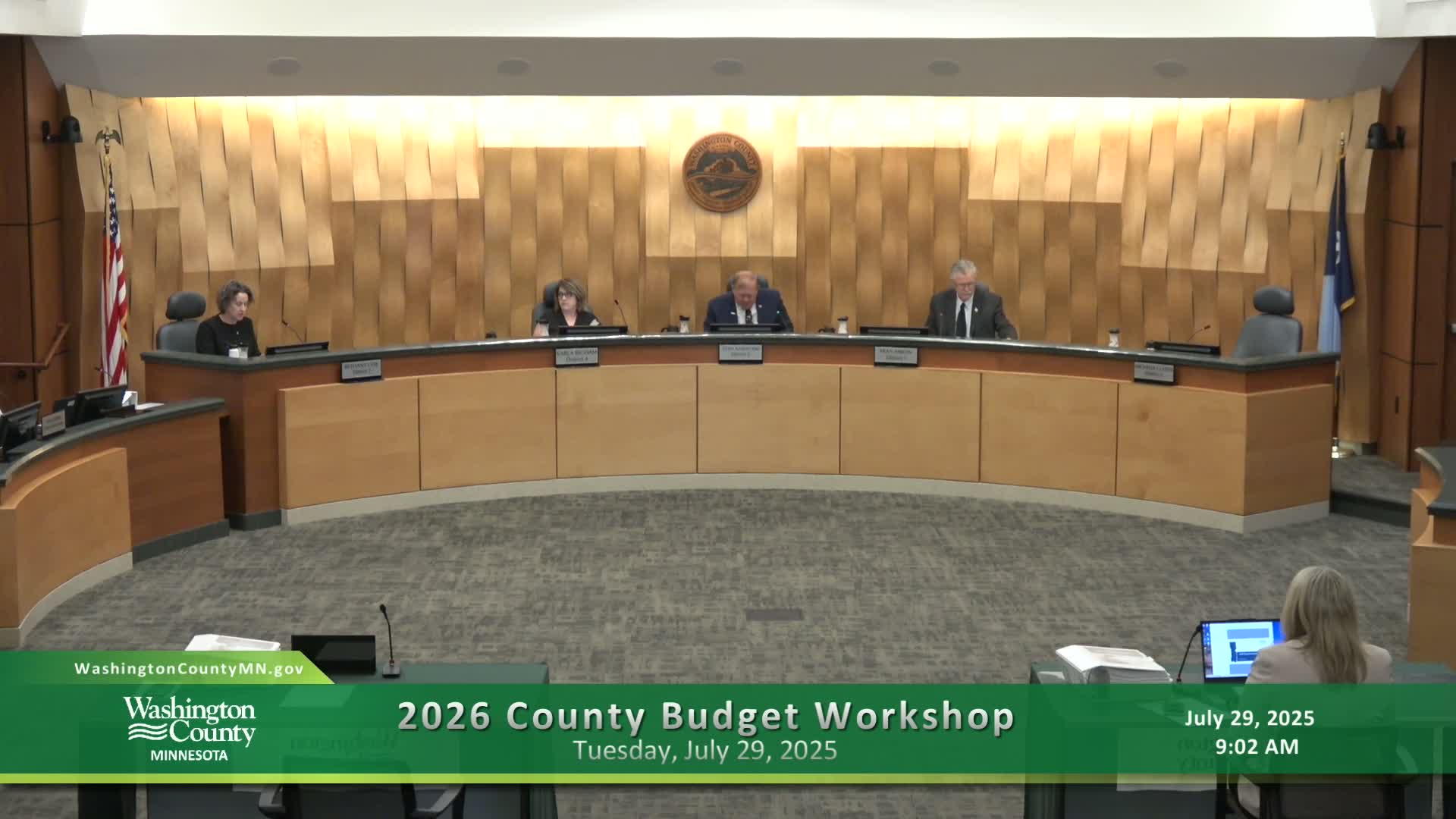
Washington County Administrator Kevin Corbett presented the county's recommended $438,000,000 2026 budget on July 29 and asked the Board of Commissioners to begin review of a proposed 6.95% county levy increase. Corbett and Deputy Administrators Jan Lucky and Wagenius (Deputy Administrator) described the recommendation as focused on meeting existing obligations, completing capital commitments and stabilizing human-services programs facing growing wait lists.
The memo and slides provided to the board show that most of the year-over-year growth is in capital spending; administration said roughly $50 million of the $77 million total increase is capital and the remaining $27 million is operating. Deputy Administrator Lucky said the operating increase largely covers wages and benefits for existing staff, technology contract increases and targeted staffing to address program compliance and wait lists. She summarized the recommended levy proposal as 6.95% and said that translates to about a $50 annual increase on a median-value home in a sample scenario (about a 5.1% example change in a median bill), while noting actual homeowner impacts will vary by property and final levy decisions.
Why it matters: the recommended budget funds roads and bridges, libraries and parks, emergency housing operations and human services where federal and state funding shifts and new program requirements have increased workloads. County officials said the proposal attempts to protect long-term fiscal health by using one-time resources prudently, expanding use of a revocable trust to fund retiree health subsidies, and balancing pay-as-you-go and debt financing for capital projects.
Major revenue and levy details
- Total recommended county budget: $438,000,000 (administration's presentation). - Proposed levy increase: 6.95% (presented as the recommended starting point for board review). - Gross levy presentation: administration said a $165.338 million gross levy figure on the slides includes the county net levy, the land and water legacy levy, the regional rail levy and county program aid; county program aid of about $14.5 million materially reduces the net levy the county must set. - New construction in Pay 2026 was estimated at about $886,000,000 in added taxable value for the county; median residential property value used as an example rose to about $423,700 from $416,000 in 2025.
Expenditure priorities and drivers
- Capital projects: Administration identified multiple large capital commitments in 2026, including a planned $115.5 million investment in road and bridge projects funded from a mix of state, federal and local sources and a large interchange project (Highway 36 and Lake Elmo Avenue) that accounted for much of the capital-year increase. Park Grove Library construction cost was estimated at $18.3 million (up from $13.5 million in the prior plan); Stafford Library and a South Shop also show notable cost increases in preliminary planning.
- Human services: The recommended budget included new positions to reduce wait lists and address compliance risks in programs that county leaders said are currently out of compliance or experiencing long delays. Specific program staffing proposals discussed include 4 positions for SNAP administration (50% non-levy funded), 6 positions for MnCHOICES intake and reassessments (70% non-levy funded) and multiple community services positions offset by expiring special-project roles. Lucky noted the federal share of SNAP administrative costs will decline in 2026 (from 50% to 25%), and a partial-year impact is included in 2026 with full impacts expected in 2027.
- Employees and labor costs: Administration said more than 40% of the budget is wages and benefits and the recommendation builds typical wage and range adjustments into personnel cost estimates. The county will begin employer and employee contributions for the Minnesota Paid Leave program in 2026; administration estimated total premiums of about $1.2 million and said the recommended budget includes funding for 50% of the premium while final employer/employee splits will be determined in labor negotiations.
- Internal services and technology: The recommended budget funds a migration option for the Human Resources Information System (HRIS) and payroll; administration said migrating NebraskaGov/NEOGOV to a SaaS model was projected by a vendor analysis to be materially less costly over six years than a full ERP replacement and that a fit-gap analysis was underway. IT requested an additional endpoint computer support analyst (growing that team from 5 to 6) and noted rising software subscription costs (Microsoft increases were highlighted as nearly $200,000 higher before stabilizing). The capital technology fund balance was shown at roughly $5.1 million with a proposed 2026 program of about $5.4 million.
Other operational items
- Facilities and building operations: Administration proposed raising the county's internal rent charge to reflect increased building areas and higher repair needs; a 4.5% increase in internal rent was included to fund additional custodial and project-manager staffing and to increase the building repair account. One-time funding was proposed for a countywide library facility plan and to plan additional library open-access options.
- Roads and public works: To address staffing needed to deliver a larger capital program, the recommendation includes redirecting wheelage tax growth and part of existing wheelage tax revenue to fund 4.5 new positions in the road and bridge division.
Board questions and discussion
Commissioners asked about details and timing for the HRIS decision, the county's approach to Minnesota Paid Leave costs and the inclusion of Land and Water Legacy referendum analysis in the administrative budget. Administration said the HRIS fit-gap analysis and vendor report would be available by November and that the final HRIS decision could be delayed a year if necessary. Administration also said there would be closed-session labor negotiations and expected to negotiate employer/employee cost shares for paid leave before final budget adoption. Multiple commissioners requested workshops on the HRIS/finance system decision and further review of land-and-water funding and referendum analysis.
What was not decided
No formal board votes were taken during the workshop; administration presented the recommended budget and the board began question-and-answer and workshop discussion. The preliminary levy approval required by statute remains scheduled later in the process; administration noted the preliminary levy must be approved by September 30 and the final budget adoption is scheduled for December 16.
Ending note
Administration said department-level presentations and additional workshops will follow through August and September; the board will continue review of department requests and the preliminary levy before formal action later in the year.