Get email alerts on the Audit topic
No spam. Unsubscribe anytime.
Berrien County auditor issues clean opinion while flagging multiple material weaknesses and federal grant shortcomings
Summary
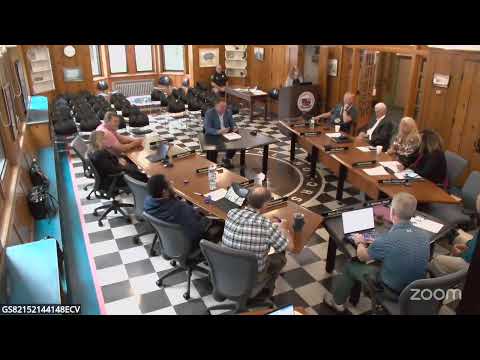
Nate Balderman, engagement principal for audit firm Raymond, told the Berrien County Board of Commissioners on Tuesday that auditors issued an unmodified (clean) opinion on the county's financial statements but identified several internal-control and reporting problems that the county needs to address.
Nate Balderman, engagement principal for audit firm Raymond, told the Berrien County Board of Commissioners on Tuesday that auditors issued an unmodified (clean) opinion on the county's financial statements but identified several internal-control and reporting problems that the county needs to address.
Balderman said, "we did issue an unmodified report or a clean opinion on that," meaning the auditors concluded the financial statements are fairly stated in all material respects. He also said the audit found four material weaknesses in internal control, and additional issues tied to the county's federal awards reporting.
Why it matters: A clean opinion means users can generally rely on the numbers presented in the annual financial statements. At the same time, material weaknesses indicate auditors found errors or conditions that could allow material misstatements to occur and not be prevented or detected by the county's controls.
Balderman summarized the principal findings. The audit recorded four material weaknesses, including material audit adjustments arising from transactions or balances that required correction during the audit. The auditors also noted errors on the schedule of federal awards (the listing of federal grants and expenditures that is treated as a financial statement for single-audit purposes) and incorrect entries related to drain capital assets.
On the county's ARPA funds, Balderman said auditors tested the Coronavirus State and Local Fiscal Recovery Funds (the ARPA SLFRF program) and issued an unmodified opinion on compliance for that program but reported three significant deficiencies: a missed quarterly report, lack of documented review procedures for reporting, and missing evidence that suspension-and-debarment checks had been completed for vendors or subrecipients tested. Balderman said the auditors themselves verified the vendors were not on the suspension/debarment lists but noted the county lacked documentation showing the county had performed one of the three acceptable verification methods required by the federal compliance supplement.
Balderman also reviewed new and recently implemented accounting standards. He said the county implemented two new GASB standards this year (including the standard on accounting changes and error corrections and the new guidance on compensated absences), and he warned that upcoming GASB standards on uncertain-risk disclosures and changes to the financial-reporting model will require more work in 2025 and 2026. "It was a lot of work, but I think we got it to the point where there's a reasonable calculation that's there now," Balderman said of the compensated-absences implementation.
During and after the presentation, commissioners asked procedural questions about who issues GASB standards and about the county's internal processes; Balderman noted that GASB is a standard-setting board overseen by the Financial Accounting Foundation and that stakeholders can comment during exposure-draft phases. He also said auditors plan to meet with county finance staff after the presentation to review details and recommended actions.
The board took one formal action before the audit presentation: it approved minutes from the previous meeting by voice vote. Later in the agenda, the county reviewed a requisition list with no questions raised.
The presentation and Q&A make clear the county received a favorable audit opinion but must address internal-control weaknesses, clean up schedules related to capital assets and federal awards, strengthen documentation of report review processes, and formalize suspension-and-debarment checks for federally funded contracts. Auditors indicated some improvements from last year in Act 51 (road-funding) reporting but said timeliness and accuracy remain an issue for the road department.
The county's finance staff and auditors will follow up to resolve the audit adjustments and to document corrective steps for the material weaknesses and significant deficiencies.
AI generated
The text on this page is AI generated. Summaries, highlights, analysis, and video transcripts are all produced from the original source material.
AI can make mistakes, so if you spot one, and we will fix it for everyone.
Note: the source content is unaltered by us. Any content source we link to, be it a video, an audio recording, or a document, is presented exactly as its publisher released it. That publisher is usually a government body, sometimes an individual official or another organisation.