Get Full Government Meeting Transcripts, Videos, & Alerts Forever!
Get email alerts on the Parks Budget Aquatics topic
No spam. Unsubscribe anytime.
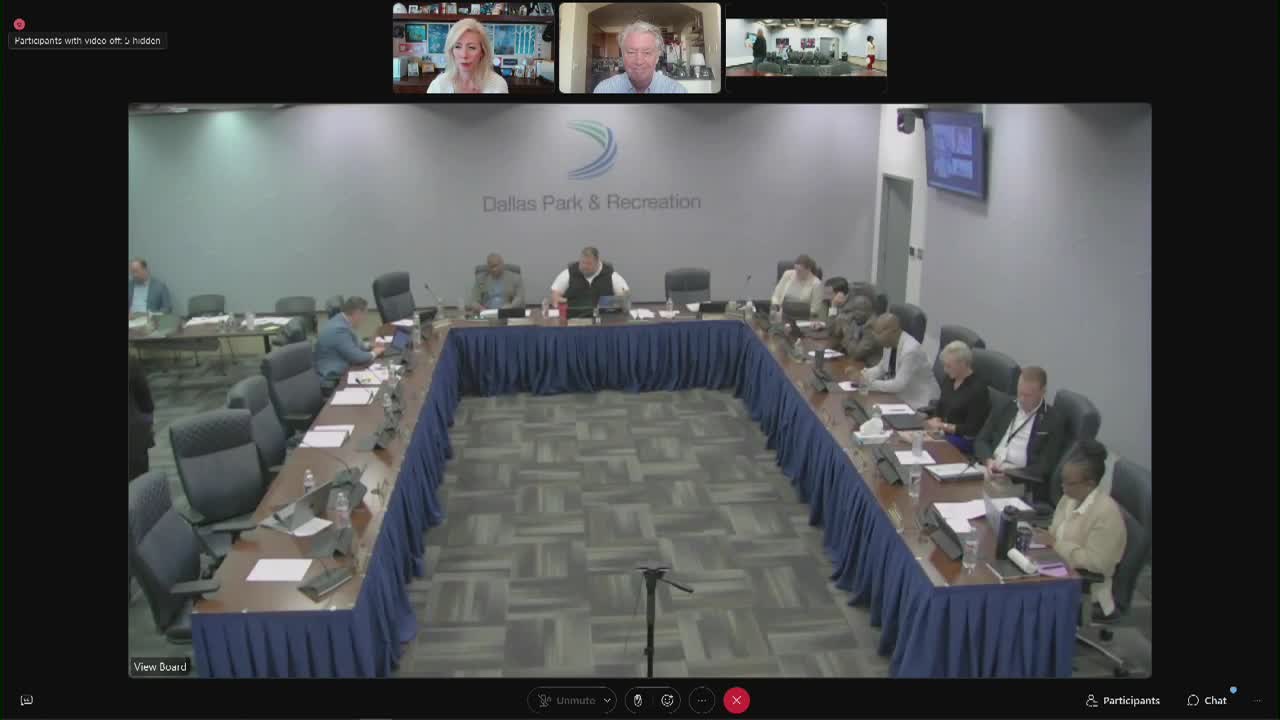
Dallas parks board debates decommissioning aging pools as budget gaps persist
Summary
Park and Recreation Board members recommended a phased plan to decommission aging community pools to meet a $3 million budget gap, sparking debate over timing, equity and replacement funding tied to bond projects and spray-ground alternatives.
The Dallas Park and Recreation Board on Aug. 21 recommended a phased plan to decommission aging community pools to help close a roughly $3 million budget gap, but members sharply disagreed over timing and how to replace lost services.
Board members said the city spent $75 million on new regional aquatics facilities after an aquatics master plan and that ongoing maintenance, parts shortages and operating costs make continuing to maintain many small, decades-old community pools unsustainable. "We have to rip the band aid off," Park Board member Calvert Collins Bratton said, arguing the city should proceed with decommissioning and reallocate funds to modern replacements.
The board heard an update from Rachel Berry, who said staff are reviewing criteria used to rank legacy facilities and that some pools may be involuntarily decommissioned because of mechanical failures. Berry said, "Our youngest facility just turned 50," and added that inspections during the off season will determine which pools can safely operate next summer.
Board members debated whether to decommission two pools now or take a larger phased approach. Several members urged a planned, multi-year schedule — for example, three pools per year — tied to the aquatics master plan and bond funding schedules, so communities know when replacements or alternative amenities will be built. Board member John Wood asked for clarity about what would be placed in communities where pools close and urged “better amenities” such as spray pads or new pools when feasible.
Some board members and staff emphasized the limits of immediate alternatives and noted that replacement facilities — including prototype spray pads and regional aquatic centers — cost far more than older, smaller pools. Staff said newer spray pads can cost $2.5 million to $3.5 million to build, while a basic splash pad prototype has cost roughly $630,000 in recent work.
The board also discussed several operational and equity considerations. Members said some neighborhoods are experiencing demographic change and that usage figures alone do not always capture future community need. Other members noted that several pools have had temporary measures to keep them operating for years — "We have duct tape. We have Band Aid. We have Super Glued," Berry said — and that parts inventories are depleted.
Staff and members agreed on next steps: finalize a transparent, time‑bound decommission plan with community outreach and tie closures where possible to bond-funded replacements. At the meeting’s close, board members said the top three recommended candidates for decommissioning under the current criteria were Fraunweiler, Glendale and Longmont Hill, while acknowledging the list could change if facilities fail mechanically before replacement funding arrives.