Get Full Government Meeting Transcripts, Videos, & Alerts Forever!
Get email alerts on the County Budget topic
No spam. Unsubscribe anytime.
Eau Claire County board warned of $1.8 million budget gap as Human Services placements rise
Summary
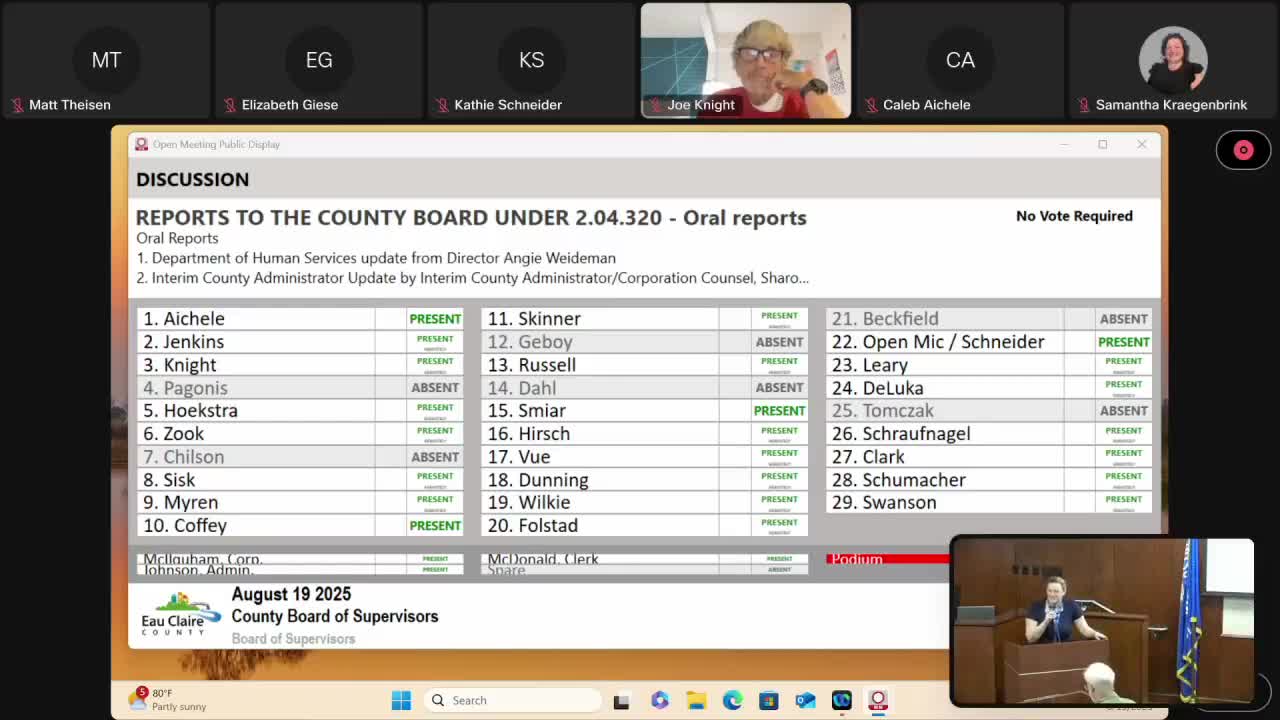
At its Aug. 19 meeting the Eau Claire County Board heard a Department of Human Services report showing placement costs running above budget and learned county administrators expect a roughly $1.8 million gap next year as health-insurance and other costs climb.
At its Aug. 19 meeting, the Eau Claire County Board of Supervisors heard a Department of Human Services fiscal update showing some placement categories are above plan and administrators said the county faces an estimated $1.8 million shortfall for the next budget cycle.
Director Weideman, director of the Department of Human Services, told the board the department’s total 2025 budget is $50,900,000, of which $10,100,000 is county levy. She said placements of children — foster care, treatment foster care and residential care — are “slightly over budget.” For January through May the department had budgeted $1,700,000 for child placements and recorded $1,900,000 in actuals; the annual budgeted figure is $4,200,000 with an annual projection of $4,700,000.
“We asked the county board for 1.9,” Director Weideman said, referring to $1.9 million added to placement budgets in the current year. She added the department also used other measures to hold costs down, including holding open positions: “We have made other shifts as well to make it manageable,” she said.
Why it matters: placement and institutional costs — for children, IMDs (institutes for mental disease) and adult placements — are the most volatile portions of the human services budget and can drive the department over its appropriation. Weideman told supervisors that IMD costs have trended lower while children's placements remain higher; adult placements also came in under the January–May budgeted amount.
Board members and staff discussed both short-term and structural responses. County administrators said they are pursuing a multi-phase approach to address the county’s fiscal challenge: 1) internal collaboration across departments to find efficiencies, 2) external partnerships with municipalities and nonprofits, 3) review of mandated services and discretionary levels of service, and 4) development of a public-facing revenue proposal if necessary. Administrator Makawam described the approach as a phased effort to preserve staff and services while identifying possible savings and new revenues.
Finance staff told the board that updated net new construction numbers modestly improved revenues (preliminary figures showed net new construction at 2.4% versus 1.5% expected), producing roughly an additional $115,000 in levy capacity. But they also warned of large cost pressures: Security Health Plan's final renewal reflected a projected 15% increase in health insurance, which the finance director estimated would raise that line by about $1,500,000.
Director Weideman also flagged workforce and federal policy risks: staff turnover is already occurring in part because of expected federal changes, and some federal policy shifts (including eligibility and funding changes mentioned in National Association of Counties summaries) may reduce or reallocate funds counties currently receive.
On potential relief, the board heard about an anticipated local facility, the Rogers Institute, which staff said may reduce transportation and out-of-area placement costs if it opens as projected (staff cited discussions with state representatives indicating the facility could offer outpatient slots and some inpatient/residential beds in Chippewa Falls). Director Weideman described the facility’s capacity figures as reported to her: outpatient slots in the 60–80 range and a mix of residential and inpatient placements that could reduce travel costs for local placements.
Board members emphasized timing and uncertainty. Supervisor Hirsch warned that favorable current-to-date results do not guarantee the year-end position because placement costs can spike. Supervisor Leary and others pressed staff for updated estimates; staff reported they had projections through June and that trends seen in the May presentation were continuing.
Discussion versus decision: the board did not adopt new policy or levy changes at the meeting. Administrators and department heads were directed to continue work on internal budget proposals and report back with more specific numbers and options for the next budget cycle.
Ending: staff said they would provide updated estimates to supervisors and continue meetings with department heads under a revised budget process timeline; no levy or service-level changes were adopted at this session.