Get Full Government Meeting Transcripts, Videos, & Alerts Forever!
Get email alerts on the School Policies topic
No spam. Unsubscribe anytime.
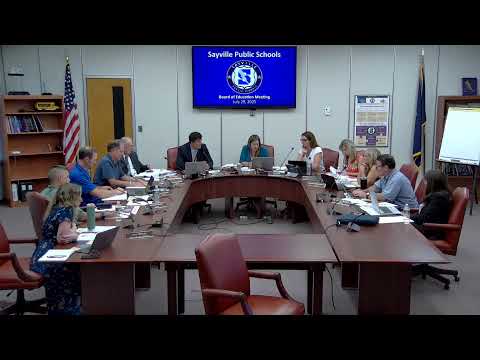
Sayville board discusses new NYS cell‑phone ban and district email restrictions; administrators plan phased rollouts and follow‑ups
Summary
Sayville administrators outlined plans to implement New York State’s bell‑to‑bell cell‑phone ban and described a district restriction on external student email, while parents and board members pressed for reliable ways to communicate last‑minute schedule changes.
The Sayville Board and district administrators spent a substantial portion of the meeting on implementing New York State’s mandated bell‑to‑bell cell‑phone policy and a recently tightened district rule limiting external email traffic to student accounts.
District administrators told the board they had drafted FAQs and a public communication plan and planned high‑school “locker days” in August to practice locker use before school begins. Amy, the administrator leading the rollout, said the high school will also use locker upgrades and an enclosed security booth to secure confiscated phones on repeat offenses.
“We recognize that the policy will particularly compel high‑school students to use their lockers when this has not been a standard practice in the past,” Amy said, and administrators plan a transition period with further review by December.
Board members and parents pressed administrators on practical logistics: many students do not regularly use lockers, transition time between classes may be short, and some families need timely communication about last‑minute schedule or practice changes. One parent said sports changes and late‑day location shifts make reliable parent‑to‑student messages essential.
Administrators said two of the main alternative approaches considered were purchased locking pouches (a commercial “Yondr”‑style solution) and a staffed collection point or “coat‑check” model. The state provided an initial allocation the district estimated at about $13,000; administrators said the pouch option would cost roughly $27,000 and would not be fully covered by the state allocation.
Separately, district technology staff have restricted external email traffic to student accounts to reduce security risks and phishing exposure. Administrators said they have white‑listed entire college EDU domains and specific research partner addresses to permit school‑related external exchanges. But white‑listing creates an all‑student permission for the whitelisted sender, which administrators said requires careful vetting.
Parents and some board members urged a case‑by‑case mechanism that would allow a parent’s address to communicate with a single student (for example, for last‑minute pickup) without opening email access district‑wide. District technology staff said such a per‑student, per‑sender allowance is technically possible but would require additional build‑out and review to meet data‑privacy and security requirements; the technology director will research options and report back.
Administrators also said they would check ParentSquare and StudentSquare settings (digest vs. instant delivery) to ensure coaches and staff send time‑sensitive items as instant messages so parents and students receive them promptly.
Why it matters: The state cell‑phone mandate touches classroom routines, student privacy and family communications. The district’s email restrictions are designed to improve cybersecurity but present practical challenges for parents and students who need timely information. Administrators plan additional technical work and a phased rollout, and they told the board they will revisit implementation after initial weeks of the school year.