Get Full Government Meeting Transcripts, Videos, & Alerts Forever!
Get email alerts on the Animal Waste Ordinance topic
No spam. Unsubscribe anytime.
Marathon County ERC directs staff to draft stricter animal-waste ordinance after year-long farmer work group
Summary
The Marathon County Environmental Resources Committee voted to ask staff to draft three ordinance changes — a winter-spreading permit, a seasonal spreading ban for medium farms, and expanded riparian buffers — following a year of work-group meetings and modeling that found large potential phosphorus and sediment reductions.
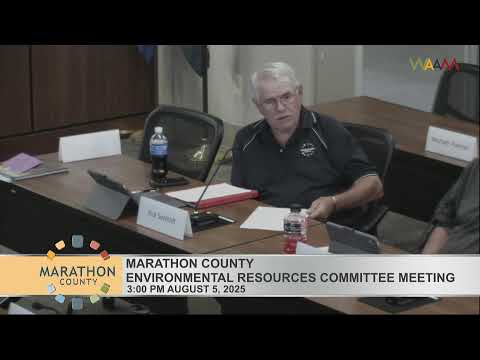
Marathon County’s Environmental Resources Committee on Aug. 5 voted to ask planning staff to draft revisions to the county’s animal-waste ordinance that would add a winter-spreading permit, limit liquid-manure spreading during a high-risk 60-day winter window for medium-sized farms, and pursue a countywide riparian-buffer program.
The committee’s vote followed presentations from county staff who said a year-long work group of about 25 participants — including farmers of varying sizes, conservation partners and state agency representatives — produced a majority-backed set of compromises to reduce phosphorus runoff into county waters. Committee members moved and seconded a motion directing staff to prepare ordinance language and return with a draft this fall for review and further public outreach; the motion passed on a voice vote.
Staff said the proposals are intended to reduce winter runoff from liquid manure while limiting burdens on small farms. One option is a winter-spreading permit for farms that apply liquid manure in winter but do not have a nutrient-management plan; staff estimated a permit fee of about $200 for a four-year permit (roughly $50 per year) modeled broadly on Dane County’s program. Farms with an approved nutrient-management plan would be exempt from requiring the permit.
A second, narrower proposal would prohibit liquid-manure spreading during February and March for medium-sized farms — defined using U.S. EPA animal-unit thresholds as farms with 300–999 animal units. County staff said CAFOs (1,000+ animal units) already face state restrictions that effectively limit winter spreading, and farms under 300 animal units would be exempt from the February–March prohibition. Staff estimated about 40–60 farms in Marathon County fall in the 300–999 range and that roughly 6–10 of those still haul daily and might need alternate short-term storage solutions. Staff proposed a 3–5 year delayed implementation period to help affected operations find options.
The third major proposal would promote (and in some cases require) riparian vegetation buffers — staff described a 35-foot buffer as consistent with county planning documents and modeled results. Using the SnapPlus model and university consultation, staff reported weighted reductions in phosphorus of roughly 60% (about 4 lb/acre/year in modeled dairy rotations) and sediment reductions of roughly 70–85% (weighted ~80% in the examples shown), depending on crop rotation, soils and slope. Presenters noted buffers and grassed waterways are especially effective at reducing runoff where fields drain directly to streams.
Presenters said the proposed local changes would go beyond minimum state standards in some areas; staff said they have already been in contact with the Wisconsin DNR and the Department of Agriculture and expect to seek their concurrence before sending a final ordinance to the full County Board. Staff also outlined outreach plans: additional open houses and educational sessions in the fall, plus immediate contact with farms likely to be affected if the committee authorizes drafting.
Committee members asked about cost-share and technical assistance for affected farms. Staff said rental options for existing state-funded manure storage, NRCS and county cost-share programs, and other interim solutions would be explored; staff did not assert that cost-share is required by state law and said they would check state agency requirements. The presenters emphasized the county would prioritize working individually with any farm that needs help complying.
The motion approved by the committee directed CPZ staff to draft the three ordinance revisions and return with a draft for committee review; staff said they expect to present a draft for initial review this fall (targeting October or November) and to follow the drafting process with further public outreach and state-agency review before any County Board action.
The committee’s action is a direction to draft ordinance language and not a final regulatory adoption. Any enforceable ordinance would require subsequent formal committee review, state-agency concurrence where necessary, and final action by the Marathon County Board of Supervisors.
The committee also discussed technical points and outreach logistics, and staff reiterated that farms already complying with nutrient-management plans or participating in conservation programs would not be affected by new winter-permit requirements. Staff urged the committee to allow drafting so that a proposed ordinance can be fully vetted with the work group and the public.
Looking ahead, staff described a phased implementation idea and promised to bring cost estimates, specific ordinance text and additional modeling results for committee review before any county-level adoption.