Get Full Government Meeting Transcripts, Videos, & Alerts Forever!
Get email alerts on the County Budget Compensation Fees topic
No spam. Unsubscribe anytime.
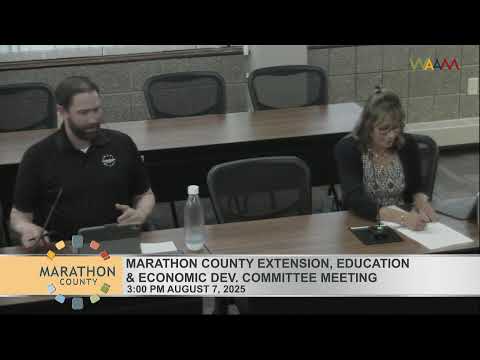
Marathon County committee hears staffing, fees and capital constraints as 2026 budget planning begins
Summary
County administrators told the Extension Education & Economic Development Committee that a new compensation study points to a roughly 7.65% pay adjustment need, while net new construction is only 1.61%, forcing staff to weigh fee increases, grant maximization and cuts to programs or capital projects as the 2026 budget is developed.
County Administrator Leonard told the Marathon County Extension Education & Economic Development Committee on July 3 that staff will build the 2026 budget around findings from a recent compensation study and other rising costs, but that limited revenue growth will force trade-offs.
Leonard said the county’s compensation ranges are about 10% below market and staff’s ‘‘best estimates are that that amount is 7.65%,’’ which would be a significant lift to implement. He also said the county’s preliminary net new construction figure this year is 1.61%, below the board’s earlier estimate of 1.75 and far less than what would be needed to fully fund the compensation changes.
The administrator said other cost pressures — notably health insurance renewals and retirement contribution increases — mean the effective cost pressure could be closer to 10% when blended. ‘‘The health insurance market is 8 to 10%. . . . We budgeted assumption of 6.5. We’re gonna work really hard to to get toward that,’’ Leonard said.
Why it matters: the county has limited options to raise ongoing revenues. Leonard told the committee staff will attempt to align position costs with funding streams, maximize grants and evaluate fee adjustments where legally and practically possible. Where services are subject to a market (for example, tipping fees for solid waste or marriage licenses), large fee increases risk pricing users to other jurisdictions. For truly county-unique services — such as some permits — staff advised the county has more latitude to increase fees.
The administrator summarized capital constraints tied to recent use of reserves. He said last year the board used reserves to reduce the debt levy and made an $8 million loan from the general fund to Bug Tussle instead of a conduit bond; such choices reduce funds available to roll into capital improvement projects. After the 2024 audit, Leonard said, the county currently shows $0 available to roll into the capital improvement plan and staff have recommended zeroing out nonessential projects, preserving only rolling stock replacements, a set of critical IT security projects and necessary highway projects. Leonard said the initial cost estimate for the prioritized capital needs was about $4.7 million and staff have refined that to about $4.5 million.
Committee chair Robinson and other members urged regular fee reviews and early board guidance on new proposals. Chair Robinson noted the county’s roughly $200 million budget and that less than $60 million comes from the levy, observing that fee revenue and operational efficiencies will be needed to avoid program cuts.
The committee was also briefed on internal staffing and administrative changes. Leonard introduced Candice Pesch as the new deputy county administrator, noting she had joined the county the week of the meeting and would participate in capital and budget planning.
Votes at a glance: the committee unanimously approved the July 3 meeting minutes on a motion by Supervisor Rosenberg, seconded by Vice Chair Fifrick. (The transcript records the vote as unanimous; individual vote names or counts were not specified.)
The committee did not adopt any final budget; Leonard said staff will present proposed compensation implementation and fee recommendations to the Human Resources, Finance and Property Committee in mid-July and will bring a full county administrator’s proposed budget to the board in September, followed by a short committee review, publication and public comment before final adoption expected in November.
Additional context and constraints: Leonard emphasized that some department dollars are heavily reimbursed (not levy-funded) while other departments such as the sheriff’s office are primarily levy-funded, which complicates across-the-board adjustments. He repeatedly advised that if supervisors want new programs or positions they should identify offsetting reductions because current revenue projections (1.61% net new construction) will not absorb expansive new recurring costs.
The committee’s next scheduled meeting for continued budget work was set for September 4, 2025, and members were asked to forward position requests and other budget ideas early to permit evaluation of funding trade-offs.