Get Full Government Meeting Transcripts, Videos, & Alerts Forever!
Get email alerts on the Homelessness Rehousing topic
No spam. Unsubscribe anytime.
Council committee reviews $6 million 'Safe Move Tulsa' rehousing plan; vote set for the 20th
Summary
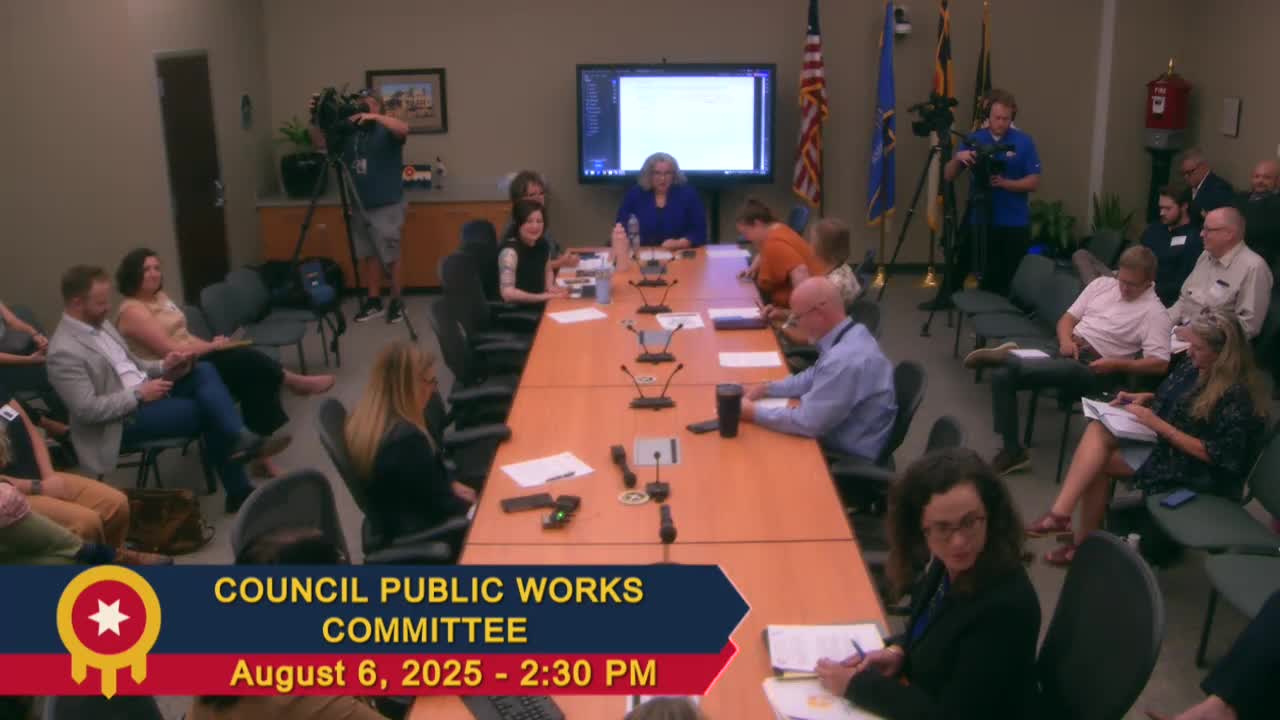
The Tulsa City Council Public Works Committee on Wednesday heard a presentation on Safe Move Tulsa, a proposed $6,000,000 rehousing initiative that would reallocate opioid‑settlement, pandemic recovery and ARPA funds to place people experiencing homelessness into supportive housing.
The Tulsa City Council Public Works Committee on Wednesday heard a presentation on Safe Move Tulsa, a proposed $6,000,000 rehousing initiative that would reallocate existing Walmart opioid-settlement dollars, pandemic recovery funds and ARPA dollars to connect people experiencing homelessness to supportive, individualized housing and services.
Emily Hall, the mayor’s senior adviser on homelessness, told the committee the package would rehouse roughly 300 people and support individualized needs plans. “This is a $6,000,000 investment,” Hall said, summarizing the funding mix and goals.
Hall and budget staff introduced two companion budget amendments: one to transfer $4,026,700 within the city’s Walmart opioid settlement sub-plan to broaden the scope of an existing project, and a second to move about $340,000 of balances within the Pandemic Relief Recovery Fund toward the same rehousing effort. The measures were introduced for committee discussion; the committee did not take a final vote. Committee members were told second reading and a public hearing are scheduled for the 20th.
Why it matters: city staff and service providers framed Safe Move Tulsa as a short‑term, targeted effort to move people into permanent, supportive housing and then use the freed shelter capacity to decommission encampments. Committee members repeatedly cited shelter congestion and point‑in‑time data presented by staff: 1,449 people counted as experiencing homelessness in January (953 in shelters and 469 unsheltered). Presenters said immediate rehousing would both reduce unsheltered counts and create space to assist people who are chronically unhoused.
Program design and services
Hall described Safe Move Tulsa as a scattered‑site rehousing strategy run with Away Home for Tulsa partners and lead agencies such as Housing Solutions. The program components described include rapid housing placement, individualized needs plans that can include financial literacy, transportation, mental health and substance‑use services, and flexible funds for move‑in costs and short repairs.
Program examples used in the presentation illustrated typical service needs: short‑term rent and deposit assistance, case management, employment navigation, health and recovery supports and child care. Presenters said some individuals may need only a few months of assistance while others may require up to 12 months of housing subsidies and continued service supports; the stated goal is that participants be able to maintain rent within 12 months.
Providers and capacity
Mark Smith, chief executive officer of Housing Solutions, said service partners already maintain housing lists and case management capacity and that scattered-site units exist across the metro area. Presenters told the committee the goal is to house 300 people over a roughly nine‑month placement window rather than require all units be available simultaneously. Committee members raised concerns about preserving community connections for people moved to scattered sites and about barriers such as childcare, pets and transportation (including vehicle upkeep and insurance). Presenters said partners such as Catholic Charities provide vehicle‑repair assistance and that flexible funds could be budgeted to cover small repairs, bus passes or similar needs.
Residential care center and 59 deeply affordable units
Committee members asked about a previously discussed residential care center project in North Tulsa that had been expected to provide 59 deeply affordable units. Staff said those units remain part of the housing inventory but that the residential care center’s original use as a transitional living center would shift under the proposed reallocation; the facility’s developer is expected to complete the housing units and they would be used as permanent affordable housing. Several councilors cautioned that the North Tulsa site currently lacks dense local services, transit access and grocery options, and that residents and neighbors had been told wraparound services would be part of earlier zoning discussions.
Contracting, administration and limits
Several councilors asked about administrative costs, oversight and who would decide how flexible funds are spent for individual households. Staff said the ordinance amendments only reallocate appropriations; contracting and program rules would be clarified in a later contracting phase (RFP/contract negotiations) and that Oklahoma state statutes limit how municipal dollars may be used. Staff also said a portion of ARPA funding has been held back for grants compliance; details about the percentage of funds for case management versus direct assistance will be defined during contract development.
Equity and program risks
Council members pressed for details on participant selection, prioritization (sheltered vs. unsheltered individuals, families, and people with vehicles) and measures to reduce returns to homelessness. Presenters described an intake process through Away Home for Tulsa partners and the continuum of care; they emphasized individualized planning and ongoing linkages to Medicaid, behavioral‑health providers, and long‑term case management when needed. Staff characterized implementation risk as medium, noting some components depend on contracting and provider capacity.
Next steps
Committee members did not vote; staff said the ordinances will return for second reading and a public hearing on the 20th. If the ordinances pass, staff expect to proceed to contracting with providers and an RFP process to operationalize case management, flexible funds and placement. Several councilors asked staff to return with periodic reporting on people served, funding‑use breakdowns (case management vs. direct assistance) and program outcomes.
Public‑safety and other costs
Presenters emphasized potential cost savings from reduced shelter use and justice involvement, citing older city assessments that one night in municipal jail cost roughly $600 and an average emergency shelter bed cost about $88 per night. Staff said they will work with city finance to generate more precise, Tulsa‑specific analyses of cost‑benefit if the initiative moves forward.
Committee comment
Councilors broadly expressed support for scaling proven rehousing approaches while requesting more detail on housing unit counts, service budgets, administrative costs and how the city will ensure safety and sustain services. Several councilors asked for follow‑up briefings and written materials before second reading.
Schedule and public comment
Staff told the committee the second reading and public hearing are set for the 20th; no final council action occurred at the committee meeting. If the ordinances are adopted, staff said contracting and implementation steps would follow and the program would use existing provider networks to begin placements as soon as contracts are in place.
Ending
Councilors agreed the proposal aims to accelerate placements using existing service capacity but asked staff to return with contract details, reporting metrics and clarifications about eligibility and administrative costs before final approval.