Get Full Government Meeting Transcripts, Videos, & Alerts Forever!
Get email alerts on the Emergency Services Districts topic
No spam. Unsubscribe anytime.
Collin County commissioners call November election to decide proposed Emergency Services District No. 1
Summary
After a three-hour public hearing with nearly two dozen speakers, Collin County Commissioners Court set an election for Nov. 4 to let voters confirm establishing Emergency Services District No. 1; court did not set any tax rate.
Collin County Commissioners Court voted unanimously Thursday to call a November 4 election so voters can decide whether to create Collin County Emergency Services District No. 1, a county administrator said at a public hearing that drew dozens of speakers.
The court’s action allows the ballot language and election date to be set; it does not establish a tax rate for the proposed district. “Really the voters will have to first create through their vote this special district and then it will be the board … that will be setting the initial tax rate,” County Administrator Yoon Kim told the court during his presentation.
Why it matters: The district would be able to levy a property tax to fund fire protection and related emergency services across unincorporated Collin County and included extraterritorial jurisdictions (ETJs) where municipalities have given consent. Proponents say a dedicated taxing district would provide a stable funding source as cities and volunteer departments struggle with rising costs and faster growth; opponents and many residents asked for detail on tax impacts, municipal contracts and how to avoid double taxation for properties inside municipal utility districts (MUDs).
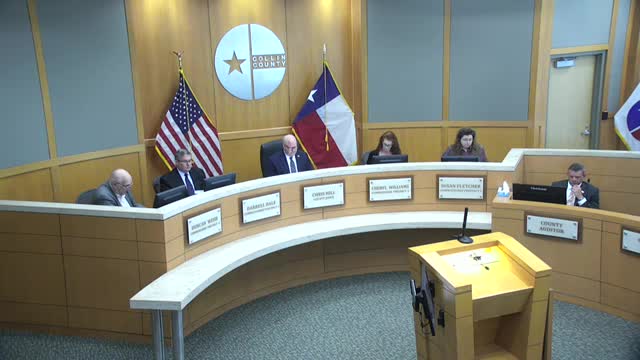
What the court decided and why: After a roughly two-hour county presentation and more than an hour of public comment, the court found that the petition and the ETJ consents satisfied statutory requirements and called the election. The court’s recorded action: “Motion carries 5 to 0,” the judge said after a vote to set the election date and order the ballot language for ESD No. 1.
What county staff told the court: Kim summarized the petition timeline — the ESD petition was filed Feb. 6, 2025, and accepted in open court Feb. 24 — and explained the county’s role under Health and Safety Code section 775.016, which governs creation of emergency services districts. Kim said county staff had notified all municipalities whose ETJs were included in the petition and listed which city councils had consented and which had not. He emphasized that the commissioners court is not setting an ESD tax rate: “We have confirmed that … this board is not setting a tax rate today,” Kim said. The initial tax rate will be set later by the ESD board if voters approve the district.
Estimates presented to the court: Kim said preliminary taxable-value estimates (based on appraisal district figures available in June) showed a gross taxable value for the proposed boundaries of roughly $18.4 billion, with MUDs worth about $7.7 billion and a net taxable value after the court’s prior resolution about MUD double‑taxing of about $10.6 billion. Using a conservative 90% capture assumption, staff showed a back-of-envelope that a 10¢ tax rate would generate about $9.5 million annually; staff also noted county funding currently directed to contracted fire protection is about $950,000.
Public comment and concerns: The court heard roughly two dozen comments from firefighters, chiefs and residents across the county. Stuart Blassingame, president of the Collin County Fire Chiefs Association, read a resolution of principles from the association and urged contractual delivery of services rather than a county-run fire department: “The district should not establish an independent Collin County Fire Department. Instead, all fire and emergency medical services should be delivered through contractual agreements with existing fire departments,” Blassingame said.
Several residents and volunteer chiefs raised the same three themes: (1) concern about the potential for double taxation of residents living inside MUDs and how reimbursement or contract transitions would be handled; (2) requests for assurances there will be no service gap if cities withdraw from county contracts ahead of ESD operations; and (3) requests for more clarity on timing, tax estimates and how the ESD board will be constituted and operate. “Failure to pass the emergency service district in Collin County on November 4 is not an option for the people living outside the city limits,” said Richard Hill, a resident who urged broad voter outreach.
County response and follow-up direction: Commissioners and staff repeatedly said their goal is to avoid a coverage gap if cities withdraw from current contractual arrangements and to work with municipal partners to maintain service continuity until an elected ESD board takes over operations (the ESD would begin operations, and could set its tax rate, on Oct. 1 of the ESD’s first budget year if approved). The court asked staff to update public-facing materials and the county website with the timeline and to coordinate with the elections administrator after the court’s boundary order is finalized so interested groups can obtain lists of voters in the proposed district for outreach (state law requires the court itself remain neutral after an election is called).
Votes at a glance (related items taken or announced at the meeting): - Call election for Emergency Services District No. 1 (agenda items 2a & 2b): approved, outcome recorded as 5–0 in favor; court set ballot language and authorized calling the Nov. 4 election (tax rate not set today). - Consent agenda: approved with several items pulled for later consideration. - Personnel promotion (detention sergeant Manuel Estrada): approved. - Grants reallocation and grant-policy update needed to consolidate county grant-funded positions (health department): commissioners approved a net-neutral reallocation and directed staff to hold a contingency in health services for grant-funded positions (motion carried). - Sheriff’s office overtime budget amendment (to cover fiscal-year overtime shortfall): approved (amount discussed at meeting roughly $825,000 to fund overtime through the fiscal year). - Move of magistrate court clerks into the District Clerk’s office (per Tex. Loc. Gov. Code §54.2210): approved; court directed administrative staff to finalize the court order and handle remaining departmental details in the budget process.
What the court did not do: The court did not and could not set a tax rate for an ESD at this meeting; staff explained state law requires the district board (if created by voters) to set the initial rate. Several cities’ responses to ETJ consent were recorded and will determine the district boundaries the court ordered. The court also did not adopt a media or advocacy campaign for or against the ESD; court staff will publish neutral, factual materials and answer citizen questions.
Look ahead: The court set the timetable required to place the ESD question on the November 4 ballot and asked staff to complete the boundary order and ballot language before the administrative cutoffs required by law. Commissioners and staff said they will continue talks with municipal leaders — especially with cities that have notified the county they may not renew current fire‑service contracts — to seek service continuity and avoid coverage gaps between today’s contracted services and any future ESD operations.
Ending: The hearing drew lengthy public comment and detailed technical questions; commissioners said they would rely on statutory processes for boundaries and election timing and urged the public to consult county materials for specifics. The court’s formal order calling the election was adopted at the end of the session by a recorded 5–0 vote.