Get Full Government Meeting Transcripts, Videos, & Alerts Forever!
Get email alerts on the Strategic Planning topic
No spam. Unsubscribe anytime.
Medford subcommittee outlines survey, focus-group plan to shape district strategic plan
Summary
Members of the Medford Public Schools strategic and capital planning subcommittee agreed on a public‑input approach — a districtwide survey plus multiple focus groups and targeted outreach — and voted to finalize the materials for presentation to the full school committee.
Medford Public Schools subcommittee members on a strategic and capital planning panel agreed on a two‑phase approach to update the district strategic plan, starting with broad community input through a written survey and a series of focus groups.
The meeting, held remotely, centered on how to gather representative feedback to rewrite the district mission statement and set priorities that will feed a later action plan. Subcommittee member Jenny Grama, who led the discussion, said the first phase should “ask the community what the community wants their schools to look like.”
Why it matters: The community input is intended to guide both the district's short‑ and long‑term priorities and to provide context for leadership decisions, including criteria the community expects in district leadership. The subcommittee discussed timing so the work can inform an education plan due in January tied to the ongoing MSBA (Massachusetts School Building Authority) process for the new high school.
Members described a two‑part effort. Phase one focuses on eliciting what residents, families, students and caregivers want (using a survey and focus groups); phase two will translate those priorities into a concrete action plan that district leadership can implement. “I do want the output to be compelling and to make people feel like they want to be part of this district,” Grama said.
Superintendent (name not specified) described prior outreach: “I had, over about 30 listening sessions, across the district,” and said the administration will present themes from those sessions to the full school committee at its next meeting. The superintendent and staff emphasized that the listening sessions to date did not capture all voices and recommended holding some meetings in community spaces, not only at schools, and offering Zoom options and interpretation where feasible.
The subcommittee reviewed proposed survey content and focus‑group structure. Draft survey elements discussed include demographic questions (residence, affiliation to MPS, language, student IEP/504 status and similar items), a question asking respondents to select top priorities (e.g., academics, safety, facilities, after‑school programs), and specific questions aimed at probing familiarity with and reactions to the current mission statement. Members debated question formats (ranked top 3/top 5 vs. 1–5 scales) and whether to include branch questions targeted to educators, students and caregivers.
Outreach and inclusion were recurring themes. Staff and members suggested targeted distribution through school and PTO newsletters, community liaisons at city hall, Medford Family Network, CPAC and LPAC, athletics and arts programs, and texts for families who do not use email. Will (staff) urged efforts to “meet people where they are,” including placing QR codes in local businesses. Members also discussed offering small incentives and raffle drawings to boost survey response rates.
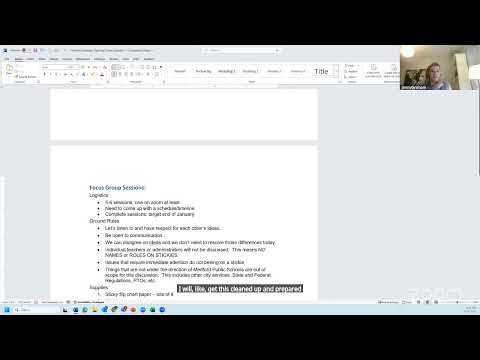
On logistics, the subcommittee discussed holding both in‑person and Zoom sessions and estimated starting with roughly five or six community meetings plus follow‑up Zoom sessions to dig deeper on priorities that emerge. Members noted the analysis workload that will follow high participation and flagged the need to monitor demographic representation so results do not reflect the same subset of respondents repeatedly.
The subcommittee also connected this work to the MSBA high‑school timeline: members said the district's educational plan is due in January and a preferred schematic design is expected later in the MSBA process. Members asked staff to query the architects and the owner's project manager about flexibility and scheduling so the strategic‑plan outreach can align with the high school visioning timeline.
Formal actions: the subcommittee voted to have staff finalize the draft survey and focus‑group materials for presentation to the full school committee on Monday; the mover and seconder were recorded and the motion passed unanimously. Later the subcommittee voted to adjourn 15 minutes early; that motion also passed unanimously.
The subcommittee asked staff to return with a cleaned‑up survey and a proposed schedule for community sessions and outreach channels. Members emphasized inclusion of students, non‑parent caregivers and Medford residents whose children attend other schools, and noted the need for translation and accommodations where possible.
Next steps: staff will revise the survey and the focus‑group agenda for the school committee meeting and coordinate timing with MSBA high‑school engagement. The committee did not adopt a final mission statement at the meeting; the work plan approved by the subcommittee is an input step toward drafting and later adopting an updated mission and strategic plan.