
California announces CalRx insulin to sell long-acting insulin at $55 retail starting Jan. 1
Get AI-powered insights, summaries, and transcripts
Sign Up Free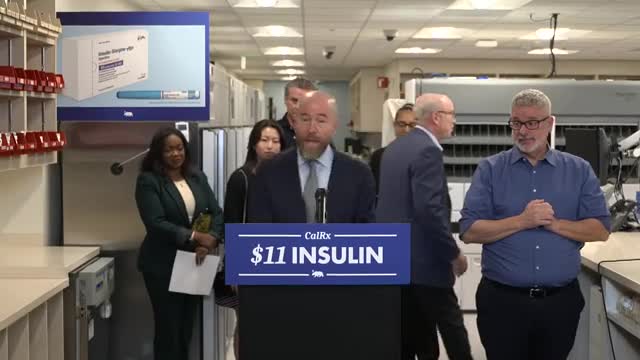
Summary
Gov. Gavin Newsom announced at Cedars-Sinai on Oct. 26 that California will make a long-acting insulin, insulin glargine (a biosimilar interchangeable with Lantus), available under the state-backed CalRx brand at pharmacies and by direct mail starting Jan. 1.
Gov. Gavin Newsom announced at Cedars-Sinai on Oct. 26 that California will make a long-acting insulin, insulin glargine (a biosimilar interchangeable with Lantus), available under the state-backed CalRx brand at pharmacies and by direct mail starting Jan. 1.
The announcement, made alongside Civica Rx executives, patient advocates and California Health and Human Services Secretary Kim Johnson, frames the CalRx insulin rollout as part of a broader state effort to lower prices for essential medicines. "January 1, we will be the first state to provide...lower cost insulin available to anyone and everyone at pharmacies and direct mail pharmacies all throughout the state of California. $11 per pen, $55, for a month's supply of this long lasting insulin," Gov. Gavin Newsom said.
Alan Cucko, identified in the event as chief government affairs and public policy officer of Civica Rx, said the product will be labeled CalRx in California and Civica insulin elsewhere. "Insulin should never be out of reach for those who need it," Cucko said, and he described Civica's pricing for the product as a list price of $45 for five pens with a maximum recommended retail price of $55.
Civica and state officials said the product is manufactured with partner Biocon Biologics and that wholesale distributors Syncora and Cardinal have agreed to help place the product in pharmacies. Civica said the package will include a QR code linking to the maximum recommended retail price for transparency.
Patient advocates at the event described the stakes for families who rely on insulin. Nikkita Kolom Harris, who described living with type 1 diabetes since 1999, said she was once out of insulin for five hours and was hospitalized in an intensive care unit for two weeks. "Nobody should feel that way," she said. Grace Peng, a high school senior who spoke about family members with diabetes, cited the governor's recent signature of Senate Bill 40 in saying the announcement gives families "hope."
State officials described CalRx as part of a larger suite of affordability efforts including naloxone distribution, school inhaler initiatives and an Office of Health Care Affordability created in 2022. Secretary Kim Johnson said the product launch "embodies California's vision of an equitable, transparently priced pharmaceutical market" and framed the rollout as one part of work to slow health-care cost growth and improve access.
Officials said insurers and health plans may independently decide whether to place the CalRx insulin on their formularies. Newsom and Civica representatives said they are in talks with large purchasers such as CalPERS and Medi-Cal, but precise savings to Medi-Cal members or other purchasers were not specified at the event. Cucko said discussions were ongoing and that exact Medi-Cal savings were "to be determined."
Newsom said the state seeded the initial phase of the effort with $50,000,000 and that the legislature has shown support for expanding the program. Officials said future CalRx targets include other drugs such as albuterol and fast-acting insulin formulations; several items require further FDA approvals or clinical trials outside the United States before wider distribution.
Organizers emphasized that the CalRx insulin offering is not a subsidy program but an effort to lower list prices and bypass intermediaries. Civica described the product as a long-acting biosimilar intended to increase competition in a market largely dominated by three companies, and noted that consumers with insurance may see lower out-of-pocket costs than the listed maximum.
Officials and presenters also said pharmacies across California will be able to order and dispense the product. Governor Newsom added that no new prescription would be required for patients to transition to the biosimilar where clinically appropriate, though officials advised patients to consult their providers or pharmacists about switching.
Questions remained about the size of the immediate impact on state programs and private insurers, and officials said more details about distribution, purchasing agreements and formulation approvals will be provided as those conversations progress.