Get Full Government Meeting Transcripts, Videos, & Alerts Forever!
Get email alerts on the Short Term Rentals topic
No spam. Unsubscribe anytime.
Pacifica council approves HomeAway voluntary collection agreement and HDL contract amid public questions about auditing and STR enforcement
Summary
The Pacifica City Council unanimously approved nine consent items Aug. 11, including a voluntary collection agreement (VCA) with HomeAway/VRBO and an expanded contract with vendor HDL for short-term rental (STR) administration. Public commenters and one council member pressed staff for details about privacy protections in the VCA and how HDL will:
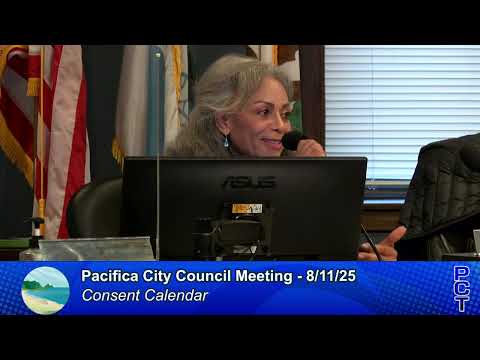
The Pacifica City Council unanimously approved its consent calendar Aug. 11, including a voluntary collection agreement (VCA) with HomeAway/VRBO to collect transient occupancy tax and an expanded contract with HDL to support short-term rental identification, monitoring and enforcement.
The vote completed a consent calendar that included nine items. Councilmember Beier moved to approve the consent agenda and Councilmember Wright seconded; the council vote was unanimous.
City staff and several members of the public discussed two items on the consent calendar at length during the meeting: the VCA with HomeAway/VRBO and the amended agreement with HDL, the city’s contractor for STR compliance work. Cindy Abbott, a Pacifica resident who spoke during public comment on consent items, urged the council to reconsider the VCA and the HDL contract and asked for clearer auditing and enforcement procedures.
“Item 6 of this agreement prevents the city from fully auditing the tax reporting of HomeAway stating that, quote, ‘HomeAway will not be required to disclose the homeowner or guest name, and the city shall not directly or indirectly audit any individual guest or homeowner relating to such transactions,’” Abbott told the council. She said the privacy provisions would make it harder to enforce the STR ordinance and to ensure transient occupancy taxes (TOT) are collected.
Assistant City Manager Yulia Carter responded that the city had negotiated with the Expedia/VRBO legal team for more than a year and that the language in the VCA reflects the platforms’ privacy limitations. “Neither Airbnb nor VRBO agreed to violate some of the privacy provisions, so they’re really strict about that,” Carter said. She also said the VCA nonetheless advances the city’s ability to collect TOT from platform bookings and noted other components of the STR program — platform accountability provisions in the city’s ordinance — will require platforms to list permit numbers and verify them before collecting taxes.
Councilmembers asked how auditing authority is preserved. Carter noted the city’s TOT ordinance gives the city the ability to audit transient operators who do not pay TOT directly, and she said the VCA’s limited platform disclosures do not eliminate the city’s other auditing tools.
On the HDL contract, Councilmember Espinosa sought clarification about the contract term and fees. Councilmembers and staff confirmed the HDL agreement is for two years with an option to extend one additional year, and that the new HDL contract adds a $24,700 line item for STR identification, monitoring, education, registration and compliance while increasing the base fixed amount from historical amounts to $125,000 plus contingency fees. Councilmember Espinosa asked whether the $125,000 sum is fixed or could vary with workload; staff said the new figure is a fixed base fee but the total annual cost will include ongoing contingency fees tied to recovery revenues.
Public commenters including Cindy Abbott and Caitlin Quinn also sought more detail on HDL’s methods for using platform data and on whether HDL will adopt an approach similar to San Francisco’s practice of monthly spreadsheets from Airbnb that allow cities to cross-check listings and enforcement.
City staff said the VCA and HDL negotiations were lengthy and that a VCA that platforms would sign was not guaranteed. Carter said staff was pleased platforms agreed to a deal and that other enforcement tools and the STR ordinance’s platform-accountability provisions would supplement the VCA and HDL contract.
Action: The consent calendar (items 1–9), including the VCA with HomeAway/VRBO and the HDL contract amendment, was approved unanimously (motion by Councilmember Beier; second by Councilmember Wright). The council recorded the consent vote as unanimous.
What the vote did and did not do: The council’s approval put into effect the VCA and the HDL contract as staff presented them. Council discussion and public comment left open unresolved questions about the VCA’s privacy provisions, how HDL will use platform data and whether the city’s auditing and enforcement approach will mirror methods used by other cities. Staff said the city retains auditing authority for transient operators under the TOT ordinance and that further refinements would require renegotiation with platforms or additional follow-up work by staff.
Looking ahead: Staff said the HDL contract and VCA can be amended in the future if the city wants to pursue additional access or new reporting provisions, and indicated the city could pursue separate enforcement or data-sharing agreements as the STR program is implemented.