
City department heads outline priority budget requests as council readies 2026 spending plan
Get AI-powered insights, summaries, and transcripts
Subscribe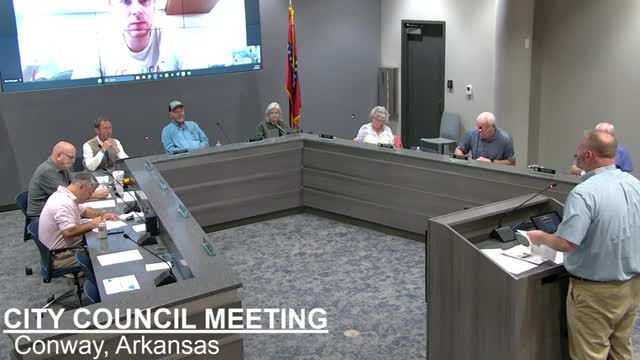
Summary
Department directors presented capital needs, staffing requests and program costs at a Conway City Council budget workshop, highlighting public-safety apparatus, parks and recreation facility operations, street overlays, animal-shelter improvements, and potential changes to employee health coverage.
Conway City Council heard a wide-ranging set of budget requests from department directors at a workshop Wednesday, with presentations emphasizing additional staffing, equipment replacements and capital repairs ahead of 2026 budget decisions and a public sales-tax question this fall.
Directors pressed for money to address immediate maintenance and safety needs — requests ranged from a new tractor and side-by-side utility vehicle for physical plant work to multi-million-dollar apparatus and ambulance investments for the fire department — while several departments also asked for pay adjustments to help retain staff.
Why it matters: Council members and staff said the city faces a short-term squeeze as routers, radios and vehicles age, major street projects and airport loan payments loom, and recruiting and retention pressures increase. Several department heads asked the council to consider targeted increases or new revenue options (including a sales tax measure on the November ballot and a possible business-license revenue stream) to prevent service gaps and reduce longer-term costs from deferred maintenance.
Most prominent requests
- Physical plant, code enforcement and animal services (Spencer Claussen): Claussen sought funds for equipment and personnel across physical plant and animal services. Specific asks included a John Deere tractor and attachments quoted at $32,912; a Kawasaki Mule SX side-by-side priced “All in $11,006.63”; $9,000 added overtime for the physical plant general fund line; restoration of printing/binding funding to $2,500; an increased building-maintenance allocation (noted historically at $16,000); and creation of a Maintenance Specialist I position with a stated salary of $36,771 to allow internal promotion and backfill. In animal services, Claussen requested a Kennel Tech II position, an adoption coordinator (cross-trained to work events and the front desk), infrastructure upgrades including synthetic turf estimated at $24,140 and a 36x30 A-frame carport at $7,290.08, and an adoption-trailer wrap quoted at $5,905. He also asked that call-out pay be aligned with the street department’s rate (transcript: “increase the call out pay to $4.50 a week”) and noted pay compression for code and animal officers (current base cited as ~$39,000) relative to state low-end averages.
- Fire apparatus, staffing and EMS options (Fire Department): Fire leaders outlined aging apparatus and personal-protective-equipment replacement needs (including SCBA replacement) and presented three staffing/capital options. The department said national staffing guidance implies Conway would need more personnel to meet a 1.8 firefighters-per-1,000-residents standard; chiefs estimated a 3-person minimum on engines would require hiring roughly 15 firefighters at a projected added payroll cost; a 4-person-per-apparatus standard would add more. The chief also described a possible municipal ambulance service scenario (six full-time ambulances plus reserves) with substantial upfront capital and multiyear recoupment estimates.
- Streets/transportation and major RDOT projects (Kurt Jones, Jacob Reynolds): Street staff summarized overlay programs and coordination with Conway Corporation on utilities and timing, noted large future obligations tied to state projects (including a Robbins/Harkrider intersection reconstruction) and warned of an expected annual overlay funding need substantially above current spending if the city wants to resurface its network on a 20-year cycle. Staff also reported a Union Pacific maintenance/annual-fee proposal for modified crossings they have been told could be about $30,000 annually for one intersection.
- Parks, community center and recreation (Jamie Bryce, Andrew Thames): The new community center reported strong early demand (about 2,200 new members and roughly 24,000 check-ins in the first weeks of operation, per staff). Bryce asked for modest capital and additional full-time lifeguard and maintenance staffing to stabilize operations and allow more in-house certification (WSI). Parks requested investments at Don Owen (concessions/restrooms in poor condition), additional grounds equipment and staff for the soccer complex, and capital priorities such as dugout/field improvements estimated previously in the $1.4M–$2.0M range depending on scope.
- Airport (Jacob Riley): Airport staff outlined a runway extension, scheduled FAA-funded projects, and equipment/maintenance needs; Riley noted a $600,000 loan tied to the airport that comes due next year and a multi-year program to bank FAA funds for future hangar construction.
- Permits/inspections and planning (Cecil Corning; Anne Tucker): Permits reported steady single-family activity and retirement-driven replacement needs; Corning asked to adjust a permits coordinator pay to $55,000 and planned continuing certification training. Planning outlined an ongoing zoning-code rewrite and said planning pays the full license for the local Tyler Technologies permitting subscription; Tucker projected the city’s share of planning and GIS subscriptions could be materially higher in 2026 (her packet overshot to $200,000 earlier but she later estimated nearer $30,000 increase tied to new modules).
- Sanitation and landfill (Joe Hopper): Hopper said the city’s landfill and material-recovery operation are strengths, reported cell construction nearing completion and asked council to consider a sinking-fund approach for future heavy capital (compactor/haul truck replacement), noting long vehicle lead times and sharply higher equipment costs.
- City attorney and court services (Charles Finkenbinder): The city attorney described courtroom space improvements completed with in-house physical plant work, credited an investigator position added earlier for outreach and school-bus safety efforts, and asked for one additional attorney and an administrative assistant to handle heavy trial workloads and increase collections and restitution for victims.
- Information technology and cybersecurity (Kevin McCoy): The IT director asked council to consider adding a security coordinator and to reclassify an existing project-manager role. McCoy outlined recurring software/subscription costs (cloud email/file storage, backup and endpoint security), the need for ongoing server and storage investment to accommodate body-worn-camera and other data growth, and an annual security-risk assessment and SaaS-security posture tools.
- Emergency communications / consolidated 911 (Sean Kent): Kent described the countywide 911 consolidation and the radio-system upgrade project (expected completion late 2026). He requested a public-safety systems technician to handle day-to-day radio and CAD administration and to support the upgrade, plus replacement vehicles to reduce use of borrowed patrol cars.
- Police (chief): Police leadership highlighted the contribution of license-plate and camera systems in solving crimes, ongoing overtime and fuel costs, ongoing vehicle replacement needs, and long-term space constraints at the police station; the department is continuing to expand LPR/ALPR camera coverage pending state permits.
- Human resources & health insurance (Mabry Williams; Hawkins consulting): HR reported employee satisfaction with the current Blue Cross Blue Shield Health Advantage plan and said the carrier offered a rate hold if the city did not issue an RFP. Council also heard a separately presented consultant option for a partially self-funded health plan: the consultant explained stop-loss insurance, third-party administration and financial mechanics that let an employer retain unspent premium dollars and potentially lower net costs over time. Staff noted timing constraints if the council wishes to pursue a change for 2026 (insurer and vendor timelines require quick action).
Council process and next steps
Council members asked follow-up questions throughout and encouraged department heads to prioritize capital-list scheduling so long-standing items are placed on a calendar rather than left open-ended. Finance staff warned the council that, if the city continues to assume a 3% sales-tax increase in its 2025 budget plan, actual receipts to date fall short of that assumption and the city may need to revert to a more conservative (flat) sales-tax projection approach when finalizing the 2026 budget. Finance also flagged two loan payments in 2026 that will stress the general fund unless new revenue is approved or prioritized otherwise: the airport loan (about $600,000) and increased debt service on recently financed fire apparatus (roughly $900,000–$1,000,000 depending on the structure).
No formal votes were taken at the workshop; department leaders were asked to return detailed cost breakdowns where numbers were preliminary and to work with finance on spacing capital items and staffing requests for council consideration in the formal budget adoption process.
Taper: Council staff said they will bring refined cost detail and revenue projections after September sales-tax receipts are published; the council also noted a November public vote on a proposed public-safety sales tax that could fund some capital needs if approved.