Get Full Government Meeting Transcripts, Videos, & Alerts Forever!
Get email alerts on the Spay Neuter Mobile Unit topic
No spam. Unsubscribe anytime.
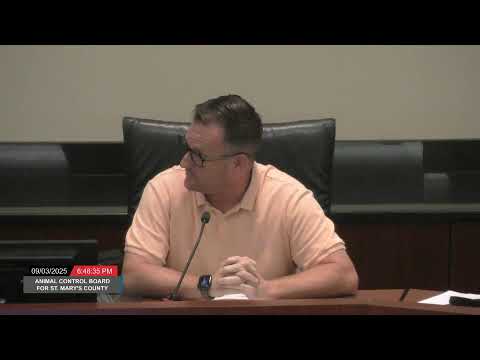
Advisory board opts against buying mobile spay/neuter unit, urges vet hire and equipment inventory
Summary
Members of the St. Mary's County Animal Control Advisory Board discussed mobile "neuter scooter" costs and staffing challenges Sept. 3, concluding the purchase is not feasible now and recommending a focus on hiring a veterinarian, inventorying existing equipment and preparing targeted budget requests.
St. Mary's County Animal Control Advisory Board members discussed whether to acquire a mobile spay/neuter surgical unit — often called a "neuter scooter" — during their Sept. 3 meeting and determined the cost and staffing risks make purchase impractical at this time. Members agreed the county should prioritize hiring a veterinarian and inventorying existing equipment so specific budget requests can be made.
Board Chair Steve Tuttle opened the discussion on the mobile unit after the group approved minutes from a prior meeting. A board presenter who researched mobile units told the group that two manufacturers dominate the market and the smallest functional 26-foot units start at roughly $200,000. Specific quotes reviewed by the board showed one vendor's base model at about $236,000 and a fully equipped example as high as $270,000; another vendor's figures ranged in the mid-$240,000s. The presenter said experience from other shelters — including a Roanoke Valley SPCA unit that was difficult to keep staffed — suggested buying a new unit could create an expensive, underused asset.
Why it matters: the board and staff said a mobile surgical unit would be expensive to acquire and to operate, and that equipment purchases for in‑shelter surgery require a veterinarian on staff to justify the cost and to ensure use. Members repeatedly emphasized that the county budget process requires line‑item quotes and clear operational justifications for equipment funding.
Board members discussed alternatives, including locating a used mobile unit and retrofitting an existing room in the shelter. One cost estimate referenced in the meeting for converting the room originally designed for a spay/neuter suite was approximately $700,000 (an estimate discussed two to three years ago). Several members noted that not all equipment must be purchased at once and that smaller acquisitions (autoclave, anesthesia machine, oxygen tanks, basic instruments) could allow the shelter to begin limited surgical work for far less than the seven‑figure retrofit estimate.
Staff and board members laid out a preparatory timeline tied to the county budget cycle: compile a full inventory of already purchased equipment (two dental units were reported as purchased and in storage), assemble vendor quotes for specific items, and prepare a detailed justification showing how in‑house surgery would reduce external surgical costs. The group asked staff to present an inventory at the board's November meeting so members could craft focused budget requests for the February budget-development cycle.
Board members also noted staffing considerations. Several members said a veterinarian placed on the payroll without surgical capacity would still have useful responsibilities (policy, community clinics, vaccination events), but agreed the strongest case for equipment funding is a hire plus a clear plan for surgical caseload and utilization.
Ending: The board concluded it will not pursue an immediate purchase of a new mobile spay/neuter unit. Instead, members directed staff to inventory existing equipment, continue recruitment for a veterinarian, and prepare specific equipment quotes and justifications for the next budget cycle.