Get Full Government Meeting Transcripts, Videos, & Alerts Forever!
Get email alerts on the Housing Policy topic
No spam. Unsubscribe anytime.
Council lays over moratorium on sober/supportive housing for study; public raises safety concerns at Kimball Court and council denies an appeal to convert a 12‑
Summary
Saint Paul officials held a public hearing on an interim moratorium on new sober‑house/supportive‑housing conversions and later denied an appeal to convert a 12‑resident sober house at 269 Harrison to supportive housing, upholding the Board of Zoning Appeals decision.
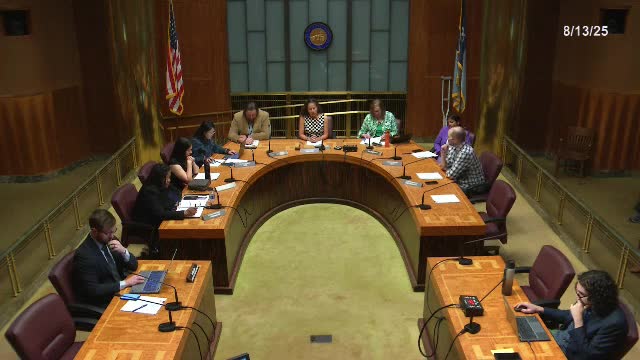
The Saint Paul City Council held a public hearing on an interim ordinance to place a moratorium on establishing or converting sober houses and supportive housing facilities pending a zoning study under Minnesota Statute 462.355, subdivision 4. The council closed the hearing and laid the ordinance over for final adoption on Aug. 20.
Several members of the public used the hearing to describe problems at Kimball Court, a permanent supportive housing program in Midway. Maisie Herling said she had submitted a report describing what she called unsafe and poorly run conditions, and urged the council to review the program as a case study. "The motto of Kimball Court could be 'accept, neglect, evict,'" Herling said in part, urging review of alleged operational failures.
Julie Hellock, who identified herself as a Hammond‑Midway resident, described allegations that Beacon Interfaith had altered the use of Kimball Court without appropriate zoning authorization, said the facility had experienced drug dealing and security problems, and recounted an April 2024 overdose death of a 26‑year‑old woman who had been a guest at the property. "She died of an overdose surrounded by needles after being a guest for nine days," Hellock said. The council invited written submissions and noted the public record could be supplemented.
Councilmember Provoatzky acknowledged constituents' concerns in Ward 4 and said state policy changes have produced a large volume of land-use applications requiring new local decisions; he described the moratorium as a policy tool forced by the scope of changes at the state level.
Separately, the council heard and decided an appeal (ABZA 2056) of a Board of Zoning Appeals denial that sought approval to convert a 12‑resident sober house at 269 Harrison Avenue into a 12‑resident supportive housing facility with on‑site services. City staff explained that, under the zoning code, supportive housing facilities are subject to a separation requirement of one quarter mile from certain congregate uses; the applicant's property was 804 feet from a shelter for battered persons and thus within the required separation. Staff also noted that a sober house is financially self‑supported and does not receive state or federal funding, a distinction that affects code classification.
The Board of Zoning Appeals denied the variance request after finding the applicant had not demonstrated "practical difficulties" or a property‑specific "plight" required to justify a variance. The city council reviewed the record and denied the appeal, finding no error in the BZA's procedure or fact findings. Council President Naker said she had reviewed the record and saw no error; she moved to deny the appeal. The vote to deny the appeal was 6‑0 in favor of upholding the BZA ruling.
Council members noted the difficulty created by changing state guidance on funding and the piecemeal pressure placed on municipalities. Several council members supported the moratorium so the city could complete a zoning study and craft consistent rules for such conversions. The moratorium was laid over for final adoption at the Aug. 20 meeting.