Get Full Government Meeting Transcripts, Videos, & Alerts Forever!
Get email alerts on the Rooftop Solar Net Export Policy topic
No spam. Unsubscribe anytime.
SFPUC proposes new net-export valuation for rooftop solar, aims to fund electrification incentives
Summary
San Francisco Public Utilities Commission staff proposed replacing retail-rate credits for exported rooftop solar with an avoided-cost-based valuation for new interconnections, while Clean Power SF and the city environment department discussed permitting, batteries and industry trends during a Commission on the Environment briefing.
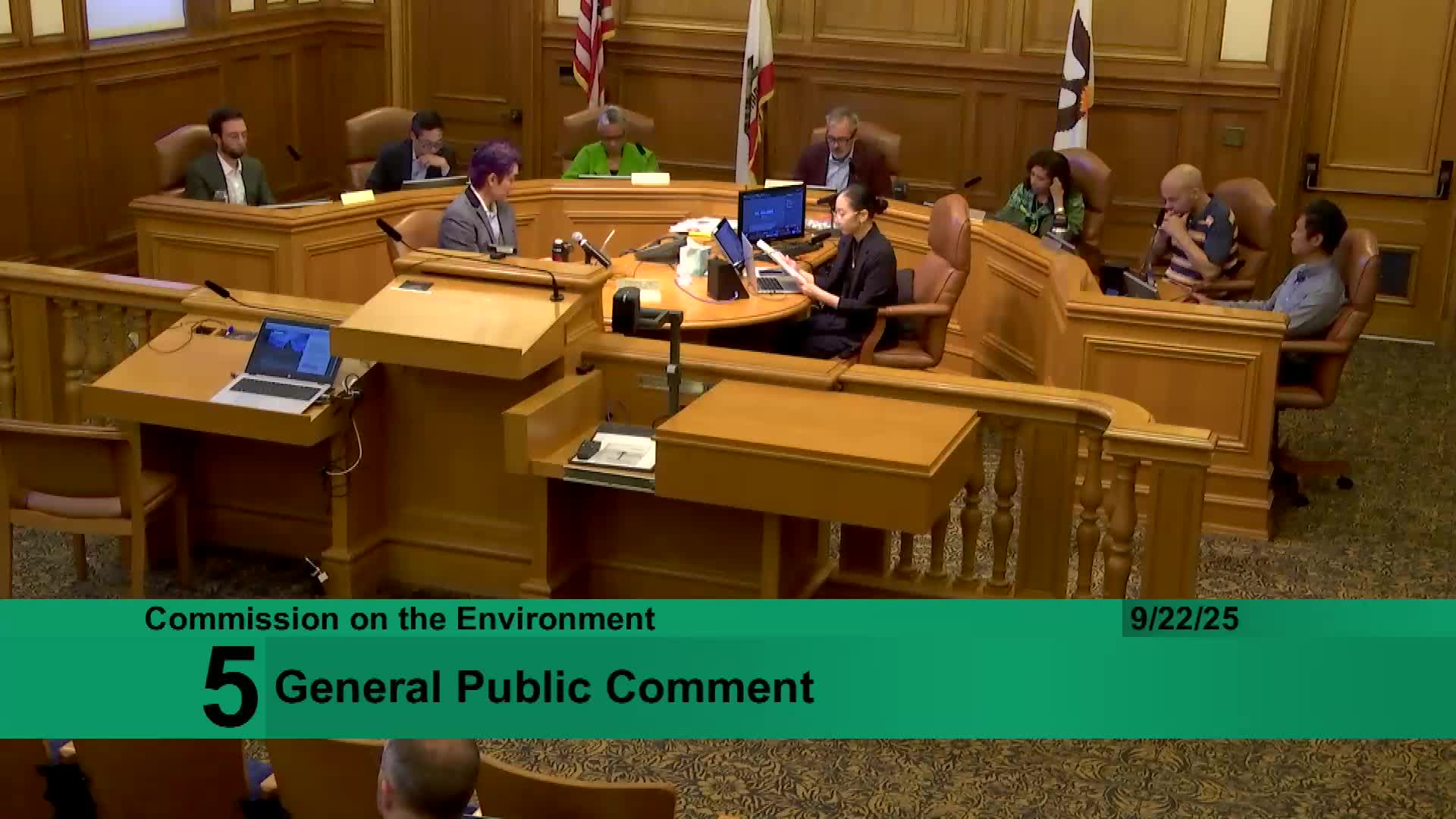
San Francisco Public Utilities Commission staff proposed changes to how rooftop solar exports are credited that would reduce retail-rate payments for surplus midday generation and redirect savings into electrification and storage incentives, speakers told the San Francisco Commission on the Environment on Sept. 22.
The proposal, described by Andrew Bevington, manager of the Clean Power SF customer solutions team at the San Francisco Public Utilities Commission (SFPUC), would limit the new tariff to solar interconnections approved after April 2023 or customers on PG&E’s solar billing plan and compensate surplus exports using a CPUC “avoided cost” calculator rather than full retail rates. "Under NEM we are now paying 12 times the wholesale energy market value of a kilowatt hour," Bevington said, summarizing the mismatch the SFPUC seeks to address.
The change aims to encourage customers to use more of the power they generate on-site — including through batteries and heat-pump technologies — instead of exporting surplus midday solar to a grid that increasingly has low wholesale prices during sunny hours, Bevington said. He said Clean Power SF would include an income-targeted adder for customers on the CARE/FERA programs and invest savings into programs such as a $1,200 bill credit for heat-pump water heaters and a residential battery incentive under development.
Why it matters: The vendor- and permitting-side context and how new export credits are calculated affect homeowner economics, industry jobs and the utility’s procurement costs. Clean Power SF staff said the change could save ratepayers about $300,000 in the first full year after adoption and grow to more than $1,000,000 annually as more customers take service under the new tariff.
Details and evidence from the meeting
Barry Hooper, senior green building coordinator at the San Francisco Environment Department (SFE), said the city has about 50 megawatts of residential rooftop solar and an additional 15 megawatts on commercial buildings, and that pairing solar with batteries produces the greatest resilience benefits. "We've cut our carbon emissions from operating in the residential sector by 50% in the last 35 years," Hooper said, adding that the remaining residential emissions come from natural-gas use and that predictable low-cost electricity helps heat-pump adoption.
Bevington laid out the staff rationale with hourly demand and wholesale-price examples, showing that wholesale prices often fall to a fraction of retail during sunny midday hours while evening prices spike. The SFPUC proposal would pay export credits closer to the wholesale value (using the CPUC avoided-cost tool) for surplus energy exported to the grid, while the retail value would still apply to solar energy used directly on-site. "If you use a kilowatt hour you generated, you don't have to purchase a kilowatt hour and import it," he said.
Bevington said the agency would keep a focus on equity by considering a roughly 4–5¢ per-kilowatt-hour adder for low-income customers and reserving program funds for electrification measures and storage incentives. He said Clean Power SF is revising the proposal based on input from a June public workshop and plans to bring a revised proposal to the SFPUC commission by the end of the year.
Industry perspective and permitting hurdles
Janine Cotter, co-founder of San Francisco design-build firm Luminalt, described local industry trends and permitting barriers. Cotter said San Francisco saw a long growth period after the GoSolarSF program launched around 2008, and that installations clustered in wealthier neighborhoods after the net-billing tariff and other market changes took effect. She also pointed to fire-department restrictions, extra local conditions that limit SolarAPP+ use, and new inspection requirements as factors that raised costs and slowed installations.
"We're finding people putting in batteries without getting permits," Cotter said, and she described field constraints such as required sheetrocking of garages and additional detectors that add installation cost. Cotter also noted that many installers left the market after 2023 and that 2025 midyear permit counts were substantially below 2024 levels.
Commission questions and outreach
Commissioners asked about program outreach, local jobs, and whether the proposed export valuation would provide a time-varying signal (higher value in evenings/summer) to address the so-called duck curve. Bevington said summer evening values are higher and that staff plan targeted communications to help customers shift consumption (for example charging EVs or running dishwashers during midday) and to explain the new credits.
The presentation also noted that about 93% of utility accounts in San Francisco are served by Clean Power SF, and that PG&E’s solar billing plan and Clean Power SF’s proposal are related because customers receive generation compensation from Clean Power SF and distribution compensation from PG&E.
Background and next steps
The SFPUC held industry and public sessions in 2024 and 2025 to solicit feedback. Bevington said staff would incorporate public comments before taking a revised tariff to the SFPUC rate-fairness board and then to the SFPUC commission, targeting a commission consideration by year-end.
Community and policy context
Speakers emphasized equity protections for low-income customers, the role of behind-the-meter storage for resilience, and the importance of permitting and fire-safety procedures for safe battery deployment. Industry speakers urged streamlining and clarified that local workforce programs historically supported local hiring during earlier incentive eras.
Planning and implications
If implemented, the proposed valuation change would reduce export credits for new interconnections compared with the full-retail NEM model and use some of the resulting savings for customer-directed electrification and storage incentives. SFPUC staff projected initial ratepayer savings and outlined a set of programs intended to increase on-site use of solar and manage grid impacts.