Get Full Government Meeting Transcripts, Videos, & Alerts Forever!
Get email alerts on the Community Needs Assessment topic
No spam. Unsubscribe anytime.
Maui County presents Community Needs Assessment Survey 2025; department to use findings in grants and outreach
Summary
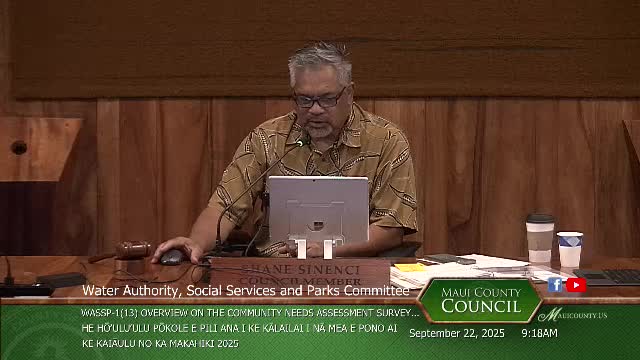
Maui County’s Department of Human Concerns presented the Community Needs Assessment Survey 2025 to the WASA Committee on Monday, Sept. 22, reporting results from a scientific survey of roughly 900 residents and outlining next steps for using the findings in grantmaking, outreach and program planning.
Maui County’s Department of Human Concerns presented the Community Needs Assessment Survey 2025 to the WASA Committee on Monday, Sept. 22, 2025, reporting results from a scientific survey of roughly 900 county residents and outlining next steps for using the findings in grantmaking, outreach and program planning.
The assessment, completed by contractor Anthology Marketing Group Inc., measured resident perceptions of county human services across nine districts and on topics including early childhood, services for seniors and people with disabilities, homelessness, immigrant services and volunteerism. Department officials said the report is intended to inform future policies, program development and resource allocation.
Survey findings cited by Deputy Director Jessica Krause and Anthology senior partner David Pettinger included strong public support for core human services (95% of respondents rated early childhood programs as very or somewhat important), generally high access to fundamental resources (valid ID, mailing address, smartphone/computer and transportation), and a notable digital access gap: about 9% of respondents reported lacking reliable internet. Krause told the committee that 34% of residents reported low confidence in their awareness of county programs and 63% of respondents who reported difficulty accessing county programs said that a lack of knowledge about available services was a primary barrier.
Krause described steps already taken to operationalize the report’s findings: division heads in the Department of Human Concerns have access to the full report; the department built the needs-assessment summary into its invitation-to-apply packet for the fiscal 2027–28 grant cycle to encourage alignment of applicants with documented community needs; the Early Childhood Resource Center convened a data walk in August to combine the survey with other sources; and the Immigrant Services Division is exploring mobile or satellite passport services to reach rural residents.
Committee members pressed Anthology and department staff on methodology, representativeness and next steps. David Pettinger said the survey used a scientific random-sample approach with mixed modes (telephone and online contact) and that the sample was later weighted by ethnicity to better reflect county demographics. Pettinger described the sample as “a 900 sample size survey” and said the design allowed analysis by region. He and Krause acknowledged limitations: the survey’s mixed-mode methodology and phone interview component yielded an older respondent profile (average respondent age reported in discussion as about 60; median about 62), and members asked how the county might better capture younger residents’ experiences.
Members asked about how the county would use the results for rural islands and specialized populations. Pettinger and Krause said the report highlights geographic differences and that some findings already informed localized efforts—for example, Molokai’s strong interest in distributing free books reflected high local engagement with the Dolly Parton Imagination Library. Committee members from Lānaʻi and Molokaʻi emphasized local constraints (limited physical space for services on Lānaʻi, transportation and staff shortages) and urged the department to continue pursuing mobile and outreach options.
Krause said the department is coordinating with the mayor’s office, the managing director’s office and communications staff to increase public awareness of available services. She also told the committee that grant reviewers in the department are using the assessment to evaluate incoming applications for alignment with identified community needs.
Anthology staff declined to recommend specific policy solutions; their scope was to collect and analyze resident perceptions. Committee members asked for further detail and follow-up research to better capture younger households and certain subpopulations, and Krause said divisions will conduct deeper dives as appropriate.
Formal actions recorded during the session included the committee’s designation of David Pettinger of Anthology Marketing Group as a resource under rule 18(a) of the council rules for this agenda item, and committee members agreed—without recorded objection—to defer further action on the item for follow-up and additional questions.
The presentation and committee discussion ran through questions about program awareness, service delivery in rural districts, and how the department will use the assessment when evaluating grant applications and shaping outreach plans. Department staff said they will provide follow-up information requested by members, including details on program capacity and coordination with state agencies.
The WASA Committee did not take final funding or program decisions at the Sept. 22 meeting; members closed public testimony, took questions, and agreed to defer the item for follow-up.
Sources: presentation by Deputy Director Jessica Krause and Anthology Marketing Group, public committee Q&A and public testimony at the WASA Committee meeting, Sept. 22, 2025.