Get Full Government Meeting Transcripts, Videos, & Alerts Forever!
Get email alerts on the School Capacity Planning topic
No spam. Unsubscribe anytime.
Capacity study warns of growth at Cooper, Stone Creek and Wynter; district to form committees for facility planning
Summary
Consultant RSP told the Derby Board of Education the district should expect enrollment growth over the next five years, with capacity pressures at Cooper, Stone Creek and Wynter (middle/elementary). The board will begin committee work and a Sept. 29 workshop to consider early learning, CTE, natatoriums and innovative spaces.
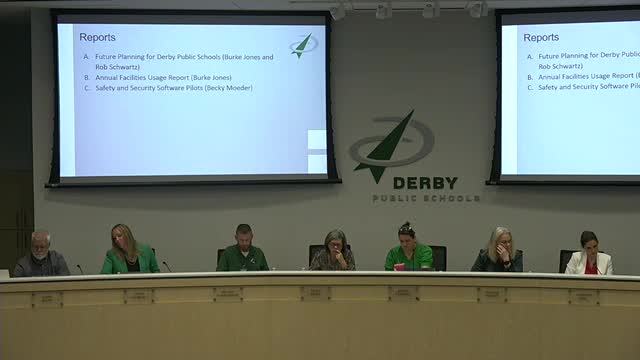
Rob Schwartz, an RSP consultant working with Derby Public Schools, told the Board of Education on Sept. 22 that the district’s enrollment is forecast to rise over the next five years and that several elementary and middle-school buildings will face capacity pressures.
Schwartz said the capacity analysis in the consultant’s packet shows particular constraints at Cooper, Stone Creek and Wynter (the transcript spelling varied). He told the board the study uses a functional-capacity methodology that distinguishes core classrooms, elective/noncore spaces and program-specific rooms (special education, ELL, music) and that the way those rooms are used materially lowers effective capacity compared with a simple classroom-count method.
“Functionally that we can provide the right programming with the way the programming is being delivered to students,” Schwartz said, summarizing the capacity approach. He noted the report presents a current functional-capacity range for Stone Creek of about 474 to 534 students, and a districtwide functional-service capacity of roughly 8,400 students, and that repurposing some program spaces could raise building capacity but would require trade-offs with intervention and other support areas.
The consultant also reported about 2,200 shovel‑ready housing units in the district’s planning inventory and described variable yield rates by housing type (single-family, multifamily, mobile home parks). Schwartz said yields and the timing of new construction affect when students from new housing appear in the district rolls.
Board members asked procedural and technical questions about how the capacity metrics are calculated. Director of operations Burke Jones said the district would gather board questions by Wednesday ahead of a workshop scheduled for Sept. 29 and an October 1 kickoff for committee work to evaluate early learning, high-school CTE, student activities/athletics, and innovative facility options. The district plans student panels for high-school perspective as part of the process.
Schwartz and Jones emphasized that capacity numbers are fluid and that repurposing rooms can alleviate short-term pressures but may create instructional-space trade-offs. The RSP team toured nine facilities, reviewed demographic and development maps, and will return to support the board and committee planning.
Next steps outlined in the packet include: committee meetings beginning Oct. 1, a board workshop on Sept. 29 focused on site tours and visioning, and follow-up reports that will align enrollment projections, planning-area development, and capacity scenarios.
Why it matters: the capacity analysis will guide district decisions about whether to add wings, relocate programs, create an early-learning center, or resize school assignments; administrators said the board’s strategic priorities (early learning, special education, high-school CTE, athletics and innovation) will steer next steps.
What the board asked for: members requested clarifying details on the methodology, the list of planning-area developments, and how program repurposing would affect intervention spaces; administrators said they will collect questions and return answers at the workshop or in the Oct. 1 committee kickoff.