Get Full Government Meeting Transcripts, Videos, & Alerts Forever!
Get email alerts on the Housing Density Bonus topic
No spam. Unsubscribe anytime.
Planning Commission recommends updating density bonus rules to align with state law
Summary
Humboldt County planning staff presented amendments to the county zoning code to bring local density-bonus provisions into conformity with state law; the Planning Commission voted to recommend adoption to the Board of Supervisors.
Humboldt County planning staff told the Planning Commission on Tuesday that proposed amendments to the county's density-bonus ordinance mainly bring local rules into alignment with state requirements, broaden eligible target households and clarify how incentive calculations and housing agreements are handled.
The proposal would: expand eligible target populations for set‑aside units to include lower‑income students, transitional foster youth (ages 18–21), disabled veterans and people experiencing homelessness; clarify that density bonuses are ministerial where state law requires them; adjust bonus percentages and caps; require equity‑sharing agreements for for‑sale affordable units and designate the Planning Director as the county’s agent for housing agreements. Planning staff recommended the commission forward the amendments to the Board of Supervisors with a finding that the changes are consistent with the general plan and exempt from environmental review.
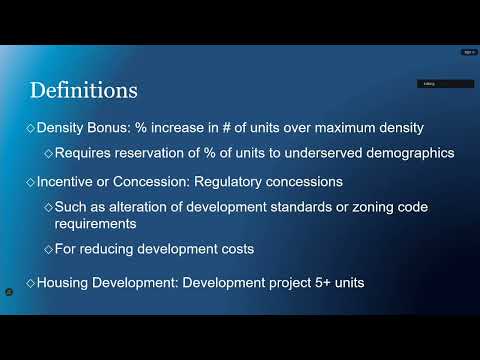
Why this matters: density bonuses increase the number of units that can be built on a site in exchange for reserving some units for underserved households. Local code must match state law to avoid legal conflict and to ensure developers obtain the ministerial review state law requires for some bonuses. The change affects how many bonus units a developer can receive and which household groups may qualify for set‑aside units.
Planner Augustus Grama explained the mechanics with a hypothetical: on a parcel with a 10‑unit maximum density, a 14 percent set‑aside would require roughly two reserved units and—depending on the bonus percentage—could translate into up to five additional bonus units after rounding. Grama told commissioners the code will also clarify that ‘‘actual cost reduction’’ (the state standard) is the correct test to qualify incentives, replacing the current local phrasing of ‘‘necessary for financial feasibility.’’
Commission discussion focused on enforcement and long‑term restrictions. Commissioner O'Neil asked whether the housing agreement imposing the set‑aside survives sale; Grama replied the obligation typically ‘‘passes to any buyer’’ and is enforced through the county’s density‑bonus housing agreement (and that state law generally requires a 55‑year term for such agreements). Commissioners also pressed staff about when applications are processed ministerially versus referred to the Planning Commission: staff said projects that request financial assistance or otherwise trigger discretionary approvals would come to the Commission, while simple ministerial approvals would be handled by the Planning Director.
The commission voted by voice to recommend that the Board of Supervisors adopt the amendments. The motion was made by Commissioner Muldaur and seconded by Commissioner Levy; no members voiced opposition.
Planning staff said they worked closely with County Counsel on the draft and noted that further adjustments (for example, raising bonus caps) could require additional CEQA review.
The item now goes to the Board of Supervisors for final consideration.