
School committee votes amendment to expand baseline concussion testing to all sports, then tables policy for policy-subcommittee review
Get AI-powered insights, summaries, and transcripts
Subscribe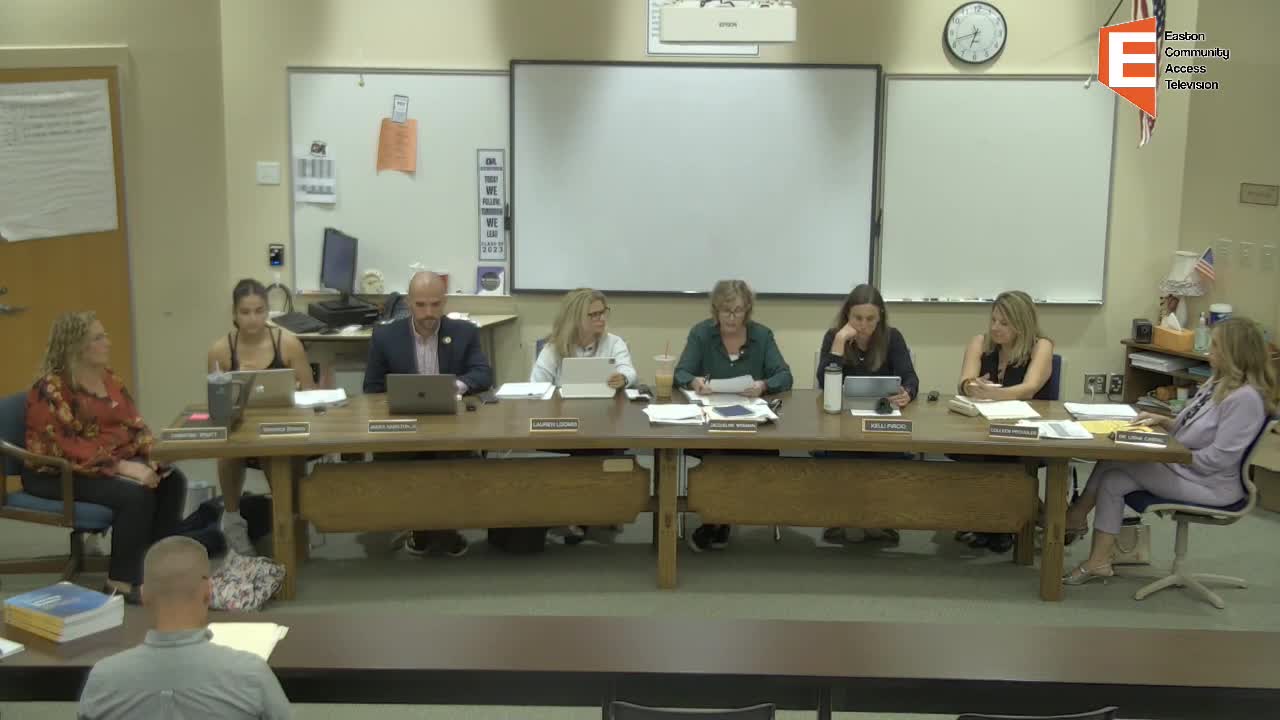
Summary
After debate on costs, equity and opt-out mechanics, the Easton School Committee voted to amend policy JJIF/JJIF‑R to include baseline concussion testing for all sports but later voted to table the policy and asked the policy subcommittee to draft clearer language on opt-outs and implementation.
The Easton School Committee voted on Sept. 18 to amend district policy JJIF and JJIF‑R to require baseline concussion (impact) testing for students participating in all school sports, but committee members later voted to table final adoption and referred the policy language to the policy subcommittee for revision.
The discussion, which included the athletic director and the district’s athletic trainer by consultation, centered on whether baseline testing should be limited to collision/contact sports or extended to all athletes. Mary McDonald, the district athletic director, described the baseline tests as an online assessment that takes about 20 to 30 minutes and currently is required for the district’s collision and contact sports. She said the purpose of baseline testing is to provide a pre-injury reference for the trainer when managing return-to-play decisions.
"Ultimately, anyone can have a concussion," McDonald told the committee and said that, in principle, testing all athletes would be feasible but would increase costs. When asked for a cost estimate, she said, "My guess would be maybe an additional thousand dollars roughly," for the district to expand testing beyond currently mandated sports.
Committee members raised implementation questions including whether multi-sport athletes need repeat testing each season (McDonald said testing is done once and is valid for two years) and whether parents should have an opt-out option. McDonald said that district trainers follow return-to-play protocols regardless of whether a baseline test exists and that the baseline is an additional tool used during medical clearance.
A public commenter with swimmers in the district, Christie McDonough of 14 Cedar Drive, urged the district to include swimmers and divers when determining which sports are considered collision sports because she has seen head injuries at swim meets and said her college swimmer was required to complete baseline testing by the NCAA.
After discussion, committee member Lauren moved to amend JJIF and JJIF‑R to include all sports; that motion was seconded and passed on a voice vote. Later in the meeting the committee voted to table the policy and asked the policy subcommittee to draft clearer implementation language, including whether parents may opt out and how additional costs would be addressed; the committee scheduled a policy-subcommittee review on Sept. 30 and directed staff to return with recommended language.
The committee did not finalize whether the expanded baseline testing would be mandatory or allow parental opt-out; several members flagged the timing problem that formal policy amendments require two readings, which could delay an individual athlete’s ability to participate if the committee tried to finalize opt-out rules immediately.
No precise vote tallies were recorded on the floor for the amendment or the tabling motion; committee members used standard "all in favor" voice votes for most motions during the meeting. The athletic director said the district can implement expanded testing if funds are made available or if the committee chooses a phased approach and that the athletic trainer recommended testing all athletes but acknowledged practical trade-offs.
The committee asked staff to bring draft policy language to the policy subcommittee and return to the full committee with suggested language and budget implications.