Get Full Government Meeting Transcripts, Videos, & Alerts Forever!
Get email alerts on the Climate Comprehensive Plan topic
No spam. Unsubscribe anytime.
Clark County staff outline proposed climate element, recommend 32 goals and 100+ policies
Summary
Clark County staff presented a consolidated climate element—combining resilience and greenhouse-gas reduction policies—recommending 32 goals and more than 100 policies for the comprehensive plan periodic update and described next steps toward adoption and implementation.
Clark County planning staff on an informational call described a consolidated climate element for the county comprehensive plan and said a community advisory group recommended 32 goals and over 100 policies to move into the local adoption process.
Project manager Jenna Kaye, a long-range land use planner with Clark County Community Planning, said the consolidated policy list merges separate resilience and greenhouse-gas-reduction drafts after staff and consultants identified substantial overlap. Kaye said the policies are intended to meet the requirements of House Bill 1181 and to guide 20-year resilience and emissions-reduction work in unincorporated Clark County.
The proposed policies cover health and well-being, green jobs, ecological stewardship, transportation and land use, building and energy, waste management and county governance. Kaye said the list includes actions that address environmental justice, consultation with tribal governments including the Cowlitz Indian Tribe, urban heat island effects, trees and plantings, reducing vehicle miles traveled, energy efficiency in buildings, and waste reduction measures.
Why it matters: House Bill 1181 added a climate change and resiliency goal to Washington’s Growth Management Act and requires counties to adopt a climate element; Kaye said the county has a mandatory implementation date “by the end of this year” as stated in the meeting and is preparing policies and implementation sequencing to meet that obligation. Because the climate element is part of the county’s comprehensive plan periodic update, the item will go through the same planning commission and county council adoption process as the broader update.
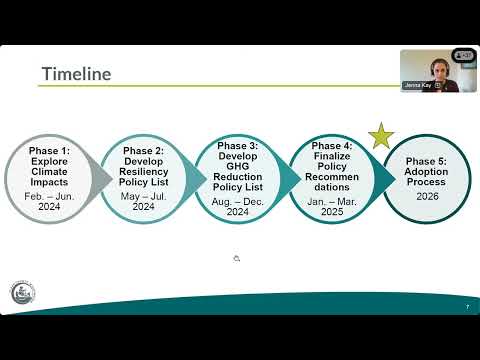
Staff described the project timeline and next steps. Kaye said the community advisory group and an environmental justice coalition led iterative drafting and review; consultants audited existing county policies and performed a high-level scoring of draft policies to prioritize further analysis. The advisory group then used a consensus-based process to recommend the final package for staff to carry forward to the planning commission and county council. Kaye said the county is running behind the original schedule and currently estimates adoption near 2026.
Kaye described different participation paths for stakeholders: state agencies can expect a 60-day notice of the comprehensive plan periodic update (anticipated to be submitted to the Washington Department of Commerce early in 2026) and were invited to submit formal comments to the planning commission and county council; partner agencies and other noncounty organizations were encouraged to sign up for comp-plan notifications and to testify during hearings; and county departments were told staff will organize internal meetings to coordinate implementation across departments once the council adopts the element.
Public-health data on extreme heat was raised during the meeting. Kaye said Clark County Public Health ran a 2024 heat-watch campaign and the county now has more granular heat data than it had previously; she said the comprehensive-plan policies are intentionally written at a higher, guiding level and that the new heat data will be used during implementation to develop and prioritize specific heat-mitigation and response actions.
Kaye said the county coordinated with city jurisdictions, including the City of Vancouver, and used shared consultants and methodologies for greenhouse-gas inventories and resilience analyses. She said some proposed climate policies are placed in a new dedicated climate chapter while other policies will be integrated into existing elements (land use, housing, environment, transportation, capital facilities and utilities, parks and open space), and that any policy will be labeled with whether it supports greenhouse-gas reduction (GHG), resilience (RES), or both.
There were questions from meeting participants about how state agencies might support county-level interagency coordination (for example, among emergency management, public health and ecology) and about how the county’s heat-watch data would inform policy implementation. Kaye said she expects state agency partnerships and additional technical support will be important during implementation and that public-health colleagues are already using the heat data.
Kaye said staff will post the advisory-group recommendation and policy tables on the county web site and that planning commission and county council work sessions on the topic are recorded and posted online. She closed by saying staff will not reconvene the entire stakeholder group but will intersect with participants through the adoption hearings and implementation partnerships.
Ending: Staff said they will share the meeting slides and links to proposed policy language and encouraged interested parties to sign up for comprehensive-plan notifications and to provide comments during the upcoming adoption process.