Get Full Government Meeting Transcripts, Videos, & Alerts Forever!
Get email alerts on the Tobacco Regulation topic
No spam. Unsubscribe anytime.
National City adopts tobacco retail licensing ordinance after contentious public hearing
Summary
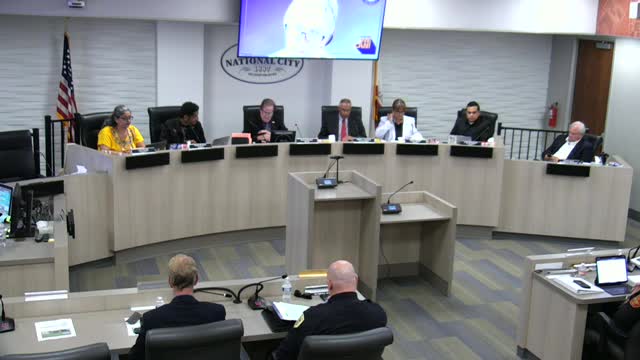
After more than two hours of public testimony from business owners, health advocates and residents, the City Council voted 3–2 to adopt a tobacco retail licensing (TRL) ordinance that sets location limits and a compliance regime for sellers of tobacco and vaping products.
National City’s City Council adopted a new tobacco retail licensing ordinance after a long public hearing that drew more than two dozen speakers for and against the measure.
The newly adopted ordinance establishes a city-issued tobacco retail license, sets a cap on the number of retail licenses, creates distance limits from sensitive uses, and defines a multi-part compliance program. The council’s final vote to adopt the ordinance was 3–2.
Supporters told council the licensing program is needed to reduce youth access to flavored nicotine products and strengthen local enforcement. “Tobacco retail licensing is not about punishing small businesses, it’s about accountability, ensuring retailers adhere to laws, protecting kids, reducing exposure to harmful products,” said Megan Stewart, a youth-prevention advocate. Irma Hernandez, chair of the local National City for a Better Health Coalition, told the council that “if you are responsible, then you’d have nothing to worry about” under the new rules.
Public-health organizations and county advocates also spoke in favor. Emily Miller, Community Impact Director for the American Heart Association in San Diego, urged the council to require more frequent “decoy” checks of sales to underage decoys. Blythe Young of the American Heart Association and Lena Delgado Flores of the American Lung Association urged the council to make annual checks routine and to fund enforcement through licensing fees.
Opponents — primarily owners of small, long-standing convenience and liquor stores — argued the ordinance would strip the value from businesses by preventing transfers of the license and by imposing restrictive distance rules. “This is my retirement,” said Jack Bazzi, owner of Cozines Market, and warned that if owners could not transfer a license to a buyer the business would become unsellable. Several other business owners repeated that concern and said the proposed transfer restriction would disproportionately harm family-run stores.
City staff and the council debated multiple technical points during the hearing. Acting Community Development Director Martin Reeder told council that the ordinance contains two different kinds of checks: a staff-initiated inspection and a separate “decoy” compliance check that uses underage decoys. He said the code as written requires staff to conduct at least one compliance inspection per year for each licensed retailer; the ordinance also describes decoy checks, which the council had discussed earlier in the process as taking place at a lower frequency (one decoy check every two years unless additional checks are required).
After nearly three hours of public comment and two rounds of council discussion — including an unsuccessful substitute motion to change the ordinance’s transfer prohibition — the council voted to adopt the ordinance as presented by staff. The ordinance establishes the licensing program, the cap on number of licenses, distance limits from specified “sensitive uses,” and a graduated penalty structure tied to the compliance checks.
Councilmembers who supported the ordinance said the city needs a local enforcement tool to reduce illegal sales to minors and to back up state law and FDA enforcement actions. Councilmembers who voted against the measure said they were concerned about the effect on small, family-run businesses and asked staff to report implementation details and impacts back to council after the ordinance takes effect.
The ordinance will take effect 30 days after adoption. City staff indicated they will publish application and fee details, and that the licensing fee is expected to help fund inspections and enforcement. Councilmembers and staff said they plan follow-up reporting on program implementation, enforcement staffing, and the initial compliance-check results.
Votes at a glance - Action: Adopt ordinance creating a tobacco retail licensing program for retailers of tobacco and vaping products in National City. - Vote: 3 in favor, 2 opposed. - Outcome: Adopted; ordinance becomes effective 30 days after adoption.
Discussion vs. decision - Discussion: Residents, storeowners, public-health groups and retailers debated youth access to flavored nicotine products, the role of decoy compliance checks, and whether license transfers should be allowed. - Direction: Staff to publish license application process and fees, and to implement the inspection program described in the ordinance. - Decision: Council adopted the ordinance as presented by staff.
Why it matters The new TRL gives National City a local enforcement tool to monitor and penalize illegal sales, restrict locations and densities of tobacco retailers near schools and youth-serving sites, and fund inspections through licensing fees. Proponents say the program targets youth vaping; opponents say key provisions will harm long-running, family-owned small businesses and reduce the resale value of their businesses.
What’s next Staff will post application and fee information, implement the inspection schedule (staff inspections plus decoy checks as described), and return to council with implementation updates. Public commenters and business groups may pursue further engagement with the city about transfer rules and penalties.
Attributions Quotes in this article come from public comments and staff testimony reported on the council record: Irma Hernandez (chair, National City for a Better Health Coalition), Megan Stewart (youth prevention advocate), Martin Reeder (Acting Director, Community Development), Emily Miller (American Heart Association, San Diego), Blythe Young (American Heart Association), Lena Delgado Flores (American Lung Association), Jack Bazzi (Cozines Market owner), Arcan Somo (Neighborhood Market Association), and other public speakers as noted on the official meeting record.