Get Full Government Meeting Transcripts, Videos, & Alerts Forever!
Get email alerts on the Strategic Budgeting topic
No spam. Unsubscribe anytime.
Council begins strategic budget review as staff warns reserves could fall below 25% in 2–4 years
Summary
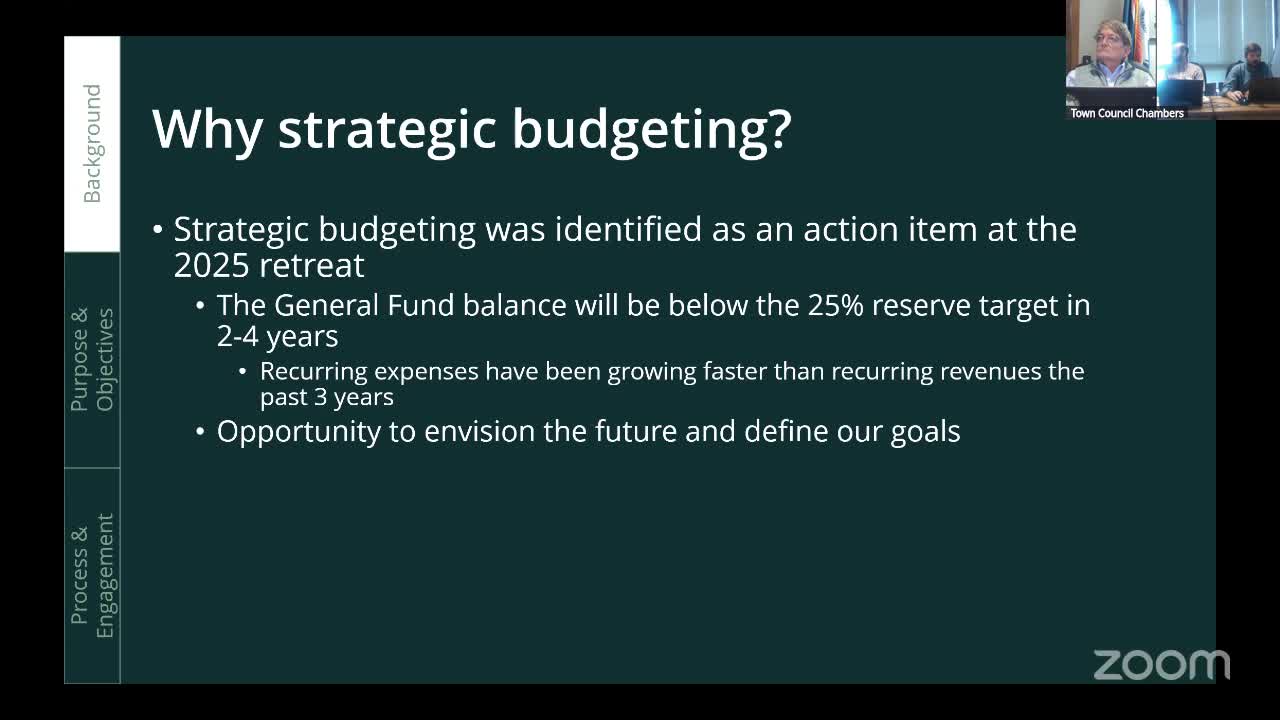
At a special council workshop on Sept. 16, staff urged the council to undertake a multi‑year strategic budgeting process after projecting the town’s general‑fund reserve could fall below its 25% target in two to four years.
At a special council workshop on Sept. 16, staff urged the council to undertake a multi‑year strategic budgeting process after projecting the town’s general‑fund reserve could fall below its 25% target in two to four years.
The warning came as Tyler (staff member) summarized staff’s fiscal outlook and stressed the timing and choices ahead. “The general fund balance will be below [the] 25% reserve target in 2 to 4 years,” Tyler said, and added the problem combines two related imbalances: recurring expenditures that now exceed recurring revenues, and expenditures that are growing faster than revenues.
The nut of the presentation was that the town’s unusually large reserves built during the COVID years have declined as recurring expenses — primarily compensation, added staff and higher capital and operating costs — outpaced the return to normal revenue growth. Tyler told the council that while FY26 numbers in the packet show revenues at 36.3 and expenditures at 39 (units not specified in the staff presentation), the pattern of a revenue/expenditure gap and drawdowns in the fund balance persisted across projection scenarios.
Staff described a four‑step strategic budgeting process: (1) confirm budget inputs and projections, (2) model future scenarios (status quo, “doing more,” and “doing less”), (3) develop an explicit budget philosophy to guide tradeoffs, and (4) prepare an action plan and contingency (plan A, B, C). The slides and discussion emphasized that decisions about long‑term remedies — including voter‑directed revenue measures — take time and will affect the timing of implementation.
On causes, Kelly Thompson, finance director, attributed the higher expenditures to compensation increases, higher labor and consultant costs, medical benefits and inflationary pressure across capital and operating budgets. “It’s consistent with the compensation across the board,” Thompson said. Staff also noted the council has increased programmatic spending in housing, transportation and conservation without securing legally dedicated long‑term revenue streams those programs would require.
Council members pressed for more detail on the drivers of expense growth and asked staff to break out how much of the general fund supports housing, transportation and conservation programs. Councilor Schechter and others said they want a clearer accounting of where added staff and compensation increases explain the delta between revenue growth (roughly 3–4% historically) and recent expenditure growth (often in the 6–8% range in recent years, per staff remarks).
Staff recommended the council decide soon whether to include robust public engagement in the process. The presentation outlined two engagement levels: “inform” (regular public updates) and “consult” (surveys and workshops to solicit public priorities and willingness to pay). Staff cautioned that meaningful consult‑level engagement requires time and resources and recommended the council decide early if it wants that approach so it can be done well. Several councilors said they are open to engagement but wary of a costly, unfocused effort that would not produce actionable guidance.
On timing staff proposed a multi‑month sequence: finish technical inputs and scenario work in the fall, consider broader public engagement through late fall, aim to refine budget philosophy and an initial action plan in early 2026, and leave open the option of a voter measure in November 2026 if the council chooses a revenue path that requires voter approval. Staff noted certain statutory and election deadlines (staff cited June 2026 as a deadline for placing items on a November 2026 ballot), and said exact dates and paths will determine whether measures could affect the FY27 operating budget.
Council discussion covered tradeoffs. Some members urged the council to finalize a budget philosophy early so it can guide choices; others preferred to see scenarios and technical inputs first and to postpone broad public consultation until recommended options were clearer. Councilor Beaman and others urged outreach that reaches beyond the “usual” voices; Councilor Schechter and others warned that consultation done hastily can be expensive and produce little actionable information.
As next steps staff will return with a tightened scope for the next workshop, a proposed timeline and more detailed breakdowns of expense drivers and program spending. The council scheduled a follow‑up special meeting for the ‘‘20 third’’ date on staff’s list at 9 a.m. (staff will circulate the confirmed calendar date), and staff said they will meet individually with council members to refine the next meeting’s materials.
The meeting concluded when a motion to adjourn to executive session pursuant to Wyoming statute 16‑4‑405(a) on matters concerning litigation was made and seconded; the motion passed unanimously.
What the council did not decide: no formal revenue measure or specific cuts were approved at the workshop; staff and the council left several technical questions for the next round of briefing materials and asked staff to scope the cost and design of any consult‑level public engagement before returning with a recommendation.
Ending: Staff and council members agreed to continue the iterative process. Staff said the effort will include scenario modeling, possible outside experts to review projections and, if directed, a public engagement program designed to gather community priorities and willingness to pay. The council will revisit the work in a follow‑up meeting and in additional briefings before making any binding decisions on revenues or service levels.