Get Full Government Meeting Transcripts, Videos, & Alerts Forever!
Get email alerts on the Career Technical Education topic
No spam. Unsubscribe anytime.
Camas board hears annual CTE update; advisory input, certifications, parent involvement named priorities
Summary
District staff presented the required annual career and technical education (CTE) program evaluation and outlined three priority goals for the upcoming five‑year plan: boost local parental involvement in advisories, rebuild college articulation agreements, and expand industry certification access.
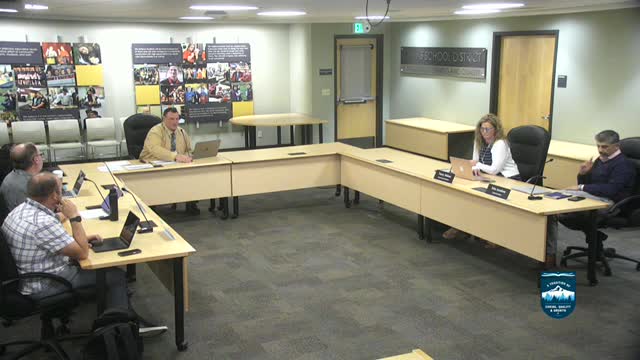
The Camas School District Board of Directors on Tuesday heard the district’s annual career and technical education program update from Derek (CTE staff member), who reviewed the program evaluation used to set priorities for the district’s five‑year CTE plan required by state and federal rules.
Derek said the evaluation is compiled by local advisory groups and district staff, and that the report will feed the five‑year plan the board will be asked to approve at the next regular meeting. "This is our annual CTE program update," he said. "This is probably the favorite part of my job. I love CTE." He told the board the district uses the advisory feedback to rank program areas on a four‑point scale and then target lower‑scoring items for improvement.
Why it matters: CTE programs are structured around federal Carl Perkins guidance and state OSPI frameworks; the district must review and submit program frameworks and the five‑year plan for federal compliance. Derek told the board that, nationally, Carl Perkins funding was not reduced in the current federal budget negotiations, and that OSPI remains the state organizer for CTE frameworks.
Board members were given a summary spreadsheet of program review results and the district’s proposed goals. The advisory evaluation highlighted three primary areas for 2025–26: rebuilding local parental involvement in program advisories, restoring articulation/equivalency agreements with postsecondary partners, and expanding industry certification opportunities for students.
Advisory structure and parental participation Derek described two advisory structures the district uses: local program advisories (by program area) and a regional advisory that pools industry partners from across Clark County. He said the regional approach has brought resources and opportunities — for example, a regional construction “grade 13” hiring event and student projects such as small toolboxes — but that the district wants to increase local parent participation in advisories to strengthen school‑level connections.
"Part of our goal is to include more parents, try and cast a wide net," Derek said, adding that the district will send communications to recruit parents to the advisory process. He also noted strong parental involvement in CTE extracurricular organizations — DECA, SkillsUSA, FIRST Robotics, and Science Olympiad — even where classroom parental participation is lower.
Articulation agreements and equivalency credit Derek told the board the district’s articulations with local colleges have shrunk over the last decade: "When I first came to Camas in 2012, we had 16 articulations with Clark, and now we have 4." He said college‑in‑high‑school programs and shifting postsecondary approaches changed how dual credit and CTE articulations operate. The district will pursue rebuilding articulations with Clark College and maintain relationships with partners such as Perry Technical Institute and Cascadia, which offer deeper industry certification programs.
Industry certifications and costs The presentation described current certification activity (first aid/CPR, BLS, food handler cards) and identified higher‑cost certifications as a barrier. Derek said some technical certifications (for example, CAD testing) can range from about $1,200 to $1,600 per student, which the district does not currently cover. The planned goals include expanding access to lower‑cost, industry‑recognized certificates (for example OSHA‑10) and exploring how to fund higher‑cost exams.
Program highlights and outcomes Derek highlighted program successes, including a large DECA chapter at Camas High School. He said "well over 200 students" participated in DECA last year; 157 qualified for state competition and 31 advanced to nationals. He also noted Discovery High School’s Maker Faire and regional partnerships that bring business mentors and internships into classrooms. Derek said the district passed its most recent Consolidated Program Review (CPR) from OSPI.
Logistics and next steps Derek told the board he will include the five‑year plan document for board approval on the consent agenda at the next meeting to satisfy federal compliance and grant requirements. The board did not take formal action during the update; Derek closed the presentation by asking for questions and offering to accept feedback as the team prepares the formal five‑year submission.
Ending Board members praised instructors and community partners cited in the update and discussed outreach and next steps, including an October advisory meeting open to parents and community partners. The board will see the CTE five‑year plan on the consent agenda at the next regular meeting.