Get Full Government Meeting Transcripts, Videos, & Alerts Forever!
Get email alerts on the Capital Plan Transportation topic
No spam. Unsubscribe anytime.
Board reviews five-year capital plan; transportation requests larger recurring bus funding
Summary
District staff presented a draft five-year capital plan and outlined transportation fleet needs, including a request for $4 million a year to support a 10-year rolling bus-replacement program.
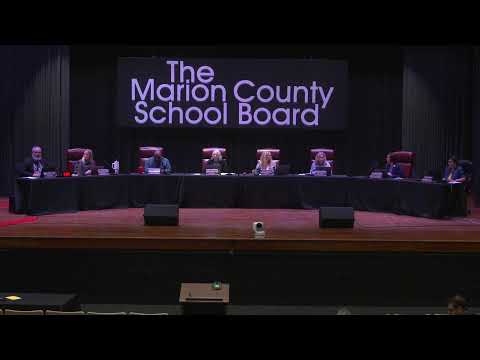
Marion County Public Schools staff presented a draft five-year capital plan during the Sept. 4 administrative work session and briefed the board on transportation fleet needs and major maintenance priorities.
Ms. Usher introduced the capital plan, summarizing statutory reporting requirements and the district’s revenue projections. She said the projected revenue for 2025–26 is about $114 million, and noted new and returning revenue sources including impact fees, a reinstated local sales surtax and local capital improvement millage. “Under the millage, the local capital improvement millage … we received about $6,000,000 more in millage than last year,” Ms. Usher said.
Transportation supervisor Mr. Stanek told the board the district currently operates 249 routes and keeps 12 spare buses. He said the fleet accumulates roughly 33,000 miles daily across all routes and that manufacturer warranties generally cover components up to roughly 100,000 miles. “Mileage wise, we are … I think it’s like 33,000 miles a day that we’re running,” Stanek said. He described an industry goal to refresh about 10% of the fleet each year so the average bus age remains within a 10- to 12-year target and noted that new buses cost roughly $165,000 each.
Stanek requested a $4,000,000 annual appropriation to support continuous fleet replacement; the board said it had budgeted $3,000,000 for the year and discussed the difficulty of negotiating warranty terms on state-bid vehicles. Board members asked staff to explore extended-warranty options and to identify funding sources that could sustain a rolling replacement program.
The facilities team led by director Yvonne Wambach and Ms. Usher then reviewed noncapacity (minor and major maintenance) and capacity projects. Funded projects this year include HVAC upgrades at Bellevue Middle (initial $1,000,000 allocation to start design/construction), a Dunnellon High well-house replacement (rollover project), bus-loop canopy repairs at Emil Schwartz and Shady Hill, a Greenway Elementary cooling-tower replacement and a new data center design kickoff. The list also included roof replacements, playground funding and athletic capital needs; the board directed staff to provide an itemized list for the $2,000,000 athletic allocation.
Staff explained how sales surtax proceeds, impact fees and local millage are being allocated among debt service, noncapacity maintenance and new capacity projects. Ms. Usher also said the district’s consultants (JB Pro and Roth EMS) are providing student-generation and facility-condition assessments to refine capacity and maintenance timing. The presentation outlined longer-range capacity projects such as a new middle-high campus in Dunnellon, a new high school (South Marion High) continuing through GMPs, Bellevue Elementary (sales tax-funded), and pre-K–8 options in the southwest area.
Board members raised concerns about the interplay among projected residential permitting, impact-fee revenue and capacity planning; several asked staff to provide clearer slides showing where additional maintenance funding for the later years is coming from. Staff said the distribution among categories varies year to year depending on capacity projects and FF&E costs for new schools.
No formal votes were recorded on the capital plan at the work session; staff will return with additional detail for board review at future meetings and will present specific contract/GMP items when ready.