Get Full Government Meeting Transcripts, Videos, & Alerts Forever!
Get email alerts on the Flooding topic
No spam. Unsubscribe anytime.
Austin officials outline flood-readiness steps after July storms
Summary
Watershed Protection and Austin Homeland Security & Emergency Management briefed council on flood history, recent storm responses, mapping updates, alerting authority and capital needs; staff reiterated outreach and grant-seeking while council pressed for bond and grant strategies.
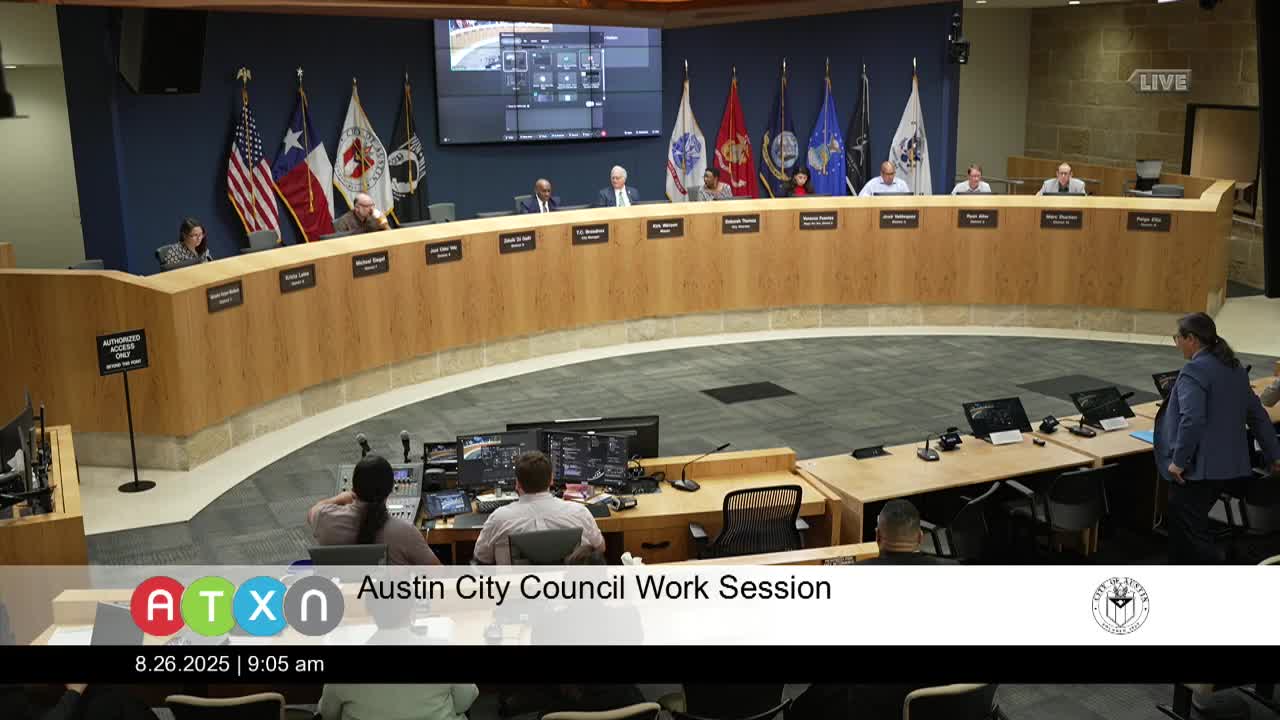
City officials told the Austin City Council on Aug. 26 that flood readiness remains a top priority after heavy storms this summer, outlining recent emergency responses, capital projects, regulatory work and public outreach aimed at reducing risk to lives and property.
"This particular item, related to flood readiness, is very important, to us as well as our residents," Watershed Protection Department Director Jorge Morales said as he opened a briefing for council. Morales and Jim Redick, director of Homeland Security Emergency Management (HESAM), summarized preparedness and response work, including real-time monitoring, debris removal, infrastructure investments and community education.
The briefing came after intense storms this year that prompted the city to activate operations centers and field teams. Morales said crews closed low-water crossings, conducted reconnaissance and removed debris; he said the department had recovered more than 10,000 tons of debris from drainage infrastructure through June and removed over 1,000 tons after one May microburst. He noted the city has completed many capital flood projects — including the Waller Creek Tunnel and Onion Creek buyouts — and that those investments helped limit local impacts during recent events.
Redick described emergency-notification work and said the city is moving to become an authorized wireless alerting authority. "I am proud, proud to say that we are becoming an alerting authority," Redick told council, adding the status will let the city issue life-safety wireless emergency alerts without routing requests through county or state partners.
Officials also outlined regulatory and planning work. Morales said the city is updating floodplain maps using ATLAS 14 precipitation data and will post draft map updates to regulate to before FEMA completes its longer review. He said roughly 10 percent of Austin’s land is in a floodplain and the city has more than 10,000 structures and 400 roads vulnerable in a 100-year event. The Watershed department is updating its strategic plan, called Rain to River, and Morales asked the public to participate in an online survey that closes Sept. 15.
Council members pressed staff on funding and prioritization. Councilmember Natasha Harper Madison asked about grant-seeking and how the city is advocating for federal funds after a missed FEMA grant; Morales said intergovernmental relations and a city grant coordinator are pursuing loans and grant opportunities, including Water Development Board programs. Council members also asked how many projects are "shovel-ready"; Morales replied many projects are in design and preliminary engineering and could advance if construction funding is available.
On historical and investment figures, staff materials and the briefing noted the city has completed dozens of storm projects since 2001 and cited roughly $600 million in completed projects to date while identifying an estimated $2 billion in overall capital needs for drainage and flood risk reduction.
Councilmembers and staff discussed outreach and the challenge of alert subscriptions. Redick and other staff emphasized multiple notification channels (wireless emergency alerts for life-safety messages and Warn Central Texas for subscription updates) and warned of "alert fatigue" when messages are not targeted. Redick said Warn Central Texas still requires opt-in by users, and that the city will continue public education and work with media and ATXN to boost awareness.
Councilmembers praised specific mitigation projects presented during the briefing. Councilmember Chido Vela and others highlighted the near-complete Little Walnut Creek ("Smearns Metals") and Mearns Meadow projects as examples where construction already delivered benefits during recent storms.
What’s next: staff will continue the Rain to River outreach, finalize draft floodmap updates for public posting, pursue grants and loans, and refine notification and evacuation guidance. Redick said a revised, more user-friendly evacuation/protective-action plan will be posted at the end of the month.
The briefing and question-and-answer session ended before the council moved on to other agenda items.