Get Full Government Meeting Transcripts, Videos, & Alerts Forever!
Get email alerts on the Homelessness Severe Weather Response topic
No spam. Unsubscribe anytime.
Clark County outlines $800,000 severe-weather RFA for homeless-response services; applications due Sept. 17
Summary
County staff detailed a request-for-applications to fund planning, staffing, shelter expansion, outreach and supply distribution for severe-weather responses serving people experiencing homelessness. Applications opened Aug. 11 and are due Sept. 17 at 11:30 p.m.; questions are due Sept. 15.
Clark County staff on Aug. 11 described a request-for-applications designed to expand the county’s ability to respond to severe-weather conditions that threaten people experiencing homelessness, including cold snaps and extreme heat.
Kayla Williams, a Clark County staff member and the meeting presenter, said the two-year funding pool is about $800,000 and is divided across five service categories: severe weather planning (approximately $300,000), seasonal winter shelter staffing (about $200,000), severe cold response (about $150,000), severe hot-weather response (about $100,000) and severe-weather supply distribution (about $50,000). “This severe weather response RFA is focused on strengthening our homeless crisis response system’s ability to respond during severe weather events,” Williams said.
The RFA opened on Aug. 11. Full applications must be submitted through the Bonfire procurement portal by 11:30 p.m. on Wednesday, Sept. 17; questions must be posted to Bonfire by Sept. 15 so answers can be published for all applicants, Williams said. County staff will perform a technical completeness check on Sept. 18 and the scoring committee will receive applications on Sept. 22. Staff expect award identifications in early October and county-council approval scheduled for Oct. 21; the target start date for funded programs is Nov. 1.
Why it matters: The funds are intended to expand capacity and standardize countywide response so providers can activate coordinated shelter, outreach, transport and supply-distribution activities when Clark County’s responsible coordinating entity declares a severe-weather activation. Williams emphasized that awards must increase existing or planned capacity and cannot be used to supplant existing funding.
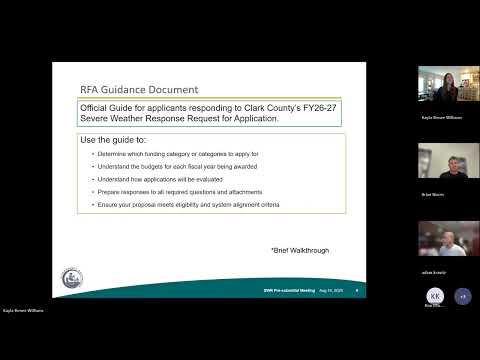
What the RFA requires and how applications will be scored Applicants may be nonprofits, tribes, local jurisdictions or public agencies that can meet county reporting and invoicing requirements, Williams said. The RFA requires an anti-lobby certification, conflict-of-interest disclosures, debarment checks and E-Verify compliance as standard contract conditions. Applicants must sign a guidance document certifying they have watched or reviewed the presubmittal recording; closed captions are available, and the recording will be posted to YouTube.
Each organization submits a single questionnaire in Bonfire that includes a shared “core” tab plus up to five program-specific tabs (tabs 2–6). The shared core is worth 4 points; each program tab is worth 8 points. Scores for each program will be reported on a 12-point scale (the program’s 8 points plus the shared-core 4 points). Williams said organizations must upload a separate budget table and a slide deck for each program; the slide decks (maximum seven slides per program) are for the scoring committee’s review only and will not be presented live.
Bonfire will flag missing required items at submission, and county staff will perform a last technical check after submission closes to request corrections if documents were uploaded blank. Williams and another county staff member, Michael (last name not given), reiterated that applicants bear responsibility for submitting complete applications and that staff cannot improve application content on behalf of applicants.
Permitted activities and operational expectations Eligible activities include system-level planning (creating local activation thresholds and protocols, convening the county severe-weather task force, public communications), direct response (shelter expansion, pop-up warming/cooling spaces, outreach, transport between sites) and centralized purchasing and distribution of emergency supplies (thermal gear, blankets, water, electrolyte packages, storage and logistics). Williams said funded providers are expected to participate in Clark County’s severe-weather task force and to coordinate activations and service tracking with the county’s coordinating entity.
Contract timing and practical limits Williams said the two-year award period begins Nov. 1; the first contract year will run Nov. 1 to June 30 and the second will be July 1 to June 30. Because the first-year contract does not cover a full summer season, she advised applicants to account for that timing when budgeting and planning implementation. She also cautioned the county is prioritizing organizations that can be operational by Nov. 1 rather than brand-new programs that require extensive start-up assistance.
Technical assistance and collaboration The county is offering two optional technical-assistance drop-in sessions and individual TA upon request. Williams also noted that two entities may submit a single collaborative application if one organization agrees to be the contracting lead. All public Q&A and staff answers will be posted in the Bonfire portal so applicants receive consistent information.
Documents and plans referenced Williams pointed applicants to the state’s Homeless Housing Strategic Plan and Clark County’s Homeless Action Plan; she said the county plan is being updated with a new plan expected to launch in December and asked applicants to review both the existing plan and the forthcoming update as part of system alignment.
Questions and clarifications raised during the meeting Attendees asked about the total funding amount, the contract period and which activities are eligible; Williams and Michael provided the category-level budget figures, confirmed the two-year structure, and reiterated that the solicitation is for services and system components rather than for a software product. Williams said the county still needed to upload finalized budget templates to Bonfire and expected to post those templates the same day as the meeting.
Next steps and deadlines Applications due (via Bonfire): Sept. 17 at 11:30 p.m. Questions due (via Bonfire public Q&A): Sept. 15 County technical completeness review: Sept. 18 Scoring committee provided applications: Sept. 22 Expected awards identified: early October County-council approval (scheduled): Oct. 21 Planned program start (goal): Nov. 1
Ending: County staff encouraged interested providers to review the full RFA guidance document, use the checklist included in the guidance and reach out through Bonfire or by email for TA well before the Sept. 15 question deadline.