Get Full Government Meeting Transcripts, Videos, & Alerts Forever!
Get email alerts on the Transient Vacation Rentals topic
No spam. Unsubscribe anytime.
Maui County committee creates investigative group to study transient vacation rental rules in apartment districts
Summary
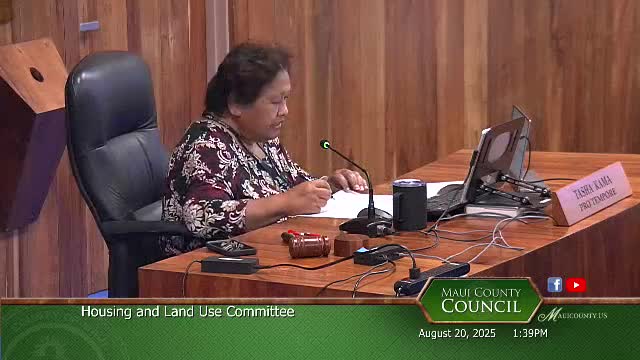
The Maui County Council Housing and Land Use Committee voted Aug. 20 to establish a Temporary Investigative Group to study policies and procedures for transient vacation rental uses in apartment districts, a step tied to ongoing deliberations over proposed Bill 9.
The Maui County Council Housing and Land Use Committee voted Aug. 20 to establish a Temporary Investigative Group to study policies and procedures for transient vacation rental uses in apartment districts, a step tied to ongoing deliberations over proposed Bill 9.
The committee moved to form the four-member TIG during a meeting that featured public testimony both supporting and urging limits on the group's scope. Committee Vice Chair Hodgins moved to create the TIG and Member Yukio Sugimura seconded the motion; the motion carried with members in favor saying “aye” (the chair reported seeing eight ayes on the roll). The committee set a target to present the TIG’s findings to the committee by Dec. 31, 2025.
The TIG is charged with four investigation areas: (1) analyze impacts of phasing out transient vacation rental (TBR) use in apartment districts; (2) study economic and social effects, including housing affordability at different income levels and impacts on small businesses; (3) assess lending and condominium governance issues such as special assessments and repair liabilities that could affect conversions to long-term housing; and (4) review whether changes to County Code (Chapter 19) or the rezoning/entitlement processes are necessary to streamline conversions while avoiding unintended consequences. The TIG may use department resources, conduct site visits and consult outside experts. The committee also noted TIGs are exempt from usual Sunshine Law public‑meeting requirements and do not have to take public testimony at every meeting, but the TIG must include agendas and resource lists in its final report.
Public testimony at the meeting illustrated the range of perspectives the TIG will take up. Kathy Kim, a resident, said Bill 9 "started out to create affordable housing. And at this point, the word affordable doesn't appear anywhere in the bill," and warned of local economic impacts tied to housing and tourism. Bo, an owner at Maui Kamaoli resort, asked the TIG to consider rezoning his property from apartment zoning to hotel zoning, saying the property "has been consistently used and advertised as a short-term rental unit" and is surrounded by resort uses. Tom Crowley urged the TIG to explore a zoning overlay as an alternative to wholesale rezoning, saying an overlay could allow criteria-based continued TBR use without enabling full hotel buildout. Caitlin Miller, representing NVRA, said the TIG should ensure "thoughtful, well informed policy" and not be used to rush legislation. Stacy Alapai urged narrowing the TIG’s scope so it focuses on apartment-district TBR issues and does not become a vehicle for broad, countywide code rewrites.
Committee members said the TIG will include Council Member Tamara Paulton, Member Tom Cook, Member Shane Cenensee and Vice Chair Hodgins (the TIG membership was described in committee discussion as a four-member panel). Committee members discussed the TIG doing site visits to buildings on the so-called “Minetoya”/Bill-9 property list and noted the TIG could identify buildings suitable for long-term housing or for county purchase. Member Gabe Johnson suggested the TIG consider a special fund or transition assistance to help workers and residents pivot if properties shift from short-term rentals to long-term housing.
The TIG’s procedural rules discussed in the meeting: three affirmative votes will be required to establish a TIG recommendation; TIG meetings need not be agendized like regular council meetings; resource staff from OCS (Office of Council Services) and council staff will support the TIG; the TIG must document meeting agendas, resource contacts and a final report describing findings and recommendations.
Next steps: the committee expects the TIG to begin meetings soon, coordinate with Planning Department staff and administrative resources, and return recommendations to the Housing and Land Use Committee by Dec. 31, 2025. The committee will continue deliberations on Bill 9 (first and second readings remain to be scheduled). The committee adjourned after the vote.