Get Full Government Meeting Transcripts, Videos, & Alerts Forever!
Get email alerts on the Slope Protection topic
No spam. Unsubscribe anytime.
Building Inspection Commission backs repeal of Slope and Seismic Hazard Zone Protection Act, requests guidance for steep‑slope reviews
Summary
The Building Inspection Commission on Aug. 20 recommended that the Board of Supervisors approve an ordinance removing the city’s Slope and Seismic Hazard Zone Protection Act, while voting to require DBI to publish guidance on when geotechnical peer review and Structural Advisory Committees will be used.
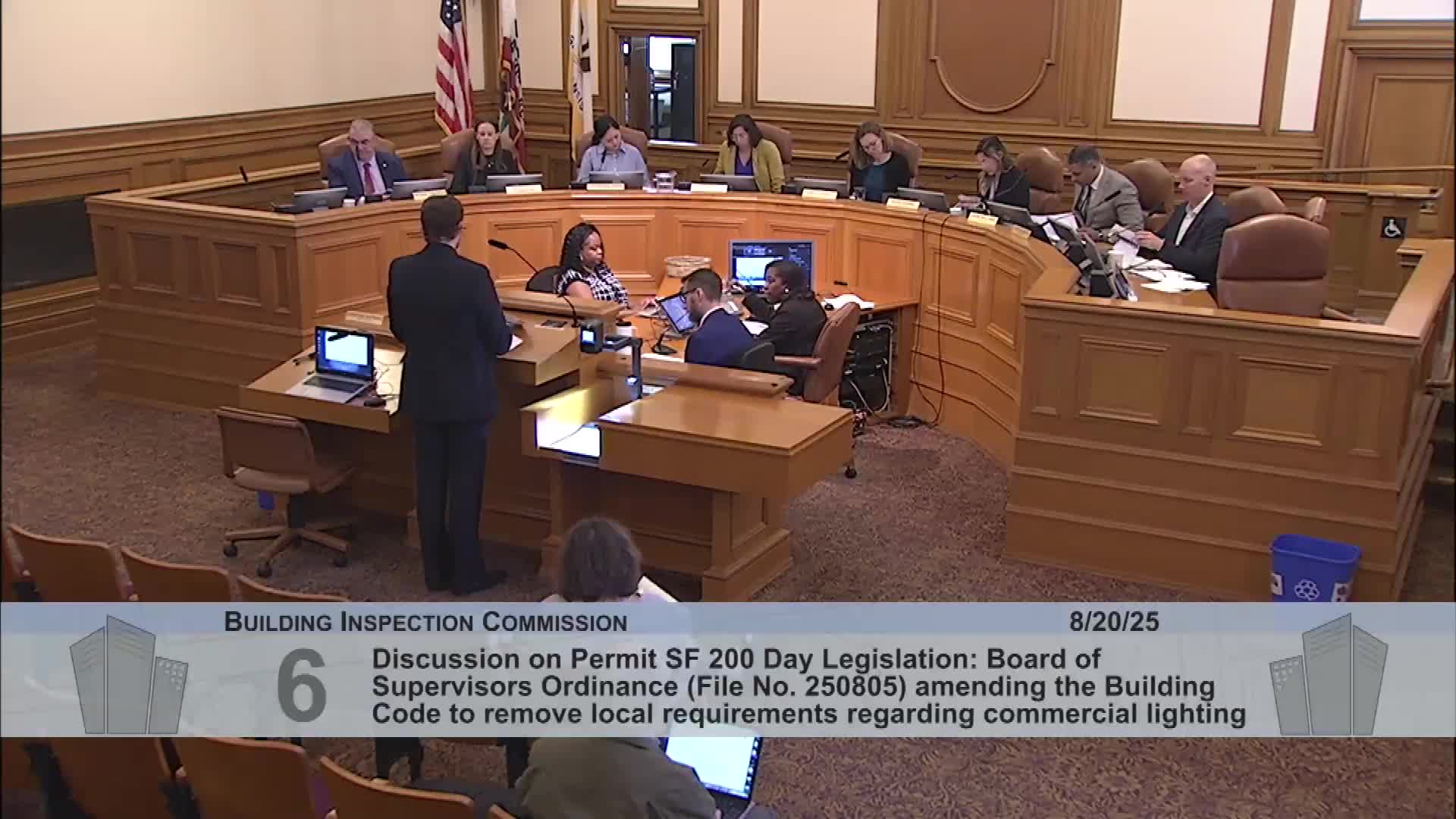
The Building Inspection Commission on Aug. 20 recommended that the Board of Supervisors approve ordinance file 250805, which would remove the city’s Slope and Seismic Hazard Zone Protection Act and revert several San Francisco-specific building-code amendments to the California Building Code.
The vote followed a lengthy discussion about whether the ordinance would reduce public protections on hilly lots and what procedural safeguards would remain. Commissioner Dan Kalamucci moved the motion to recommend the ordinance with an amendment calling for an information sheet explaining when DBI will require third‑party peer review or a Structural Advisory Committee; President Alexander Tute seconded. The motion passed unanimously (Tute, Kalamucci, Chavez, McCleese, Newman, Williams voted yes).
Why it matters: The Slope and Seismic Hazard Zone Protection Act currently can trigger mandatory geologic and geotechnical reports, possible third‑party peer review and applicant‑funded Structural Advisory Committees (SACs) for projects on parcels identified on state mapping or with an average slope above 25%. Those requirements can add tens of thousands of dollars and months to some projects. Proponents of repeal, including DBI staff, said the requirement is applied inconsistently and duplicates other geographically specific protections that will remain.
Public commenters and several commissioners urged safeguards. Georgia Shudish, a Noe Valley resident, told the commission she had seen deep lot excavations and asked, “Please explain how much oversight there will be in order to prevent a black swan event.” Structural engineer Stephen Moynihan submitted written public comment saying the act “is overreaching and applied too liberally” and that mandated geologist reports have rarely changed soils‑engineer recommendations but have increased costs for small projects.
DBI’s presentation noted that the ordinance would keep two geographically specific protections — the Northwest Mount Sutro and Edgehill Mountain Slope Protection Areas — and would retain the building official’s discretion to require heightened scrutiny where warranted. DBI staff said they would revise public information sheets and guidance to clarify when discretionary peer review or SACs would be used.
Commissioners pressed staff for clarity on operational practice: which plans will be required to include shoring or drainage details at intake, when peer review will be triggered, and whether the information sheet will be brought before the commission. DBI staff agreed to prepare the information sheet and indicated they would present guidance for commission input before final adoption.
Ending: The commission’s recommendation advances the ordinance to the Board of Supervisors. DBI agreed to prepare and present a guidance/info sheet on when additional geotechnical review and SACs will be required; commissioners asked that the department return with that document so the public can see how DBI will apply discretion for steep‑slope projects.