Get Full Government Meeting Transcripts, Videos, & Alerts Forever!
Get email alerts on the Downtown Development topic
No spam. Unsubscribe anytime.
Raleigh Austin outlines 2026 bond priorities, potential uses for historic City Hall and other downtown sites
Summary
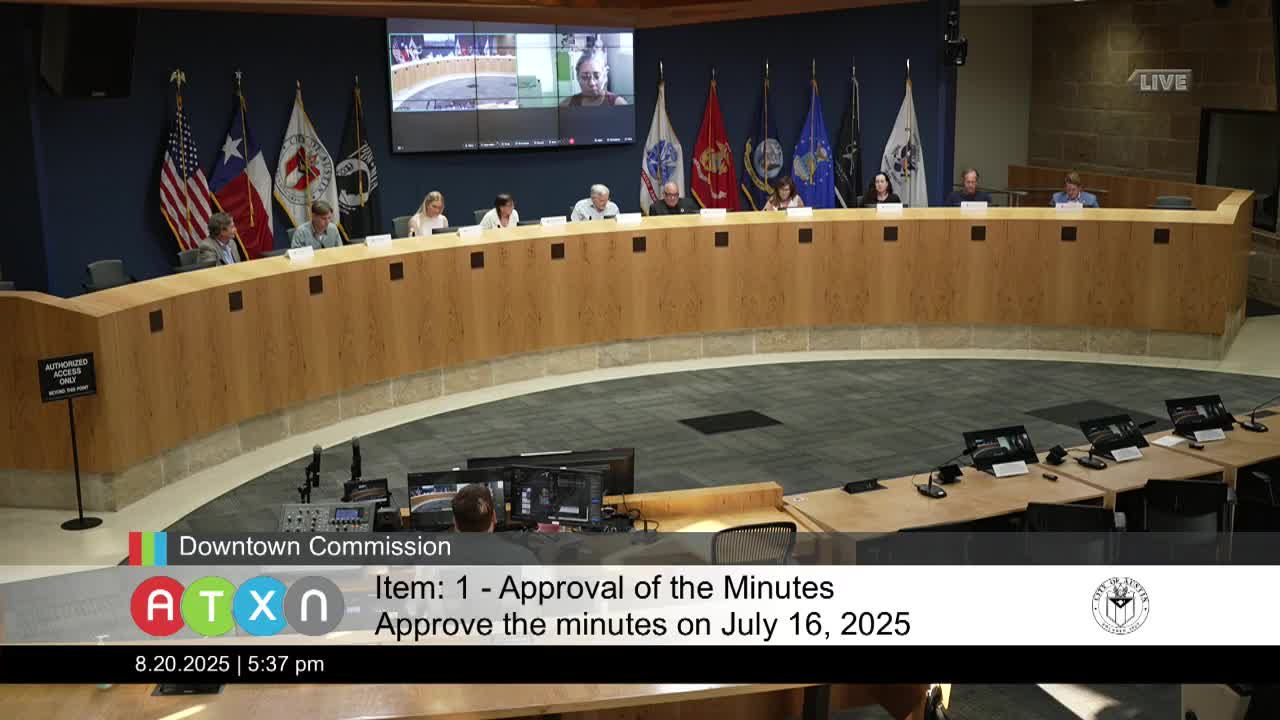
David Colligan, chief operating officer of Raleigh Austin, told the Austin Downtown Commission on Aug. 20 that Raleigh Austin is positioning itself to support downtown redevelopment through a multipurpose local government corporation model and a proposed ask in the city’s 2026 bond program.
David Colligan, chief operating officer of Raleigh Austin, told the Austin Downtown Commission on Aug. 20 that Raleigh Austin is positioning itself to support downtown redevelopment through a multipurpose local government corporation model and a proposed ask in the city’s 2026 bond program.
Colligan said Raleigh Austin — formerly the Austin Economic Development Corporation and organized as a 501(c)(3) — is focused on three “rallies”: arts, music and cultural space; complete communities; and catalytic development. He said the agency currently manages about $160,000,000 of real estate and development projects under its work with the City of Austin and has assembled a cultural-trust program that the presentation described as a $27,000,000 initiative to preserve local creative venues.
Why it matters: Raleigh Austin is seeking new financing tools and city direction to accelerate projects the city has not been able to pursue directly. Colligan framed the bond proposal and Raleigh Austin’s role as ways to bring private leverage and flexible financing to preserve cultural venues and support affordable and workforce housing downtown.
Key points from the presentation
- Organization and mission: Colligan described Raleigh Austin as “the first multipurpose local government corporation requested by the community and created by the Austin City Council in 2020,” and said the structure gives the agency autonomy and access to financing tools the city may not be able to use. He said the board has multiple nomination seats from city departments and cultural bodies and that the agency is meant to operate regionally as well as locally.
- 2026 bond proposal: Colligan said portions of Raleigh Austin’s 2026 bond ask would expand the cultural trust (acquisition, capital improvements, grant/loan programs) and seed a commercial trust to preserve legacy local businesses. He said the cultural trust has produced six funded projects so far and that Raleigh Austin received roughly 40 responses in an RFP process representing about $350,000,000 in need against the $27,000,000 pool described in the presentation.
- Specific downtown sites: Colligan reviewed several city-owned sites commissioners had asked about and described Raleigh Austin’s level of involvement: - Historic City Hall (identified in the presentation as the municipal or historic City Hall at Eighth and Colorado): Colligan said an earlier request had asked how Raleigh Austin would use the fourth floor for creative purposes but he told the commission the fourth floor has structural and accessibility limitations that make it unsuitable as standalone creative space. He noted a ULI (Urban Land Institute) study and community work that produced recommendations for creative uses but said that effort has largely gone dormant. - HealthSouth site: Colligan said negotiations on the HealthSouth site reached a pause and that Raleigh Austin has not been brought back into active discussions about bringing the property to market. - Austin Police Department headquarters and convention-center–adjacent parcels: Colligan said Raleigh Austin has not been asked to lead transfers or redevelopment of those properties; ULI produced possible community-use information but Raleigh Austin was not engaged to assemble or negotiate community benefits. - South Central Waterfront: Colligan said Raleigh Austin performed a financial study under an interlocal agreement and would have managed a TERS (as described in the presentation) had the project moved forward; the waterfront project is on hold. - I‑35 inclusive development: Raleigh Austin provided a corridor report to the transportation department on potential acquisitions and community benefits related to the planned I‑35 expansion and said that report is being used by the transportation department in grant deliverables.
- Process for engagement: Colligan said Raleigh Austin typically becomes involved when City Council directs staff to work with the agency via resolution or when council members invite Raleigh Austin into discussions. He said Raleigh Austin can either hold property or collaborate with developers depending on what makes sense for the transaction and the community benefits desired.
Selected direct quotes
"We are the first multipurpose local government corporation requested by the community and created by the Austin City Council in 2020," Colligan said, describing Raleigh Austin’s statutory origin and structure.
On the historic City Hall, Colligan said: "There were a number of obstacles for having creative cultural space on the fourth floor … height restrictions on level floor throughout that fourth floor. Also just getting to the fourth floor represented some accessibility issues."
Context and background
Colligan referenced prior community processes (ULI studies and other advisory reports) and an interlocal agreement under which Raleigh Austin conducted financial and feasibility work. He stressed the agency’s role is often advisory or catalytic and that final decisions about transfers or project approvals rest with City Council and city staff.
Next steps noted in the presentation
Colligan offered to return to review the 2026 bond proposal in detail and encouraged council members and staff to consider resolutions that would formally task Raleigh Austin with site-specific work.
Ending
Colligan said Raleigh Austin remains available to the city as a partner on publicly owned properties, and commissioners asked follow-up questions about structural constraints at the historic City Hall and about the paused HealthSouth negotiations.