Get Full Government Meeting Transcripts, Videos, & Alerts Forever!
Get email alerts on the Housing Policy topic
No spam. Unsubscribe anytime.
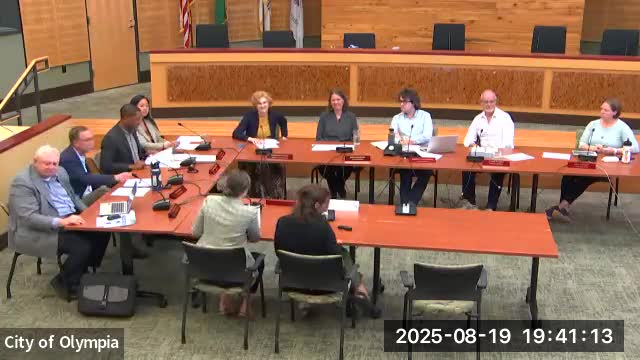
One-year review: Olympia's rental registry shows progress and software, staffing and data challenges
Summary
City staff presented a 17-month operational review of Olympia's rental-registry program, reporting a successful launch and unit-level data collection but noting software limits, verification workload and inspection workflows have driven larger staffing needs than originally projected.
City staff presented a one-year operational evaluation of Olympia's rental-registry program and recommended a set of technical fixes, further staff work and several options that would require council policy or budget decisions.
Program purpose and basic design The rental-registry program requires landlords to register rental properties annually, hold a state business license with a City of Olympia endorsement, and schedule third-party inspections on a five-year cycle (one zone per year). Susan McLaughlin, director of Community Planning and Development, said the evaluation's objective was to "highlight successes and also talk, really frankly around some of the challenges" so council can decide whether to authorize program changes.
What staff reported as accomplished - The program launched on schedule and staff reported extensive outreach materials, webinars and handouts for landlords. Sarah Williams, the rental-registry program manager, said staff assembled unit-level data from valid registrations that has begun to illuminate rental rates and unit sizes across the city. - Staff reported collecting 555 validly registered units in the downtown zone and completing 13 third-party inspections in that zone as the program's first inspection cycle began. Staff also said the team published a downtown flooding page and offered landlord training and mold prevention webinars.
Challenges driving staff time and costs Staff documented three principal operational challenges: 1) Software and application workflow: the city currently uses the SmartGov licensing module for registrations. Staff said the module allows incomplete submissions, lacks autofill for repeated fields and requires landlords to submit a separate application for every parcel, which produced many incomplete records and large customer-service demands. Staff plan to switch the registration process to SmartGov's permitting module (no license cost) to create more tailored applications and to collect rent-roll data as structured fields rather than as an uploaded spreadsheet. 2) Department of Revenue endorsement and verification: city code requires a Department of Revenue business license with an Olympia endorsement and staff must currently verify the license, an effort that consumes staff time. Staff and council discussed alternatives, including accepting the business-license field on the registration form (with verification by tax/audit staff on a separate cadence) or issuing a city rental-business license as part of registration. 3) Inspections and inspection costs: landlords asked for clearer pricing and inspector-selection procedures; staff said they will publish average inspection cost estimates once more inspections are complete and will formalize procedures for adding and removing third-party inspectors.
Data and revenue Staff revised earlier rental-unit estimates upward after a GIS review and now estimate ~18,423 rental units in Olympia (previous estimate 15,500). As of a July snapshot staff reported approximately 28% of projected units were validly registered; another portion of units were noted as incomplete applications, previously registered but not yet renewed, or pending staff review. Sarah Williams said some of the units now registering are single-family rentals, a segment that prior data sources undercounted. The city also reported preliminary business-license revenue tied to registered units; staff noted about $25,000 was recorded in the first year but that figure includes some property owners who already held licenses prior to the registry.
Staff proposals and council-level options Staff presented a package of operational fixes they will implement without council action: switch software modules in SmartGov to improve application design; create separate application flows for 1'14-unit properties and 5+ unit properties; integrate rent-roll fields into the web form; provide clearer renewal guidance and mass-notification approaches; and publish inspector procedures and average cost data when available. These fixes, staff said, should reduce staff time per application.
Staff also listed potential policy or budget changes for council to consider: increase program staffing (budget enhancement), buy dedicated rental-registry software (estimated annual ongoing cost ~ $60,000), extend the renewal cycle (would require code amendment but reduce annual processing), eliminate the rent-roll requirement and rely on external datasets (would reduce staff time but lose unit-level detail) or shift inspections to an affidavit/self-certification model (reduces cost but depends on complaint-driven enforcement).
Council discussion Council members urged patience for a new program to mature and noted that the classification-and-compensation study that raised staff salaries after initial program budgeting affects cost comparisons; council members suggested a general-fund subsidy in the near term might be appropriate. Several council members favored keeping the business-license requirement on the books but questioned whether verifying the Department of Revenue endorsement should be handled by registry staff or matched periodically by the tax/audit team. Others urged a cautious approach to removing inspections or rent-rolls without more data.
Next steps Staff said they will implement the no-cost technical fixes in the coming months, continue targeted outreach to landlords, and return to council if a program change requiring a code amendment or budget enhancement is recommended. Staff asked council for policy guidance on which of the larger, discretionary options (software purchase, staffing increase, or inspection model change) to study further.