Get Full Government Meeting Transcripts, Videos, & Alerts Forever!
Get email alerts on the Repatriation Nagpra Uc topic
No spam. Unsubscribe anytime.
State audit faults UC repatriation pace; UC vows to return human remains by 2028
Summary
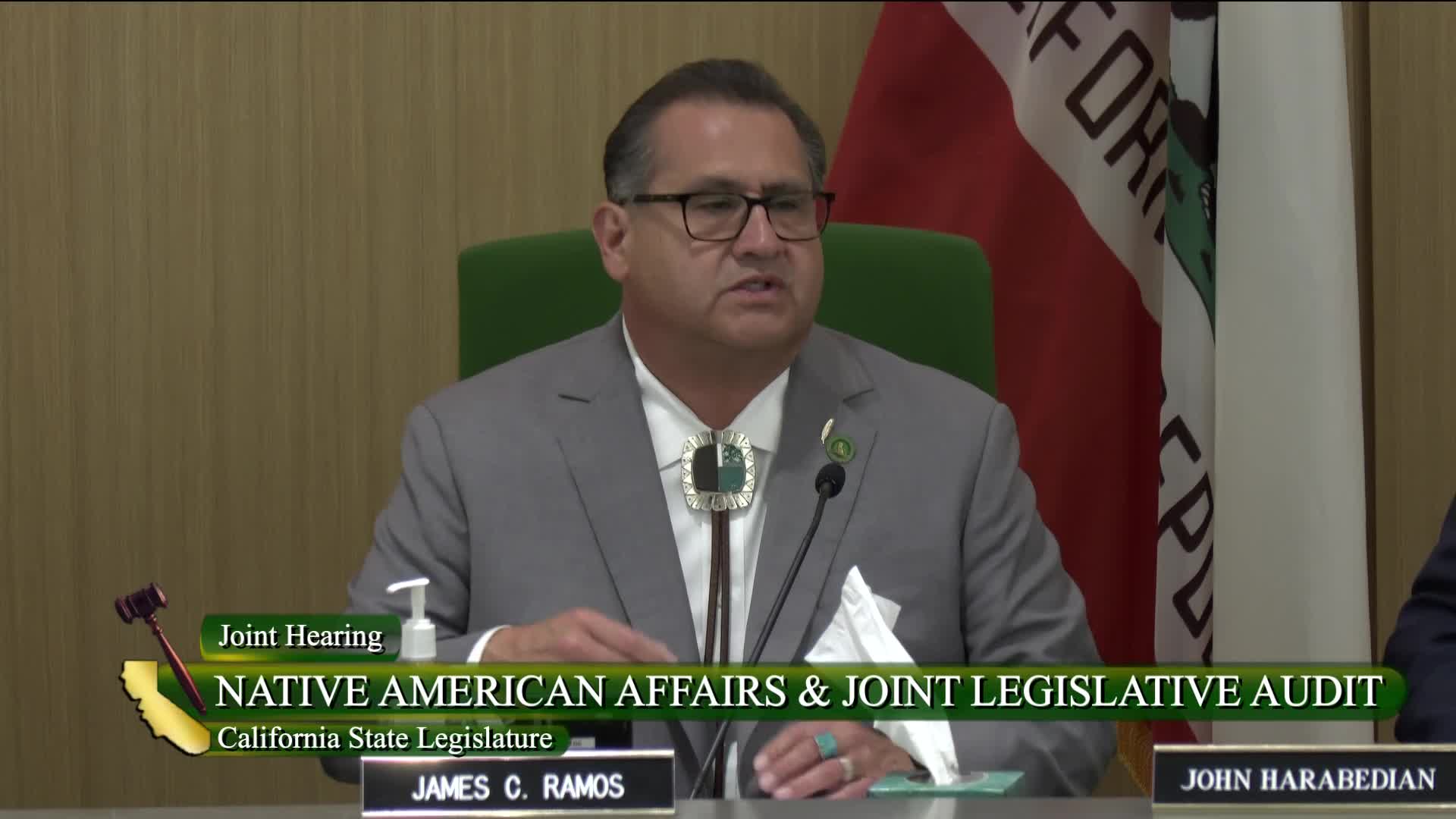
At a joint oversight hearing of the Joint Legislative Audit Committee and the Assembly Select Committee on Native American Affairs, California State Auditor Grant Parks told lawmakers that the University of California “lacks the accountability and the urgency necessary to promptly return the remains and cultural items in their possession.”
At a joint oversight hearing of the Joint Legislative Audit Committee and the Assembly Select Committee on Native American Affairs, California State Auditor Grant Parks told lawmakers that the University of California “lacks the accountability and the urgency necessary to promptly return the remains and cultural items in their possession.” The auditor’s April 2025 report found thousands of Native American human remains and hundreds of thousands of cultural items across UC campuses and warned that, at current rates, some campuses could require decades to complete repatriation; the audit projected UC Berkeley could need until 2089 to return 75% of its holdings at the pace measured in the report.
The audit’s findings were the centerpiece of the June oversight hearing, where UC provost Catherine Newman and chancellors and campus repatriation coordinators described steps the university is taking in response. Newman opened by apologizing “for the University's role in the original acquisition of Native American and Native Hawaiian ancestors and their belongings” and said the UC will accelerate repatriation, add staff, and increase funding and oversight. She pledged a systemwide timeline that prioritizes returning human remains and said the UC “expect[s] to make substantial progress in the next 3 years with the explicit and timeline goal of completing this work by 2028.”
What the auditor said
Grant Parks described the third audit his office has conducted of UC’s NAGPRA and CalNAGPRA compliance. Federal and state law, along with UC policy, require campuses to inventory remains and cultural items, consult with tribes and expedite returns. Parks told the committees that UC campuses continue to discover previously undocumented collections and that UCOP has not established performance metrics, clear systemwide goals or firm timelines that would allow lawmakers and the public to hold campuses accountable. He said campuses heeded little consequence for noncompliance and undercut timely repatriation by budgeting but under‑spending some NAGPRA funds and failing to document budget reviews at UCOP.
Parks cited specific campus examples in the audit: UC Santa Barbara failed to disclose at least five collections it had identified internally; the four campuses the auditors visited had repatriation rates that, if sustained, would leave full repatriation decades away; and UC Berkeley — the largest repository — would need to increase its pace substantially to meet meaningful near‑term goals.
UC’s commitments and campus updates
Catherine Newman said the Office of the President is implementing a plan to accelerate repatriation and will require quarterly reporting to UCOP that began in July 2025. Newman listed concrete targets and resources: a systemwide review of high‑risk campus areas for undiscovered remains and cultural items to be completed by June 30, 2026; identification and recall of loans of Native American ancestors and potential cultural items by January 2026; updated campus repatriation plans with clear timelines by December 2025; and more than $8.8 million in additional funding over three years to hire staff, improve collections databases and defray tribal consultation and reburial costs.
Newman said the system had identified 20 potential sites on UC land that could be candidates for reburial if tribal partners prefer that option, and she announced a plan to fund $400,000 over three years to design a certificate program to train more repatriation experts and expand the workforce needed to do the work.
Campus leaders described progress and gaps. UC Berkeley Chancellor Rich Lyons said the campus has repatriated more than 2,700 ancestors and roughly 29,000 funerary belongings in the last year, has a team of nine full‑time repatriation staff (with more positions planned) and has submitted 14 Federal Register notices in the past year. He said Berkeley still lists about 2,351 remaining ancestors (roughly 19% of what the campus formerly held) that must be processed through the NAGPRA publication and consultation steps.
UC San Diego repatriation coordinator Eva Trujillo told lawmakers that since creating a centralized repatriation unit in 2021 the campus has returned 486 sets of remains out of 958 and reduced its cultural‑item holdings from 25,301 to 11,907 items. UC Santa Barbara’s repatriation coordinator Hugh Ratti said UCSB has summarized more than 800 collections (about 135,000 items) and has submitted five Federal Register notices this year to represent 80 individuals and roughly 700 funerary objects; he said UCSB aims to complete certain repatriations by October 2025 and to finish a systematic review of campus spaces by June 2026.
Tribal leaders: distrust, scope and spiritual harm
Tribal leaders who testified described deep distrust of institutional timelines and processes and urged faster, less bureaucratic action. Chairman Leo Sisko (Tachi‑Yokut) said tribes are “the experts” on affiliation and provenance and criticized any implication that tribal knowledge is secondary to technical requirements. Chairman Jack Potter (Redding Rancheria) told an emotional story and said remains and associated items must travel together for proper reburial, calling cultural items and funerary goods “connected” to the identities and spiritual care of the dead.
Valentin Lopez (Amah Mutsun Tribal Band) described long delays his tribe has faced in attempts to reclaim remains and explained that competing claims by other tribes and inconsistent lists of tribes complicate repatriation for unrecognized tribes. Several tribal witnesses, including Mary Anne Carbone and Tule River Chairman Shay Nieto, urged the legislature and UC to remove administrative hurdles, improve outreach to non‑federally recognized tribes, and ensure that repatriation does not depend on prolonged disputes or technicalities.
Legislative response and next steps
Assemblymember and JLAC chair remarks at the hearing emphasized that lawmakers may consider budgetary and statutory options to ensure accountability. Parks’ audit suggested the Legislature could tie state funding to NAGPRA performance or earmark a portion of the UC appropriation for repatriation work; Newman and other UC witnesses said they welcome legislative conversation about performance‑based budgeting and additional appropriations if the Legislature wishes to require specified milestones.
What remains unresolved
The committees and tribal leaders pressed UC on several open questions the audit identified: how UCOP will enforce campus compliance, how campuses will account publicly and consistently for the hundreds of thousands of potential cultural items auditors identified, how loans and third‑party holdings (including items sent to UC by state and federal agencies) will be resolved, and how claims from non‑federally recognized tribes will be processed fairly and transparently. Tribal speakers urged that human remains and their burial goods be returned together and that tribal authorities should not be required to re‑prove ancestral affiliation where strong local knowledge exists.
The UC committed to quarterly progress reports to UCOP, systemwide deadlines for specific activities, additional staff and funding, and to working with tribal partners to implement repatriation and reburial logistics. Lawmakers said they will continue oversight and consider legislative options to embed accountability in budgeting and law.
Ending
Lawmakers, auditors, UC officials and tribal leaders left the hearing in agreement that work remains but in visible disagreement about pace and priorities. Auditors said the UC still lacks systemwide timelines and enforceable performance metrics; UC leaders pledged new resources, staff and a 2028 target for repatriation of human remains the university can legally repatriate; tribal leaders said only the prompt return of ancestors and their associated items will begin to heal longstanding harm. Committees signaled they will continue follow‑up oversight and may pursue budgetary or statutory remedies if progress stalls.