Get Full Government Meeting Transcripts, Videos, & Alerts Forever!
Get email alerts on the Early Childhood Education topic
No spam. Unsubscribe anytime.
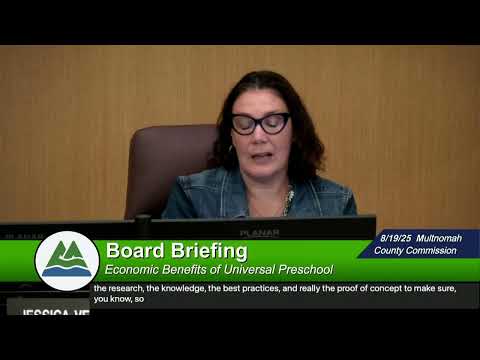
Multnomah County staff update commissioners on Preschool for All progress, funding challenges and advisory structure
Summary
County staff presented program growth, cost drivers and committee plans for Preschool for All, describing progress to date (about 3,800 seats) and modeled paths to universal coverage while flagging a projected drawdown of dedicated savings by fiscal 2034 and ongoing debate over indexing the program tax.
Multnomah County staff told the Board of Commissioners on Monday that the county’s Preschool for All program has expanded rapidly since voters approved the measure in 2020, but that reaching universal preschool will require continued seat growth, workforce investments, facilities funding and choices about tax indexing.
The briefing, delivered by interim Preschool and Early Learning director Rachel Pearl, strategy and communications manager Brooke Chilton Timmons and Senior Policy Advisor Steven Herrera, gave commissioners updated seat counts, a model for projecting future need, and a timeline for advisory committees that will produce recommendations on program funding and implementation.
County staff said Preschool for All (PFA) will have about 3,800 seats this year, more than 1,300 of which are newly created since the program began. “This year, we will get to 3,800 preschool for all seats across the county, and more than 1,300 of those are new seats created since the launch of the program,” Rachel Pearl said. Staff reported that, with other publicly funded seats included, the county currently serves more than 40% of its 3- and 4-year-olds through publicly funded preschool.
Why it matters: Commissioners were briefed on the program’s operating model and on a multiyear financial forecast showing that the county’s dedicated savings—used to cover the gap between early revenues and rising expenses as PFA expands—will be increasingly drawn down. Staff told the board that dedicated savings spending will grow to nearly $100 million in the model’s projection year when the program reaches universal service levels and that the current savings balance is projected to be exhausted in fiscal year 2034 unless revenues or program assumptions change.
Key elements of growth and cost drivers
Staff described a mixed-delivery model that partners with public schools, private centers, community-based organizations and family child care providers. They said PFA’s expansion depends on three things: recruiting more providers to join the program, supporting existing PFA providers to expand into new locations, and facilitating new providers to start programs. Based on current trends, staff estimated roughly 360 total providers at universal scale.
Brooke Chilton Timmons outlined the county’s seat-need formula: a Portland State University population forecast, an assumed participation rate (currently 77.5% overall, with 70% for 3-year-olds and 85% for 4-year-olds), and an accounting of other publicly funded preschool seats (Head Start, OPK and Preschool Promise). Timmons said those inputs are reviewed annually and adjusted as state and federal preschool funding and population forecasts change.
Facilities and workforce investments were identified as essential to growth. Staff said the PFA facilities fund has invested in 52 projects that together will create 857 new seats; the current five-year facilities contract (FY24–29) is modeled to create 2,580 seats. Workforce initiatives highlighted included paid work experience (98 participants in the most recent year, with 82% completion reported) and partnerships with community colleges (292 students received navigator support; 47 students in an online early childhood program through Clackamas Community College).
Inclusion, health and family supports
Staff said inclusion supports remain an area of growth. PFA provides inclusion coordinators at every site, coaches focused on universal classroom practices, inclusion funds to hire additional assistance, nurse consultants through the Multnomah Educational Service District and an early childhood mental health team through the county. Staff added that inclusion funding requests rose from about $3.9 million allocated last year to a $10 million budgeted figure in the current year to better meet demand.
Advisory structure and tax-indexing debate
Steven Herrera reviewed the advisory structure: a Preschool for All advisory committee (high-level guidance), a provider advisory committee, a family advisory committee (being formed), a Technical Advisory Group (TAG) charged with financial assumptions, and a Policy Implementation Committee that will work with TAG and deliver implementation recommendations by March 2026. Herrera said TAG recently deliberated whether to recommend indexing the PFA tax and reported that of seven TAG members three supported short-term indexing, three opposed it and one was absent; because the group split evenly, TAG did not make a recommendation on indexing at this time.
Board questions and concerns
Commissioners pressed staff on several operational details: how inclusion and mental health services are budgeted and staffed; the number and caseloads of inclusion coordinators and nurse consultants; the composition and decision-making connections among advisory committees; facility permitting and administrative support for providers; and whether the county had modeled cost-sharing for higher-income families. Commissioners repeatedly asked for more detailed, geographically disaggregated population forecasts (Portland State University data was cited) and for clearer, line‑by‑line cost modeling that ties potential service-level improvements to budget and tax options.
Pearl and Timmons said staff would provide follow-up detail for many of those requests and emphasized that the program was designed to complement—not replace—existing state (OPK, Preschool Promise) and federal (Head Start) preschool investments.
What commissioners directed or decided
There were no formal board votes during the briefing. Staff recorded that the Policy Implementation Committee is set to launch in September and will provide formal recommendations to the board on implementation and potential tax changes by March 2026.
Ending
County leaders said the briefing is intended as part of a continuing series of analyses and public discussion as the board considers possible changes to funding and policy for Preschool for All. Staff emphasized program priorities—equitable access, inclusion, workforce stability and facilities support—while acknowledging that reaching universal preschool will require sustained funding choices and further committee work.