Get Full Government Meeting Transcripts, Videos, & Alerts Forever!
Get email alerts on the Whistleblower Alfredo Matias topic
No spam. Unsubscribe anytime.
Civil Service Board opens whistleblower matter in Alfredo Matias case, recesses to Sept. 16 for review
Summary
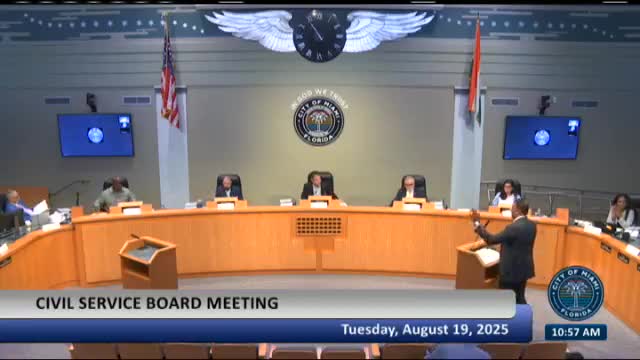
The City of Miami Civil Service Board heard opening statements in a whistleblower complaint filed by former police officer Alfredo Matias and recessed to its Sept. 16 meeting to allow members to review prior hearing transcripts, court filings and exhibits before closing arguments.
The City of Miami Civil Service Board on Aug. 19 heard opening argument in a whistleblower complaint filed by former Miami Police Officer Alfredo Matias and recessed the proceeding until the board's next regular meeting on Sept. 16 to allow members to review the record.
Matias's attorney, Robert Harris, urged the board to adopt evidence from earlier termination hearings and related court filings. "We are here because Mr. Matias filed a claim asserting that the same facts before you constitute a whistleblower complaint, retaliation, and violation of Florida statute 112.3187 for engaging in legally protected activity by providing the affidavit," Harris said, asking the board to adopt the prior transcripts, exhibits and the board's earlier findings of fact and conclusions of law.
Lanetta Geary, representing the city, said the city disputes Matias's whistleblower claim and asked the board to review the full record, including appellate filings. "The internal affairs investigation sustained Mr. Matias for untruthfulness based on the facts and evidence that they reviewed and relied on," Geary said, and told the board that the Eleventh Circuit denied Matias's petition for writ of certiorari, which the city views as supporting the manager's decision to uphold termination.
The board's counsel explained that the whistleblower standard is legally distinct from the earlier termination proceedings and that the current panel must apply the whistleblower statute's three-prong test: protected activity, an adverse personnel action, and a connection between the two. The board attorney also confirmed the whistleblower element had not been decided previously and is properly before the board now.
Board members asked questions about the timing and evidence. Counsel and the parties identified key dates in the record: Matias's original affidavit was filed in September 2020 (record cites 09/23/2020), an amended affidavit was filed in June 2021 (06/09/2021), he was suspended shortly after the affidavit in October 2020 (cited as 10/01/2020), and he was later terminated in January 2022. The board was told the prior civil service hearing included multi-day testimony and exhibits, which will be provided to the current board members for review.
Board members and counsel agreed the board will rely on the transcripts and exhibits from the prior termination hearings and on the court exhibit packet submitted by both sides; both counsel said they would submit closing arguments at the Sept. 16 meeting after board members have had time to review the materials. The board also asked staff to provide recordings of the prior hearings where available and to assemble all exhibits introduced at the earlier civil service hearing.
During the discussion, Robert Harris summarized the history: Matias and another officer, Luis Valdez, cooperated with a federal investigation into former officer Raul Iglesias; Matias later provided an affidavit in Valdez's court proceedings. Harris said the board previously found Matias's termination to be unsupported by the evidence and argued that a finding the affidavit was not false would support a whistleblower claim of retaliatory termination.
Geary told the board the city contends internal affairs' finding of untruthfulness is supported by the record and that the appellate mandate leaves the city manager within his authority to uphold the termination. Both sides agreed to the process outlined by counsel: openings on Aug. 19, board review of the record, and closing arguments at the Sept. 16 board meeting.
The board recessed the case and the rest of the meeting until Sept. 16, 2025. The chair reminded members they must not discuss the case among themselves during the recess and that any questions about needed additional witness testimony should be routed through staff so witnesses can be arranged if the board requests them at the next session.
Matias's whistleblower complaint will return to the board's agenda on Sept. 16, when the parties will present closing arguments and the board will begin deliberations.