Get Full Government Meeting Transcripts, Videos, & Alerts Forever!
Get email alerts on the Public Safety Animals topic
No spam. Unsubscribe anytime.
Flower Mound council directs staff to tighten rules for dogs that attack animals
Summary
After a string of animal attacks and public complaints, the Flower Mound Town Council asked staff to draft ordinance changes that would give municipal judges authority to order euthanasia when an animal attack causes serious injury and to mirror the state's serious-injury standard for animal-on-animal incidents.
Flower Mound's Town Council discussed amendments to the town's dangerous-dog ordinance on the council dais and directed staff to draft revisions that would expand the code's enforcement tools for animal-on-animal attacks.
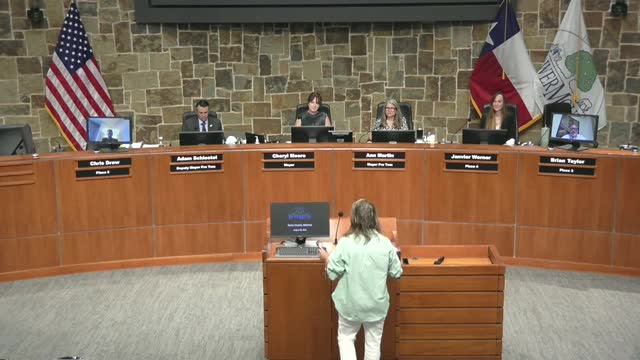
The issue was raised after resident Carolyn Auburn described a recent incident in which two pit bulls severely injured her miniature horses. Auburn told the council she felt the town's existing ordinance did not provide adequate options. "The injuries were so severe that the veterinarians in Aubrey said, 'We've never seen animals survive injuries this severe,'" Auburn said during public comment.
Council members and staff agreed the town's current ordinance follows the Texas Health and Safety Code but noted the local code previously extended some of the state's person-focused rules to animal victims. Staff recommended keeping the final determination of a dangerous dog with the municipal court rather than leaving it to an administrative officer; council members reiterated that choice.
Town staff said the state statute referencing dangerous-dog procedures is in the Texas Health and Safety Code (chapter 822) and that local governments may adopt more stringent requirements, provided they are not breed-specific. Blake Manuel, management analyst, summarized Flower Mound's existing process: an incident is reported, animal control investigates, the animal is impounded under a warrant and the municipal court holds a hearing to decide whether the dog is "dangerous." Manuel told the council the town had 11 dangerous-dog cases since the 2019 ordinance update and that eight of those were determined dangerous in the last five years.
Council direction and next steps
- Council asked staff to prepare ordinance language that mirrors the state's "serious bodily injury" threshold but applied to animal-on-animal attacks; staff was asked to use an evidentiary trigger such as enforcement-level "emergency veterinary care" to define that threshold. - Council directed that final decisions about euthanasia or removal remain judicial (a municipal court decision) with the existing appeal rights preserved. - Staff was asked to examine fees and impound costs as part of a broader fees review that will be scheduled with the upcoming budget process.
Several council members noted practical follow-up steps for animal services and police to improve communication and documentation for victims seeking civil remedies. The council also asked staff to return with recommended ordinance language and associated timelines; staff indicated a target of an October meeting to present draft changes and said any fee changes would need a separate review before adoption.
What the changes would mean
If council adopts the proposed language, municipal judges would have clearer statutory authority to order euthanasia or removal of a dog after an animal-on-animal attack that results in injuries meeting the emergency-veterinary-care threshold. The change would leave the municipal-court hearing and appeal procedures in place.
Council members emphasized they were seeking a balance: stronger tools for repeat or severe animal attacks while preserving due process and the municipal-court role. The council did not vote on an ordinance amendment at the meeting; it provided direction for staff drafting and scheduled future hearings.